


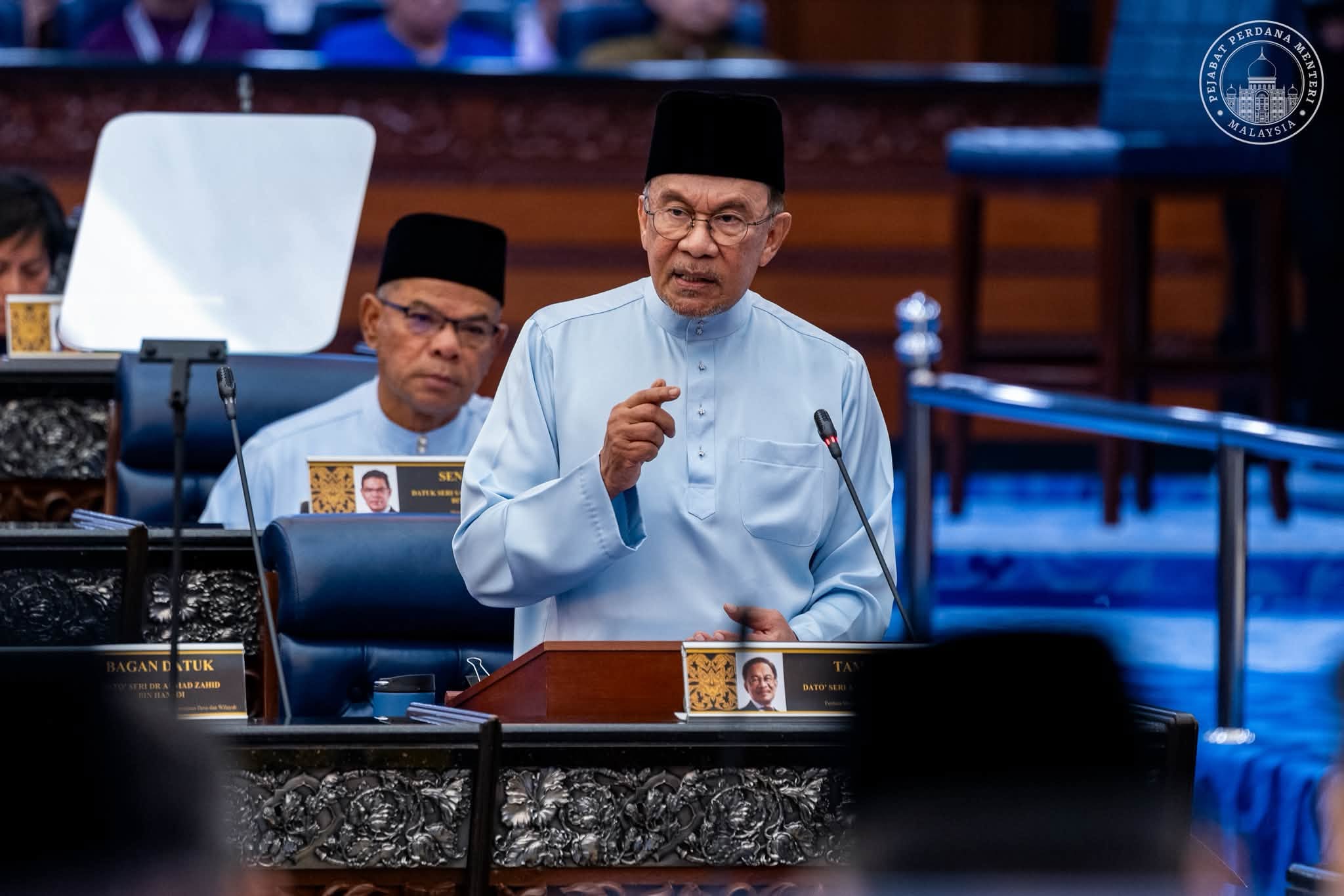
Anwar’s RM510 billion budget lifts the minimum wage to RM2,000, raises tax relief for the first time since 2010 and boosts cash aid to RM16 billion, without losing sight of the deficit.
| IN BRIEF: WHAT’S IN IT FOR YOU Workers: minimum wage up from RM1,700 to RM2,000 from June 2027; a RM2,500 floor for graduates and semi-skilled workers M40 taxpayers: up to RM1,600 more as tax relief rises to RM12,000, the first review since 2010, and rates fall one pointHouseholds: SARA of up to RM150 a month for all STR recipients; RM100, twice, for 13 million other adultsCivil servants and retirees: special payments of RM1,500 and RM750 First-home buyers: full stamp duty exemption on homes up to RM500,000 |
By TENGKU NOOR SHAMSIAH TENGKU ABDULLAH
KUALA LUMPUR, Oct 9 – Malaysian workers will take home more pay and middle-income earners will pay less tax next year, under a RM510 billion Budget 2027 tabled by Prime Minister Datuk Seri Anwar Ibrahim in the Dewan Rakyat today.
The minimum wage rises from RM1,700 to RM2,000 from June 2027. The personal tax relief threshold goes up for the first time since 2010. Cash aid under Sumbangan Tunai Rahmah (STR) and Sumbangan Asas Rahmah (SARA) climbs to RM16 billion, and 1.3 million civil servants and more than one million retirees will receive special payments.
If the first four MADANI budgets were about repairing the nation’s finances, through targeted fuel subsidies and new fiscal discipline laws, the fifth is about paying out the dividend. It is an expansionary, wage-led budget aimed squarely at the squeezed middle, yet it keeps the deficit on a downward path, from 3.6 per cent of gross domestic product (GDP) this year to 3.3 per cent in 2027.
Anwar, who is also Finance Minister, said “the fruits of growth, and every ringgit saved through reform, must return to the rakyat as greater benefits”.
Calling a national budget “a moral statement”, he added: “Fighting corruption and leakages, managing the deficit responsibly and strengthening the structure of our economy are not optional extras in the business of government.”

YOUR PAYCHEQUE
The RM2,000 minimum wage will benefit eight million workers. Anwar went further, announcing a RM2,500 monthly minimum for semi-skilled workers and graduates, the first step in reforming how Malaysians are paid for their skills. GLICs and GLCs will raise their living wage benchmark from RM3,100 to RM3,400 for 230,000 workers.
He pointed to labour’s share of GDP, still low at 33.9 per cent, and urged private employers to follow suit.
For the M40, the relief threshold rises from RM9,000 to RM12,000, and income tax falls by one percentage point to 18 per cent for chargeable income of RM70,001 to RM100,000 and 24 per cent for RM100,001 to RM150,000. About five million taxpayers stand to gain up to RM1,600 in disposable income.
CASH IN HAND
All STR recipients, up to nine million people, will receive SARA credits of up to RM150 a month. Another 13 million adults who are not on STR, including the M40, will get RM100 twice next year, ahead of Aidilfitri and for the 70th National Day. For the first time, SARA can be spent on fresh produce at 216 FAMA farmers’ markets and tamu.
Civil servants at Premier Grade B and below, including contract staff, will receive RM1,500, and government retirees RM750, both in two instalments. The minimum pension rises from RM1,000 to RM1,350.
For the 600,000 e-hailing and p-hailing workers, the government and Grab Holdings Limited will share the cost of a RM160 million package from 2027. Median net monthly income is expected to rise by up to RM227 for e-hailing drivers and up to RM100 for delivery riders, backed by SOCSO and EPF matching incentives.
| “Subsidies are the rakyat’s privilege, yet for years they bled out to foreign nationals and large corporations.”DATUK SERI ANWAR IBRAHIM |
Anwar credited targeted subsidies for paying for the bigger handouts, noting that STR and SARA aid has nearly doubled from RM8 billion in 2022. Subsidies, aid and incentives will exceed RM80 billion next year, RM40 billion of it on fuel.
THE FINE PRINT
Not every employer will pay RM2,000 from June. Micro, small and medium enterprises (MSMEs) with annual sales below RM50 million are exempted to give them room to adjust. Larger companies will only be able to claim tax deductions on wages paid into bank accounts permitted under the Employment Act 1955, a move aimed at undocumented foreign labour.
At the top end, the rate for individuals earning more than RM1 million will be adjusted to 30 per cent. MSMEs, meanwhile, get their own one-point tax cut, to 14 per cent on the first RM150,000 of taxable income and 16 per cent up to RM600,000, worth up to RM6,000 for 300,000 businesses.
DOCTORS, SCHOOLS AND HOMES
The long-running contract doctor issue is set to end: more than 9,000 contract doctors will be offered permanent posts in 2027, and medical officers who complete housemanship will in future be offered permanent appointments. The Health Ministry receives RM47.7 billion, and an affordable MediAsas health plan launches in January.
Education keeps the largest share at nearly RM69 billion. School repair funds double to RM2 billion, Early Schooling Aid rises from RM150 to RM200 per pupil, and Form Six students get a RM2,500 living allowance.
First-time buyers pay no stamp duty on homes up to RM500,000, while Syarikat Jaminan Kredit Perumahan (SJKP) will guarantee up to RM20 billion in financing for 80,000 buyers, particularly the self-employed.
THE SURPRISES
Several announcements went beyond the expected. With immediate effect, all disciplinary proceedings at public universities relating to freedom of expression, public criticism and peaceful assembly are discontinued, and the Universities and University Colleges Act will be replaced.
Drivers under the influence of alcohol or drugs will be made to compensate their victims under an amended Road Transport Act. Tax relief will now cover AI software subscriptions, sports shoes and adopting pets from registered shelters, and 100,000 more free AI subscriptions, now including ChatGPT, will go to young people.
Ordinary savers will be able to buy a tokenised retail sukuk on the blockchain and choose whether their money funds education, healthcare or social protection. Spouses of expatriates holding Category I Employment Passes will be allowed to work from 1 January 2027.
BUMIPUTERA, SABAH AND SARAWAK
Yayasan Pelaburan Bumiputra receives its first new endowment since 1981: 50 acres of strategic land in Kuala Lumpur valued at RM1 billion, to be developed by Permodalan Nasional Berhad (PNB). Procurement reserved for G1 to G4 Bumiputera contractors nearly doubles to RM7.5 billion.
Sabah and Sarawak again receive the highest federal allocations, at RM18.7 billion and RM16.2 billion, and JPA sponsorships for students born in the two states will double to 4,200 a year.
CAN MALAYSIA AFFORD IT?
The government says yes. Of the RM510 billion in resources, RM376.8 billion is federal operating expenditure and RM83 billion development expenditure, with the rest from GLICs, public-private partnerships and statutory bodies. Revenue is projected to rise to RM380.8 billion and federal debt to ease to 63.7 per cent of GDP.
Growth is forecast at 4.2 to 5.2 per cent in 2027, after second-quarter growth of 6 per cent. Approved investments hit RM218.5 billion in the first half, up 11.7 per cent, and exports in the first eight months jumped 31.2 per cent. The West Asia crisis did push this year’s deficit to 3.6 per cent, above the 3.5 per cent target, but the 3 per cent goal for 2028 stands.
On governance, a Government-Owned Entities Bill will be drafted to prevent a repeat of the 1MDB, Tabung Haji and FELDA episodes, and contractors and contract values for government projects will be made public once the Government Procurement Act takes effect in 2027.
Closing with Homer’s Odyssey, Anwar said the budget was “one more step towards Ithaca”. “We do not build a nation for a single fiscal year. We build it for a generation,” he said.
WHO GETS WHAT
| If you are… | Budget 2027 gives you |
| A low-wage worker | RM2,000 minimum wage from June 2027 (MSMEs with sales below RM50 million exempted) |
| A graduate or semi-skilled worker | A new RM2,500 minimum wage, as the first step of a new income framework |
| A middle-income taxpayer | Relief threshold up to RM12,000; 18% and 24% rates on the RM70,001 to RM150,000 bands; new reliefs incl. AI subscriptions and pet adoption |
| An STR recipient | SARA of up to RM150 a month (RM1,800 a year), now usable at 216 FAMA farmers’ markets and tamu |
| An adult not on STR | SARA MADANI RM100, twice: before Aidilfitri and for the 70th National Day |
| A civil servant (Grade B and below) | RM1,500 special payment in two instalments; maternity leave up to 98 days |
| A government retiree | RM750 special payment; minimum pension up from RM1,000 to RM1,350 |
| An e-hailing or p-hailing worker | Median net income up by as much as RM227 (e-hailing) or RM100 (p-hailing) a month; SOCSO and EPF matching |
| A parent | Early Schooling Aid up to RM200 per pupil; RM2,500 Form Six allowance |
| A first-home buyer | Full stamp duty exemption up to RM500,000; partial up to RM750,000 (2027 to 2030) |
| A PTPTN borrower | Repayment deferment in 2027 if earning up to RM2,500 a month; 10% discount for regular payers |
| An MSME owner | Tax cut to 14% on the first RM150,000 and 16% up to RM600,000, worth up to RM6,000 |
| Budget 2027: the numbers | Figure |
| Total budget resources | RM510 billion (RM470 billion in 2026) |
| Federal operating / development spending | RM376.8 billion / RM83 billion |
| Federal revenue 2027 (projected) | RM380.8 billion |
| Fiscal deficit | 3.6% (2026, revised), 3.3% (2027), 3% target (2028) |
| Federal debt to GDP | 64.0% (2026), 63.7% (2027) |
| GDP growth forecast | 4.8% to 5.3% (2026), 4.2% to 5.2% (2027) |
| Subsidies, aid and incentives | Above RM80 billion, incl. RM40 billion fuel subsidies |
| Education / Health ministries | Nearly RM69 billion / RM47.7 billion |
| Sabah / Sarawak allocations | RM18.7 billion / RM16.2 billion |
- TNS NEWS