


By TENGKU NOOR SHAMSIAH TENGKU ABDULLAH
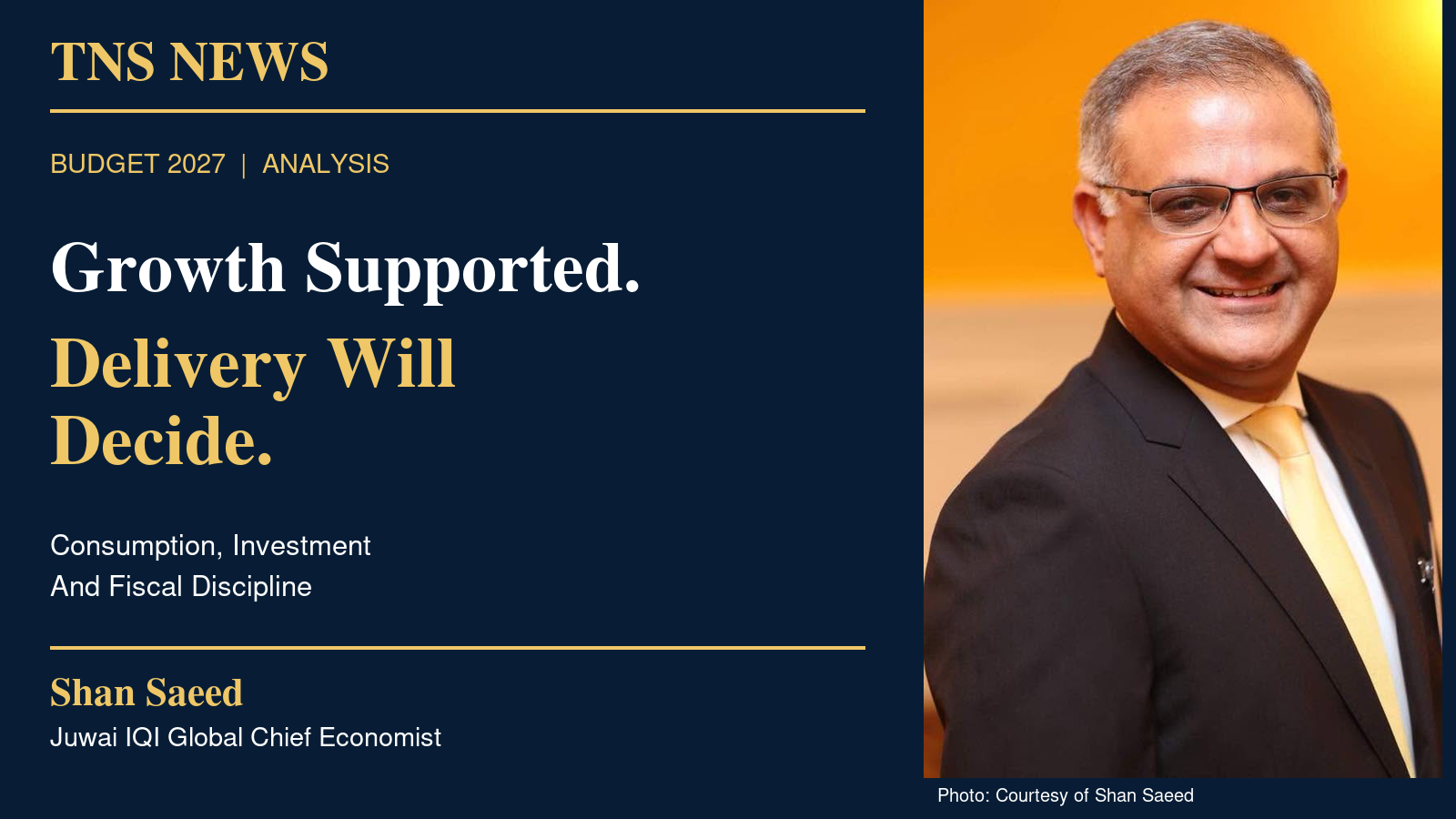
KUALA LUMPUR, Oct 10 – Budget 2027 offers a constructive balance between supporting household spending and strengthening public finances, but its success will depend on whether investment delivers higher productivity, better-paid jobs and lasting income gains, said Juwai IQI Global Chief Economist Shan Saeed.
Assessing the budget, Shan said domestic demand would provide economic resilience, while productive investment and fiscal credibility would underpin Malaysia’s longer-term growth prospects.
“Consumption sustains momentum. Investment builds capacity. Productivity compounds growth. Fiscal credibility secures stability,” he said.
Prime Minister Datuk Seri Anwar Ibrahim, who is also Finance Minister, tabled Budget 2027 in the Dewan Rakyat on Friday, October 9, outlining RM510 billion in total expenditure and investment resources, compared with RM470 billion this year.
The fifth MADANI budget combines wage measures, personal income tax relief and expanded household assistance with investment aimed at strengthening economic capacity.
The government forecasts gross domestic product (GDP) growth of 4.2 to 5.2 per cent in 2027 and targets a fiscal deficit of 3.3 per cent of GDP, down from a revised 3.6 per cent this year.
Household Spending Supports Growth
Shan said proposed tax relief and minimum-wage adjustments were intended to reinforce household purchasing power and sustain domestic demand.
However, higher nominal incomes would need to translate into real improvements in living standards.
“Sustainable consumption requires real wage gains, contained inflation and productivity improvement not merely higher nominal incomes,” he said.
His assessment draws a distinction between measures that support spending immediately and improvements that allow households to sustain that spending over time.
Higher earnings can provide relief, but their value depends on whether they outpace increases in the prices of goods and services. Productivity improvements are therefore central to ensuring that better wages remain economically sustainable.
Investment Must Deliver Tangible Returns
Shan identified semiconductors, advanced manufacturing, artificial intelligence and digital infrastructure as areas that could deepen Malaysia’s integration into high-value global supply chains.
However, investment commitments alone would not establish the success of the budget.
“Capital commitments are not economic outcomes. The real dividend lies in technology transfer, skilled employment, domestic value-added and higher productivity,” he said.
These gains, he added, must ultimately translate into stronger corporate profitability, higher household incomes and a broader tax base.
Budget 2027’s RM510 billion envelope includes RM459.8 billion in federal expenditure, comprising RM376.8 billion in operating expenditure and RM83 billion in development allocations.
The remaining resources comprise RM25 billion in government-linked investment company investments, RM11 billion in public-private investments and RM14.2 billion in investments by federal statutory bodies and Minister of Finance Incorporated companies.
Shan emphasised the importance of distinguishing the broader resource envelope from federal government spending.
“The broader envelope signals capital mobilisation beyond the federal budget—not additional government expenditure,” he said.
The distinction places attention on how effectively public and investment resources are deployed, and whether they build productive capacity within the domestic economy.
Fiscal Credibility Anchors Confidence
The government projects federal revenue of RM380.8 billion in 2027, alongside a reduction in the fiscal deficit to 3.3 per cent of GDP. It retains its target of bringing the deficit down to 3 per cent by 2028.
In his speech, Anwar acknowledged that the West Asia crisis had increased fuel subsidies to RM40 billion, pushing the projected 2026 deficit to 3.6 per cent, above the original 3.5 per cent target.
For Shan, the challenge is to consolidate public finances without weakening economic activity.
“The challenge is to consolidate without suppressing growth. Expenditure efficiency, subsidy rationalisation and stronger recurring revenues must offset energy-price volatility, external shocks and rising infrastructure demands,” he said.
His assessment places fiscal credibility alongside consumption and investment as a foundation for economic stability and investor confidence.
Maintaining that credibility requires the government to support growth while demonstrating that spending commitments and revenue projections remain consistent with its deficit-reduction path.
Cautiously Bullish, With Execution The Test
Shan described his overall assessment of Budget 2027 as “cautiously bullish”, citing its balance between near-term demand resilience and longer-term economic transformation.
“Budget 2027 offers a constructive balance between near-term demand resilience and longer-term economic transformation. The decisive test is execution: whether every ringgit deployed generates measurable productivity, durable fiscal returns and sustainable prosperity,” he said.
For households, that test will centre on whether stronger earnings translate into greater purchasing power. For businesses, it will involve the ability to raise productivity, develop local capabilities and create higher-value employment.
Shan’s assessment suggests that the budget’s lasting impact will depend on how effectively consumption support and investment work together to strengthen Malaysia’s economic capacity while keeping public finances on a sustainable path.
- TNS NEWS