


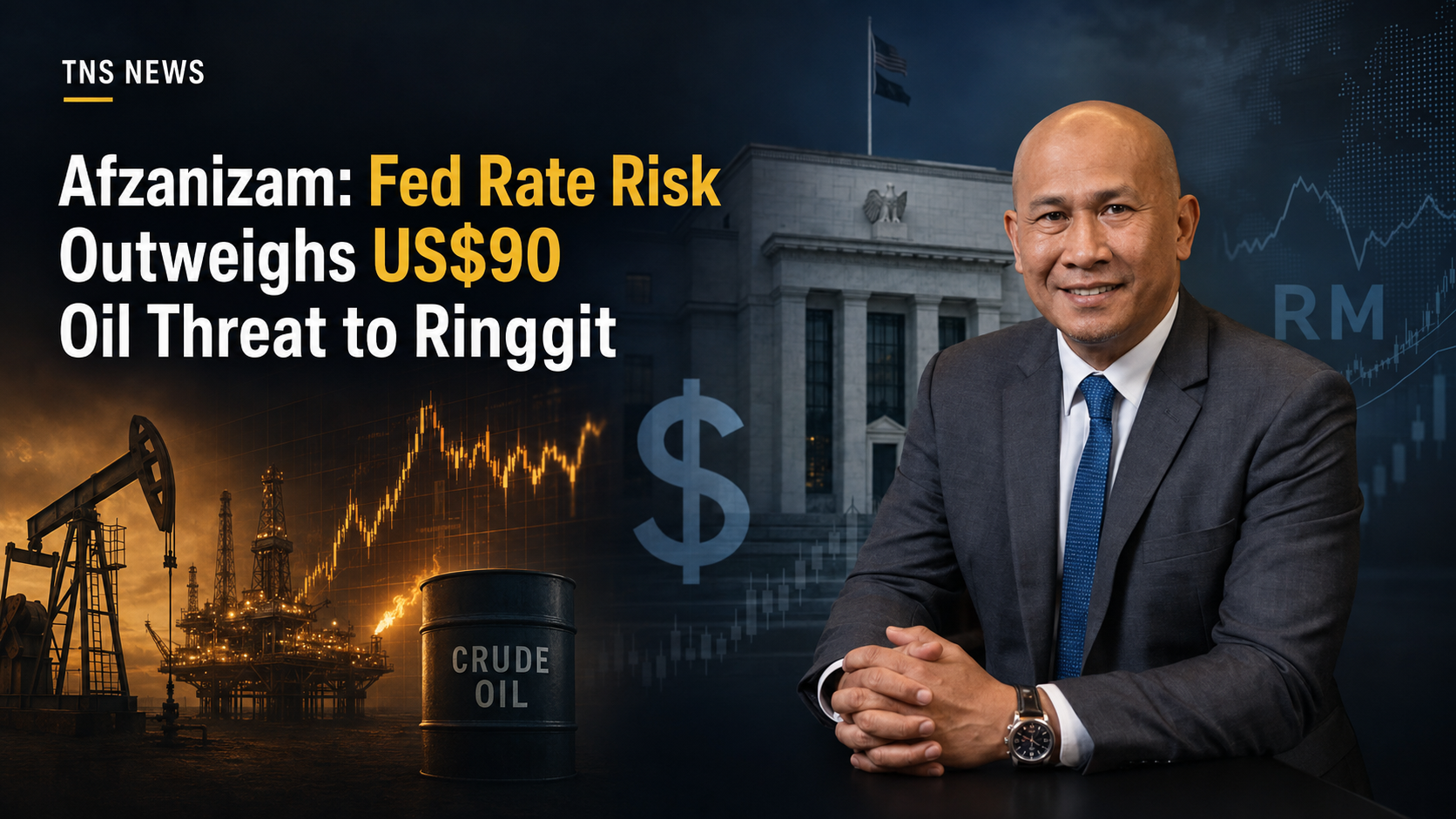
By TENGKU NOOR SHAMSIAH TENGKU ABDULLAH
KUALA LUMPUR, Aug 18, 2026 – The course of US interest rates poses a greater immediate risk to the ringgit than oil trading above US$90 a barrel, although markets expect the Federal Reserve to keep rates unchanged at its next policy decision on September 16, with only about a 36.6% probability of an increase, Bank Muamalat Malaysia Bhd Chief Economist Dr Mohd Afzanizam Abdul Rashid said.
The Federal Open Market Committee will hold its next meeting on September 15 and 16, with its interest-rate decision scheduled for 2 p.m. US Eastern Time on September 16, or 2 a.m. Malaysian time on September 17.
The meeting will determine whether the Fed keeps its target range at 3.50% to 3.75% or resumes monetary tightening in response to inflation that remains above its 2% objective.
“The greater immediate risk would be a rate rise by the US Federal Reserve,” Afzanizam told TNS News in written comments.
“Higher inflation has always been a contentious point when it comes to the Fed’s decision on interest rates.”
His assessment has taken on added relevance as Brent crude climbed above US$90 on Tuesday amid renewed concern over Middle East supply disruptions and fading hopes of a durable agreement involving Washington and Tehran.
Brent rose to about US$91.22 a barrel, its highest level in nearly three weeks, while US West Texas Intermediate advanced to around US$85.31, according to Reuters.
Afzanizam said the inflationary pressures associated with the conflict in the Middle East had strengthened the argument for tighter US monetary policy and contributed to the appreciation of the dollar.
“A US interest-rate increase is the key driver of the ringgit’s direction, and this is contingent upon the prospect of higher inflation in the United States,” he said.
September Fed increase remains uncertain
The Federal Reserve held its policy rate at between 3.50% and 3.75% at its July 28–29 meeting.
The decision was approved by a 9–3 vote, with three policymakers favouring an immediate quarter-percentage-point increase—an unusually visible division that underscored the Fed’s concern over inflation.
However, economic figures released since then have complicated the argument for another increase.
The US Consumer Price Index rose by 0.1% in July and by 3.4% from a year earlier, according to the US Bureau of Labor Statistics. Annual inflation eased slightly from 3.5% in June.
Core inflation, which excludes food and energy, stood at 2.5% year-on-year, down from 2.6% previously.
The figures showed that inflation remained above the Fed’s 2% objective but was not accelerating as strongly as some investors had feared.
Energy prices remained a longer-term source of pressure. Although the US energy index fell by 1.5% in July, it was still 14.7% higher than a year earlier, with gasoline prices up 24.6%.
The July employment report also pointed to a less robust labour market. Non-farm payroll employment declined by 23,000, while the labour-force participation rate slipped to 61.4%.
The official employment report also showed that payroll growth for May and June was revised down by a combined 103,000 jobs.
These figures reduced market expectations of a September rate increase. As of August 18, interest-rate markets were pricing in a probability of about 36.6% that the Fed would raise rates at the September meeting, according to Reuters.
This means markets presently regard the Fed keeping rates unchanged as the more likely outcome, although the calculation could change if energy prices remain elevated or subsequent US data show renewed inflationary pressure.
Minutes from the Fed’s July meeting are due to be released on August 19 and will be closely examined for further indications of how policymakers are balancing persistent inflation against signs of labour-market weakness.
Ringgit could weaken beyond RM4.10
Afzanizam said a renewed increase in US interest rates could push the dollar-ringgit exchange rate beyond RM4.10.
“There is a chance that the US dollar-ringgit exchange rate could surpass RM4.10,” he said.
However, he stressed that the decline in July payrolls and the falling labour-force participation rate indicated that the US labour market was not entirely robust.
“The rate-hike thesis will always be challenged by those who believe that the prevailing federal funds rate should stay at 3.75%,” he said, referring to the upper limit of the Fed’s current target range.
The ringgit was trading at around RM4.0550 against the dollar on Tuesday, still below the level highlighted by Afzanizam.
His RM4.10 assessment should therefore be viewed as a conditional risk rather than a level the currency has already reached.
An increase in US rates could support the dollar and place pressure on emerging-market currencies by making dollar-denominated assets more attractive. It could also influence foreign portfolio flows and raise external financing costs.
The eventual effect on Malaysia would nevertheless depend on domestic economic fundamentals, investor sentiment and whether markets had already priced in the Fed’s decision.
Oil benefit depends on subsidy mechanism
Malaysia can benefit from higher crude prices through stronger petroleum-related revenue and improved earnings for parts of the oil and gas industry.
At the same time, expensive oil raises fuel, transportation, logistics, manufacturing and household costs.
Afzanizam said whether Malaysia’s gains from higher petroleum revenue would outweigh the broader costs depended heavily on the country’s fuel-subsidy mechanism.
“This really depends on the fuel-subsidy mechanism,” he said.
“Thus far, the present system covers all income cohorts, provided they are Malaysians and possess a valid driving licence.”
The subsidy framework limits the immediate effect of global oil-price increases on eligible motorists. However, it could also increase the government’s fiscal exposure if crude prices remain elevated for an extended period.
Any increase in petroleum revenue would therefore have to be weighed against potentially higher subsidy expenditure and other government measures to contain the cost of living.
BNM likely to keep OPR unchanged
Afzanizam acknowledged that the combination of a stronger US dollar and elevated global oil prices could complicate Bank Negara Malaysia’s policy choices, particularly if inflation rises while economic growth begins to soften.
“To some degree, yes,” he said.
“Uncertainty can affect private-sector sentiment, which could also compromise the GDP growth trajectory.”
Nevertheless, he said Malaysia entered the period of external uncertainty from a relatively firm economic position.
Malaysia’s advance GDP estimate showed the economy expanding by 5.8% in the second quarter, bringing first-half growth to 5.6%.
Inflation averaged approximately 2% during the second quarter and stood at 1.9% in June, within Bank Negara Malaysia’s official 2026 forecast range of 1.5% to 2.5%.
“Thus far, the Malaysian economy is in good condition,” Afzanizam said.
“Bank Negara Malaysia is therefore likely to keep the Overnight Policy Rate steady to support economic growth.”
BNM has maintained the OPR at 2.75% since July 2025.
Holding the rate steady would allow the central bank to continue supporting domestic economic activity while assessing whether expensive oil and exchange-rate movements are producing more persistent inflation.
Clear winners and losers
If Brent remains near or above US$90, Afzanizam identified upstream oil and gas companies as among the clearest beneficiaries.
“Positive sectors would include oil and gas, especially upstream players, as well as renewable-energy companies,” he said.
Higher crude prices could also accelerate investment in alternative energy by making renewable projects more commercially attractive.
“Higher crude-oil prices would mean that efforts to add more renewable-energy capacity become more urgent,” he said.
The government could also receive higher oil-related revenue when crude prices rise, although the fiscal benefit would need to be weighed against subsidy costs.
Industries that depend heavily on fuel, transportation and petroleum-derived inputs would face greater pressure.
“Plastics, chemicals, petrochemicals, automotive and components, and logistics are likely to be affected by higher crude-oil prices,” Afzanizam said.
For Malaysia, the greater danger may therefore come not from oil alone but from its interaction with US monetary policy.
Oil above US$90 could benefit selected companies and strengthen petroleum-related government revenue. But if expensive energy keeps US inflation elevated and persuades the Fed to raise rates on September 16, the consequences could extend to the dollar, ringgit, investment flows and financing conditions.
The next Fed decision will therefore be closely watched in Malaysia, not because an increase is assured, but because its implications could reach considerably further than the oil market.
- TNS NEWS