


BY TENGKU NOOR SHAMSIAH TENGKU ABDULLAH
KUALA LUMPUR, Aug 17 – Malaysia’s economy is no longer simply outperforming expectations. It is beginning to challenge long-held assumptions about the country’s long-term growth potential.
In an exclusive interview with TNS News, Juwai IQI Global Chief Economist Shan Saeed said Malaysia is entering a new phase of structural expansion, where investment, technology, trade and regional economic clusters are collectively raising the country’s long-term growth potential beyond previous expectations.
“The conversation is no longer about whether Malaysia can grow above 4%. The real question is whether the country’s structural growth potential has shifted to a higher trajectory,” Shan told TNS News.
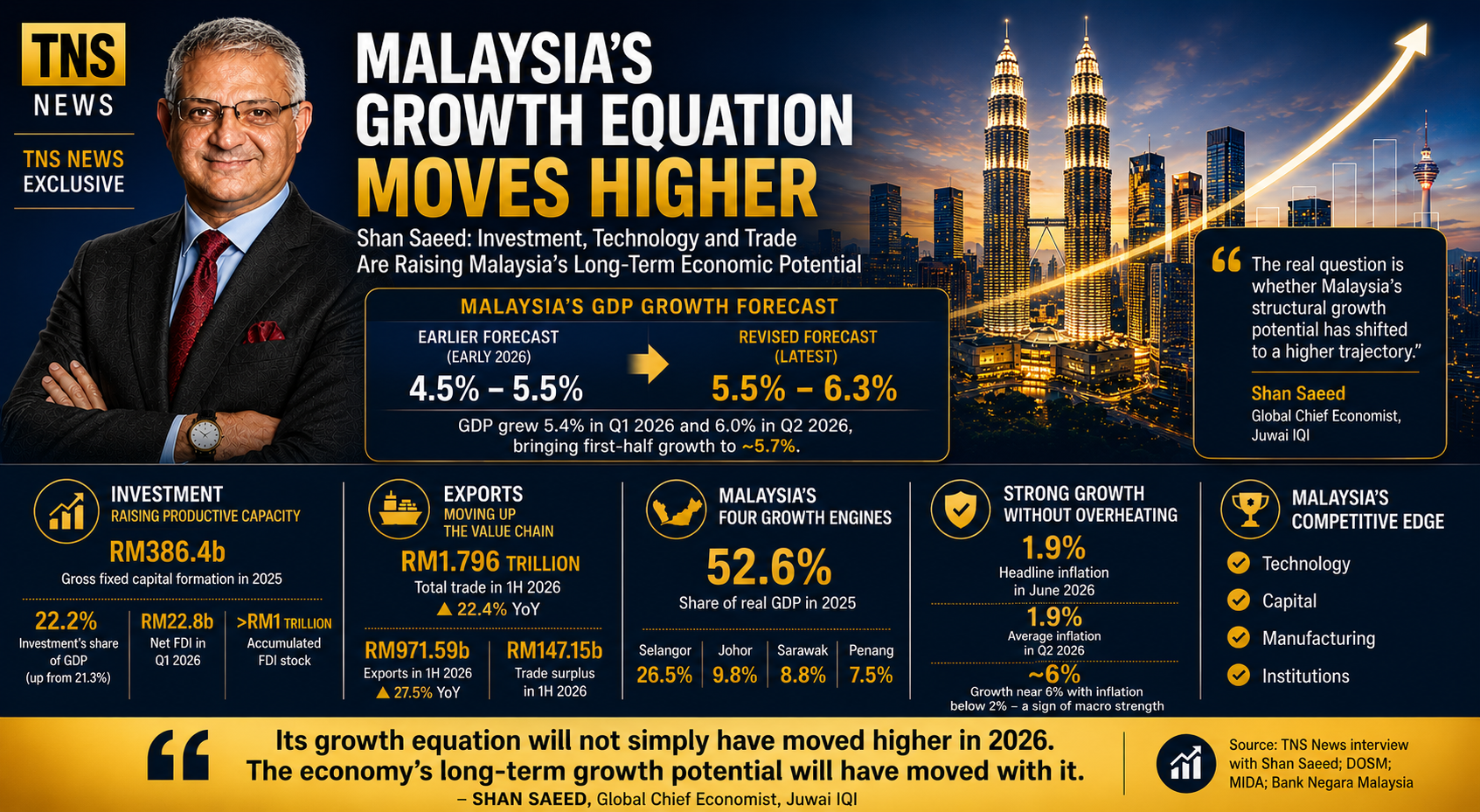
At the beginning of 2026, Shan projected Malaysia’s economy would expand between 4.5% and 5.5%. Following stronger-than-expected economic performance, he has since revised that forecast upwards to 5.5%–6.3%.
The latest economic data has reinforced that conviction. Malaysia’s economy expanded 5.4% year-on-year in the first quarter, followed by 6.0% growth in the second quarter, bringing first-half growth to approximately 5.7%.
For Shan, however, the significance extends well beyond stronger GDP numbers.
“What matters today is not simply faster growth. It is the quality, durability and composition of that growth,” he said.
Investment Is Raising Malaysia’s Productive Capacity
One of the strongest pillars supporting Malaysia’s outlook is investment.
Gross fixed capital formation expanded 9.6% in 2025, reaching RM386.4 billion in constant prices and lifting investment’s share of GDP to 22.2%, from 21.3% previously.
Private investment continued to dominate, while manufacturing, transport, information and communications technology (ICT), machinery and advanced industrial sectors attracted increasing levels of capital.
According to Shan, this represents the difference between cyclical growth and structural transformation.
“Consumption can lift GDP for several quarters. Investment in factories, machinery, logistics, digital infrastructure and technology raises an economy’s productive capacity for years,” Shan told TNS News.
Foreign capital is reinforcing that transformation.
Malaysia attracted RM22.8 billion in net foreign direct investment (FDI) during the first quarter of 2026, while accumulated FDI stock has now exceeded RM1 trillion.
More importantly, much of the incoming investment is concentrated in services, ICT, advanced manufacturing, semiconductors, digital infrastructure and other technology-intensive industries.
“The quality of capital matters as much as the quantity. Investment that transfers technology, increases capital intensity and raises productivity generates far greater long-term economic dividends than financial inflows that simply change ownership,” Shan said.
Exports Are Moving Up the Value Chain
Trade has become the second major engine of Malaysia’s economic expansion.
Total trade reached RM1.796 trillion during the first half of 2026, representing a 22.4% increase from a year earlier.
Exports surged 27.5% to RM971.59 billion, while the trade surplus widened sharply to RM147.15 billion.
Yet, for Shan, the composition of exports is even more important than the record itself.
“Malaysia is increasingly embedded in global electrical and electronics supply chains, with growing exposure to semiconductors, artificial intelligence infrastructure, advanced electronics and data-centre investments,” he said.
“The objective is not to become Asia’s cheapest production platform. It is to become one of the region’s most technologically capable and globally connected manufacturing and innovation hubs.”
According to Shan, this distinction matters because more sophisticated manufacturing encourages technology transfer, strengthens domestic supplier networks, raises demand for skilled labour and increases the domestic value-added content embedded within exports.
Four States Are Driving Malaysia’s Next Growth Phase
Malaysia’s national growth story is increasingly being powered by four highly complementary regional economic clusters.
Together, Selangor, Johor, Sarawak and Penang generated approximately 52.6% of Malaysia’s real GDP in 2025.
Selangor remained the country’s largest economy, contributing RM460.1 billion, or 26.5% of national GDP, followed by Johor (9.8%), Sarawak (8.8%) and Penang (7.5%).
For Shan, their importance lies not only in their size but also in their complementary strengths.
Selangor provides metropolitan scale through finance, services, logistics, advanced manufacturing and domestic consumption.
Johor, anchored by Johor Bahru and the wider Iskandar corridor, has emerged as one of Malaysia’s fastest-growing investment destinations, expanding 8.0% in 2025. Its strategic proximity to Singapore continues to strengthen manufacturing, logistics, digital infrastructure and cross-border investment flows.
Penang remains Malaysia’s semiconductor and high-technology manufacturing hub, directly linking the country to sophisticated global electronics value chains.
Sarawak contributes energy security, commodities and industrial depth, providing balance to both the Klang Valley’s services economy and Penang’s technology ecosystem.
“These four economic engines complement rather than compete with each other. Together they provide Malaysia with multiple, diversified sources of long-term growth,” Shan said.
Strong Growth Without Overheating
Equally encouraging is Malaysia’s inflation performance.
Consumer prices rose only 1.9% year-on-year in June, while inflation averaged 1.9% during the second quarter.
For Shan, sustained growth near 6% alongside inflation below 2% represents one of Malaysia’s strongest macroeconomic achievements.
“It suggests Malaysia has, so far, managed to accelerate growth without creating broad inflationary pressures,” he said.
Nevertheless, Shan cautioned that maintaining this momentum will require far more than continued capital investment.
“Capital accumulation can happen relatively quickly. Productivity transformation takes much longer. New factories and data centres must be matched by skilled workers, technology diffusion, stronger domestic suppliers and rising real wages. Otherwise, capital deepening eventually encounters diminishing returns.”
Malaysia’s Competitive Position Is Becoming Clearer
Following the stronger-than-expected first-half performance, Shan believes his revised 5.5%–6.3% growth forecast has become increasingly achievable.
“The lower end of the forecast range is now well anchored by first-half momentum. Reaching the upper end will require investment, semiconductor demand, exports and domestic consumption to remain exceptionally strong during the second half,” he said.
Within his “Fabulous Five” framework—Malaysia, Indonesia, Thailand, Vietnam and the Philippines—Shan believes Malaysia is carving out an increasingly distinctive competitive position.
Indonesia offers market scale.
Vietnam provides manufacturing momentum.
Thailand contributes industrial depth.
The Philippines benefits from demographics and services.
Malaysia’s comparative advantage, however, lies increasingly in technology intensity, capital connectivity, sophisticated manufacturing, institutional resilience and powerful regional economic clusters.
“Economic sophistication, institutional resilience, policy credibility and macroeconomic stability are increasingly the defining hallmarks of a country’s premium standing in the global economy,” Shan told TNS News.
He believes Malaysia is steadily strengthening across all four dimensions.
Beyond This Year’s Growth
For Shan, investors should look beyond whether Malaysia records 5.5%, 6.0% or 6.2% growth in any particular quarter.
The more important question is whether today’s investment cycle permanently expands the country’s productive capacity.
“If this cycle leaves Malaysia with a larger capital stock, more productive firms, higher-skilled workers, stronger technology capabilities and a more sophisticated export economy, then Malaysia will have achieved something far more significant than outperforming a consensus GDP forecast,” he said.
“Its growth equation will not simply have moved higher in 2026. The economy’s long-term growth potential will have moved with it.”
The distinction is significant. Economies can enjoy temporary bursts of growth driven by consumption or favourable external conditions. Structural growth, by contrast, leaves behind enduring gains in productivity, investment capacity, technological capability and competitiveness.
If Malaysia can sustain its current investment momentum while continuing to strengthen productivity, innovation and human capital, the country may not simply be experiencing another strong economic year. It could be laying the foundation for a higher long-term growth trajectory—one that positions it among ASEAN’s most competitive and resilient economies in the decade ahead.
- TNS NEWS