


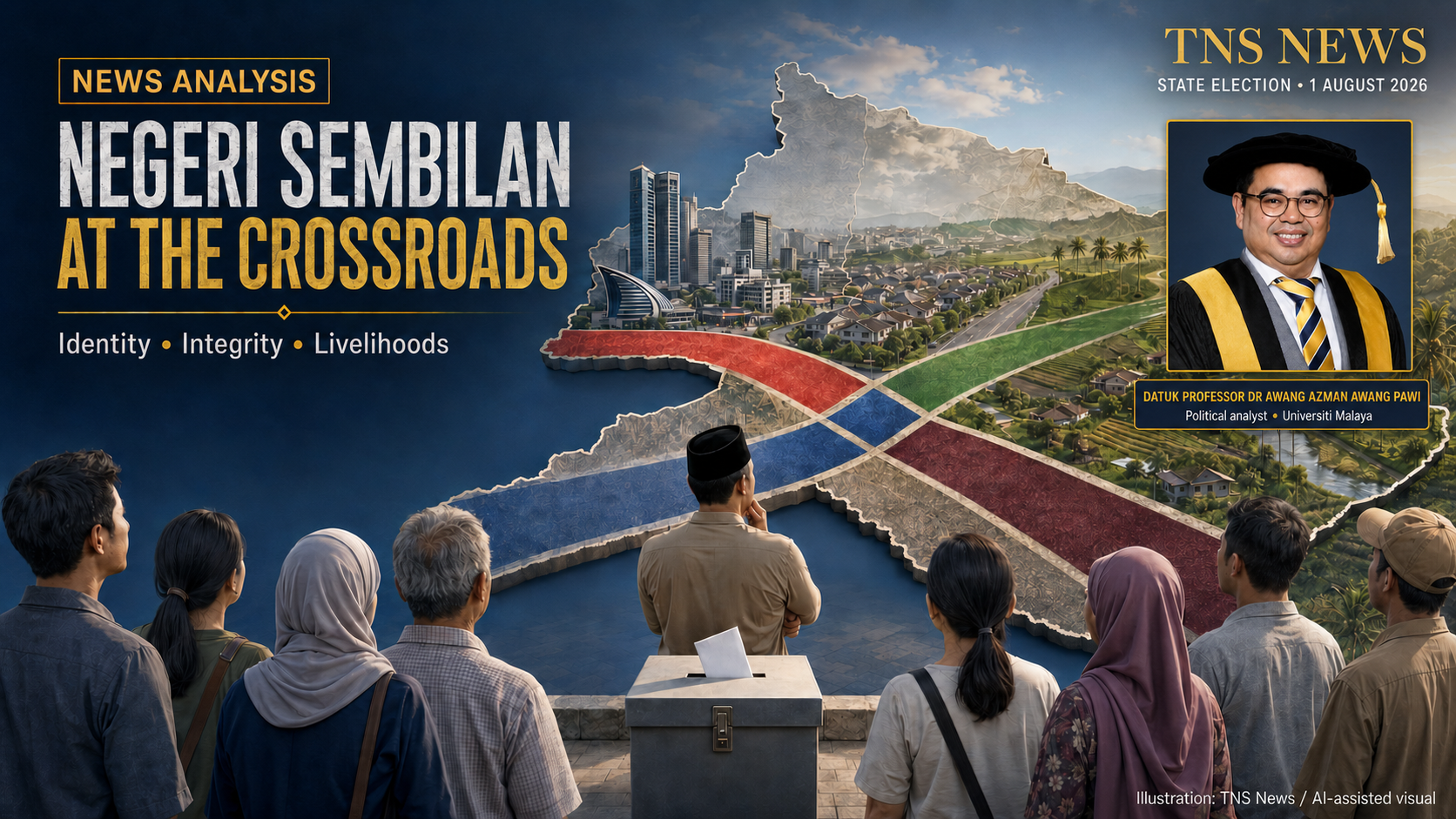
The August 1 36-seat election is no conventional three-coalition contest. PH and BN govern Malaysia together but are fighting each other in Negeri Sembilan, while BN is cooperating with PAS-led PN and Bersatu is contesting separately. According to Universiti Malaya’s Prof Awang Azman Awang Pawi, the pivotal constituency is a Malay middle that is economically anxious, culturally conservative and pragmatic about stability.
By TENGKU NOOR SHAMSIAH TENGKU ABDULLAH
KUALA LUMPUR, 30 July 2026 — Negeri Sembilan’s 1 August election is shaping up as far more than a conventional contest among rival coalitions.
Federal partners Pakatan Harapan and Barisan Nasional are competing against each other in all 25 constituencies where their candidates meet. BN and PAS-led Perikatan Nasional, opponents at the federal level, have reached a tactical understanding covering the remaining 11 seats and agreed to campaign for one another.
Bersatu, meanwhile, is fielding 24 candidates under its own logo despite technically remaining within PN. It will face PN candidates in eight constituencies.
Coalition identity has itself become an issue before voters.
At the centre of the contest is what Datuk Professor Dr Awang Azman Awang Pawi describes as the “middle Malay voter”—culturally conservative, economically anxious, increasingly sceptical of political elites, yet pragmatic about stability and effective government.
For this group, the election is “best understood as a performance referendum filtered through political identity, not simply a contest between local manifestos,” said Prof Awang Azman, Dean of Universiti Malaya’s Academy of Malay Studies.
That judgment is being demanded more than two years ahead of schedule and under extraordinary circumstances.
The dissolution followed a political rupture arising amid a dispute over customary authority, an attempted removal of the recognised Yang di-Pertuan Besar and UMNO’s withdrawal of support from the PH-led state administration.
The federal government has continued to recognise Tuanku Muhriz Tuanku Munawir as the Yang di-Pertuan Besar of Negeri Sembilan. The attempted removal and naming of an alternative claimant remain politically and constitutionally disputed.
The election also comes three weeks after BN captured 48 of Johor’s 56 seats, leaving PH with the remaining eight and wiping out PN from the state assembly. That result has turned Negeri Sembilan into an important test of whether UMNO’s revival can travel beyond its traditional southern stronghold.
A referendum filtered through identity
Economic pressures are likely to weigh heavily on voters.
Cost of living, wages, employment, housing, transport and access to public services affect how voters assess both the state and federal administrations, Prof Awang Azman said.
But voters “do not interpret these issues in a political vacuum”.
National controversies, perceptions of political leaders, Malay political identity and inherited party loyalties influence whom voters hold responsible for their circumstances.
The outcome may therefore depend on whether the competing parties can connect everyday economic concerns with a convincing explanation of whom they represent—and why their increasingly fluid alliances should still command public trust.
Negeri Sembilan’s geographic and socioeconomic divisions add another layer to the contest.
Seremban and the western urban corridor are closely connected economically and socially to the Klang Valley. Many central and eastern constituencies, by contrast, are shaped more strongly by rural, agricultural and FELDA-related concerns.
Voters across these areas may be experiencing the same national economy, but they encounter its pressures differently and assess politicians through different community networks.
When federal partners become state rivals
PH and BN entered the 2023 Negeri Sembilan election through a seat-sharing arrangement and collectively captured 31 of the 36 seats.
PH won 17 seats with 38.66 per cent of the statewide vote, while BN secured 14 seats with 22.24 per cent. PN obtained 37.65 per cent but won only five seats because much of its support was concentrated in heavily Malay constituencies.
That alliance has now been dismantled.
Some voters may accept different arrangements at the federal and state levels as a pragmatic feature of coalition politics, Prof Awang Azman said. Cooperation in Putrajaya does not necessarily require parties to cooperate in every state election.
The difficulty arises when PH and BN portray each other as unsuitable to govern Negeri Sembilan while continuing to administer the country together.
“Without a convincing explanation, voters may regard the arrangement as an elite bargain driven by political convenience rather than principle,” Awang Azman told TNS NEWS.
BN’s tactical cooperation with PAS-led PN makes the picture even more complicated. BN remains PH’s partner in the federal government but is campaigning alongside an opposition coalition in Negeri Sembilan.
The most important consequence may not be a straightforward transfer of support from one coalition to another.
Instead, according to Awang Azman, the apparent contradiction could produce “cynicism, lower turnout and weaker emotional commitment to both PH and BN”.
That makes turnout particularly important in constituencies decided by narrow margins. Eleven seats were won by fewer than 1,000 votes in 2023. Juasseh was decided by only 78 votes, Kota by 135 and Ampangan by 329.
In a close election, voter disengagement could be as consequential as voter switching.
UMNO’s machinery against a changing electorate
Traditional loyalty to UMNO and BN remains influential, particularly in rural communities, FELDA settlements and constituencies where UMNO has longstanding branch networks and locally recognised leaders.
“BN’s advantage is not merely historical nostalgia,” Prof Awang Azman said. “It lies in its organisational infrastructure, personal relationships and ability to maintain a visible presence between elections.”
The 2023 results suggest that UMNO’s rural foundations have weakened but have not disappeared. The PH-BN combination performed particularly well in rural Malay constituencies, while PN’s strongest advances occurred mainly in semi-urban Malay seats.
Younger voters, however, are less likely to inherit party allegiance unquestioningly.
They are more responsive to candidate credibility, social-media narratives, employment prospects and whether political leaders appear to understand their everyday difficulties.
UMNO can still attract younger Malay voters, Prof Awang Azman said, but it must earn their support through performance and credible local candidates rather than relying solely on historical attachment.
This election will therefore test whether the “blue wave” that carried BN to a landslide victory in Johor reflected a broader revival or was driven by advantages specific to Johor, including incumbency, organisational strength and a popular state leadership.
Can PN support survive the PAS-Bersatu split?
PN demonstrated in 2023 that it had established a recognisable identity among a substantial section of Negeri Sembilan’s Malay electorate.
It secured 37.65 per cent of the statewide vote and captured five seats. All five had Malay electorates approaching or exceeding three-quarters of registered voters.
But Prof Awang Azman draws an important distinction between durable voter sentiment and durable political organisation.
PN’s earlier advances were achieved despite limited grassroots machinery, negligible non-Malay support and considerable dependence on social media and national Malay-Muslim identity narratives.
The present split makes its organisational durability harder to assess.
PAS-led PN is contesting 11 seats, while Bersatu is independently fielding candidates in 24. Although Bersatu technically remains a PN component, the two will confront each other in eight constituencies.
PN-related support is therefore partly affirmative, reflecting Malay-Muslim identity and opposition politics, and partly negative, arising from dissatisfaction with PH and BN.
It will become truly durable, Prof Awang Azman argued, only if it is supported by credible state leadership, sustained constituency service and a convincing programme for governing Negeri Sembilan.
For PH, Bersatu’s separate campaign could create openings in marginal Malay-majority constituencies by dividing votes that might otherwise consolidate behind BN or PN. But the extent of that effect remains uncertain.
Two forecasts, one unsettled contest
Two prominent projections point in different directions, although both identify Malay vote consolidation, turnout and Bersatu’s independent campaign as decisive variables.
A Vodus Research survey of 437 registered voters, conducted between 9 and 21 July, placed PH ahead with 42 per cent of the statewide vote, followed by BN at 35 per cent and PN at seven per cent. Independent candidates accounted for two per cent, while 14 per cent of respondents were undecided or declined to reveal their preferences.
Its seat-level forecast placed PH ahead in 17 constituencies, BN in 15 and PN in two, with two PH-BN contests considered too close to call.
The survey should nevertheless be interpreted cautiously. Its relatively small statewide sample, the substantial undisclosed vote and smaller ethnic sub-samples make individual constituency projections indicative rather than conclusive.
A separate analysis by former deputy international trade and industry minister Ong Kian Ming points towards a clearer BN-PN advantage. He projected the informal partners winning a combined 23 to 25 seats, leaving PH with between 11 and 13.
The difference between the projections rests substantially on their assessments of turnout, Malay vote consolidation and whether Bersatu can divide enough votes to change the outcomes in closely contested constituencies.
The contrast underlines how open the contest remains beneath the competing headline numbers.
Adat Perpatih as a test of legitimacy
Because the political rupture developed amid a dispute involving customary authority, there is a temptation to treat Adat Perpatih as a direct predictor of voting behaviour.
Prof Awang Azman cautioned against doing so.
“Adat Perpatih influences politics indirectly rather than determining votes mechanically,” he said.
It shapes public expectations of leadership, including consultation, humility, respect for community institutions, familiarity with local society and sensitivity towards customary authority.
Candidates perceived as arrogant, culturally insensitive or lacking meaningful connections with their constituencies may encounter resistance. Family reputation, community standing and acceptance by local networks can matter considerably, particularly outside highly urbanised areas.
Its influence should not, however, be overstated.
Urbanisation, migration, national media and changing lifestyles mean Adat Perpatih no longer produces a single or predictable political preference. It is better understood as “a cultural test of legitimacy and leadership conduct, rather than an instruction to support any particular party”, Prof Awang Azman said.
The principle will also be tested by caretaker Menteri Besar Aminuddin Harun’s decision to leave Sikamat, which he had represented since 2008, and contest Linggi—a BN-held constituency won by a 1,461-vote majority in 2023.
His move will test whether his standing as caretaker Menteri Besar and record in government can overcome the importance voters attach to local familiarity and constituency connections.
The semi-urban belt may decide the state
Urban Seremban and mixed constituencies are likely to place greater emphasis on housing affordability, congestion, employment, local-government performance, public transport, institutional reform and multi-ethnic representation.
Rural voters are more likely to assess agricultural conditions, FELDA interests, roads, welfare assistance, basic infrastructure and the accessibility of their representatives.
Between these areas sits a semi-urban belt that may ultimately determine who forms the government.
“Semi-urban constituencies may be the most politically fluid,” Prof Awang Azman said.
“Their voters experience urban economic pressures but often retain strong communal and identity-based networks. Commuting costs, youth employment, housing, local development and Malay political representation can therefore converge.”
Four of PN’s five victories in 2023 occurred in semi-urban constituencies, with the fifth in an urban seat.
These constituencies sit at the intersection of economic anxiety and political identity. Their voters are exposed to the costs and expectations associated with urban development but remain connected to community institutions and identity-based political narratives.
This makes them especially difficult for parties to reach through a single national message.
What the result will reveal nationally
The election will test three major propositions.
The first is whether UMNO’s revival in Johor can travel beyond a traditional BN stronghold.
The second is whether PH can remain competitive among Malay voters without BN’s vote-transfer machinery.
The third is whether PN can transform protest support and Malay-Muslim identification into a stable organisational presence despite the rupture between PAS and Bersatu.
A strong BN performance would reinforce UMNO’s claim to represent the pragmatic centre of Malay politics. It would also increase the party’s bargaining strength within the federal government after major gains in two state elections.
A resilient PH showing in mixed and semi-urban Malay constituencies would indicate that socioeconomic delivery, governance and multiracial coalition politics remain electorally viable without a formal state-level pact with BN.
Significant gains by PAS-led PN would demonstrate that identity-centred opposition politics continues to command substantial Malay support. Bersatu’s performance, meanwhile, will indicate whether its individual party brand can survive outside a unified PN electoral operation.
But the election presents a fourth and potentially more consequential test: whether Malay politics is being reorganised around tactical electoral arrangements rather than stable coalitions.
BN is campaigning with PAS in Negeri Sembilan while governing with PH in Putrajaya. PAS has separated itself electorally from Bersatu, while Bersatu technically remains within PN.
If such arrangements prove successful, the model of cooperating federally, competing locally and forming tactical alliances where convenient could become a more prominent feature of preparations for the next general election.
That returns the contest to the voter all the principal blocs are trying to persuade.
“Ultimately, the most important constituency is the middle Malay voter: culturally conservative, economically anxious, increasingly sceptical of political elites, but also pragmatic about stability and effective government,” Prof Awang Azman said.
“Whichever party best reconciles identity, integrity and material security will possess the strongest advantage approaching the next general election.”
- TNS NEWS