


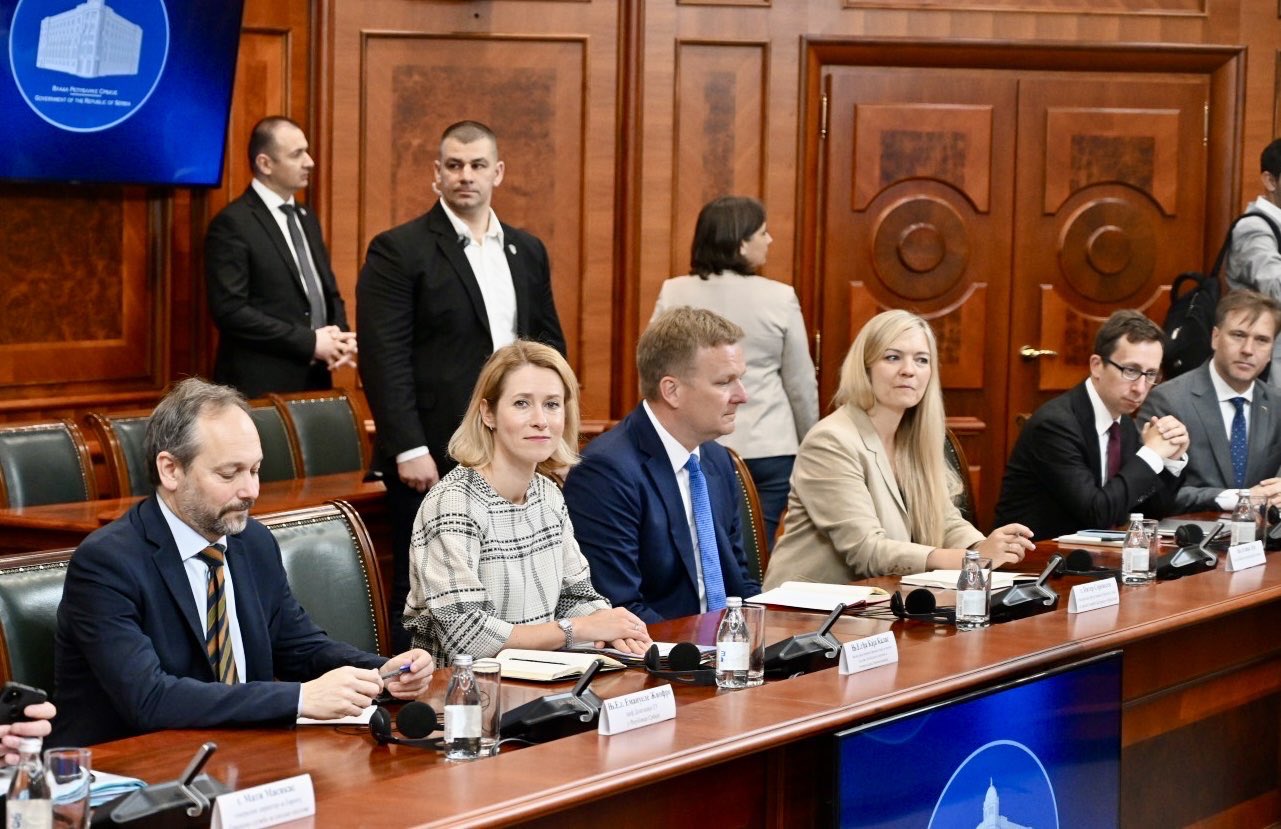

Kaja Kallas, EU High Representative for Foreign Affairs and Security Policy and Vice-President of the European Commission (second from the left) Image credit – Kaja Kallas X (formerly Twitter)
Analysis | By TNS News Foreign Affairs Desk
BRUSSELS, May 23 – When Kaja Kallas stepped into the role of EU High Representative in late 2024, expectations were modest — a steady hand, perhaps, in a divided Europe.
But her May 20 press remarks following the Foreign Affairs Council meeting signaled something bolder: a decisive pivot in tone and strategy that may redefine how Brussels projects power in a fractured world.
Three battlegrounds dominated the briefing — Ukraine, Gaza, and the Western Balkans — but behind them lay a single message: Europe’s strategic patience is running out.
Ukraine: Economic Pressure With Strategic Intent
Sanctions aren’t new. But the latest EU package against Russia — targeting shadow oil fleets and critical military supply lines — represents a refined approach. Less performative, more punishing.
“This package is already having a significant impact on Russia’s economy,” Kallas said, adding that more will follow if Russia continues to reject Ukraine’s ceasefire overtures.
It’s a shift from symbolic unity to targeted disruption — a strategy designed to degrade Moscow’s war machine without fracturing EU consensus. For Kallas, it’s also a credibility test. With U.S. support for Kyiv wavering, Brussels cannot afford to flinch.
Israel-Gaza: Principles Put to the Test
Perhaps the boldest move was the announcement of a formal review of the EU-Israel Association Agreement — a rarely used economic tool now being activated amid international outrage over the Gaza humanitarian crisis.
Kallas struck a deliberate tone:
“This is not a political gesture; it is a response to the mounting evidence of disproportionate action.”
Behind that calm phrasing is a real policy pivot: Europe is beginning to treat values as leverage. The stalling of sanctions against violent Israeli settlers — blocked by one unnamed EU member — reveals the internal friction. But the direction is clear: Brussels is no longer shielding allies from scrutiny.
Serbia and Kosovo: No More Strategic Hedging
On the Western Balkans, Kallas was unusually blunt. Serbia, she said, faces a “strategic choice” — join Europe, or continue courting Russia and China. It can’t do both.
This is not new conditionality, but a firmer line on enforcement. Kallas linked EU membership explicitly to democratic standards: press freedom, corruption control, electoral reform. The EU’s door remains open, but the price of entry just became clearer — and steeper.
Kosovo wasn’t spared either. Without a normalization deal between Belgrade and Pristina, the region’s EU prospects stall. Talks in Brussels are reportedly being prepared, but expectations are now tighter.
A Kallas Doctrine? Quietly, It’s Emerging
Taken together, the post-May 20 landscape suggests more than just reactive diplomacy. Kallas is shaping a doctrine rooted in strategic clarity: sanctions with teeth, trade as leverage, enlargement tied to principles.
She is, in effect, testing whether the EU can move beyond declarations to enforcement — whether values can be actionable, not just aspirational.
“Our unity is our strength,” she concluded. “But unity requires us to act — not just to speak.”
It’s early days, and her path will be tested by divergent interests, veto threats, and external shocks. But in style and substance, Kallas is laying down markers. Whether on Russian aggression, Israeli impunity, or Balkan ambivalence, she’s signaling that Brussels is prepared to do more than convene — it is prepared to confront.
- TNS News