


Column No. 6 — 29 April 2026 — TNS News
The Cartel Cracks, the Talks Stall: ASEAN Watches a New Energy Order Take Shape
Column No. 6 — 29 April 2026 — TNS News
By TENGKU NOOR SHAMSIAH TENGKU ABDULLAH
Sixty days into the conflict, the Strait of Hormuz remains the most consequential 34 kilometres on the planet and it is being contested from both ends simultaneously. The United States continues to blockade Iranian ports; Iran continues to restrict passage through the waterway.
Each side accuses the other of bad faith. Meanwhile, Iran’s foreign minister has been shuttling between Oman, Pakistan, and Moscow in a week of intense diplomacy that has produced a new proposal but no breakthrough.
For Southeast Asia, every week of stalemate is another week of structural damage to energy supply chains, national budgets, and the food security of hundreds of millions of people.
The diplomatic picture as of 28 April is one of managed limbo. On 21 April, President Trump extended the ceasefire which had been set to expire that Wednesday at Pakistan’s request, to allow time for Iran to submit a unified negotiating proposal.
On 25 April, Trump cancelled his envoys’ planned trip to Islamabad after Iran’s foreign minister Abbas Araghchi left Pakistan without finalising terms for a second round of talks. Trump told journalists that, shortly after the cancellation, Iran submitted what he described as a “much better” proposal, without elaborating on its contents. The US naval blockade of Iranian ports, in place since 13 April, has not been lifted.
Over the weekend of 25 to 27 April, Araghchi conducted a whirlwind diplomatic circuit: two stops in Islamabad, a visit to Muscat for talks with Omani officials focused specifically on the strait, phone calls with the foreign ministers of Qatar, Saudi Arabia, and Egypt, and finally a meeting with Russian President Vladimir Putin in St. Petersburg on Monday. The visit to Putin was significant. Moscow has been a consistent backer of Tehran’s diplomatic position, and Putin used the meeting to signal continued Russian solidarity. “We see how courageously and heroically the Iranian people are fighting for their independence and sovereignty,” Putin said at the opening of the meeting.
The substance of Iran’s new proposal, conveyed to Washington through Pakistani mediators, is now clearer. According to officials with knowledge of the talks, Iran has offered to reopen the Strait of Hormuz and end the war in exchange for the United States lifting its naval blockade and formally ending hostilities with the question of Iran’s nuclear programme to be addressed in a subsequent, separate negotiating track. Tehran has explicitly proposed that the nuclear issue be set aside at the start. The logic is sequencing: first restore the pre-war status quo, then address the deeper structural dispute over enrichment. US Secretary of State Marco Rubio appeared to reject this approach on Monday, stating that any deal must “definitively prevent” Iran from developing a nuclear weapon. Trump himself has continued to signal that the naval blockade is his primary lever of pressure, saying he intends to keep squeezing Iran’s oil exports until Tehran capitulates.
Speaking to journalists and in statements on Monday 28 April, Iranian Foreign Minister Abbas Araghchi said Iran was reassessing how to proceed with diplomacy, citing what he described as Washington’s “destructive habits” among them unreasonable demands, shifting goalposts, threatening rhetoric, and repeated breaches of commitments as the primary obstacles to progress. Tehran, he said, would make the appropriate decision on the diplomatic process in light of those factors.
The structural deadlock is now visible in its full dimensions. Iran has passed its red lines to Pakistani mediators: the nuclear issue and the Strait of Hormuz are non-negotiable in any first-stage agreement, meaning Tehran will not permanently cede control of the waterway or its enrichment programme as preconditions to ending hostilities. Washington’s red lines, as articulated by Vance and Rubio, require exactly those concessions. The result is what has been described as a “dual blockade”: the US blocks ships entering or departing Iranian ports; Iran restricts transit through the strait. Neither side has the leverage to force the other’s hand. Meanwhile, the rest of the world absorbs the cost.
The Diplomacy of Escalation: Tankers, Mines, and New Ships of War
The week between 21 and 28 April has been marked by a series of military escalations that have raised the stakes for commercial shipping across Southeast Asia and beyond. On 22 and 23 April, the US intercepted three Iranian oil tankers in the eastern Indian Ocean. On 22 April, an Iranian gunboat attacked the Greek-owned cargo vessel Epaminondas off the coast of Oman, causing significant damage to the bridge, despite having previously granted the ship permission to cross the strait. The US on 24 April announced that for the first time since 2003, three American aircraft carriers are now deployed simultaneously in the Middle East, following the arrival of the USS George H.W. Bush. The US Navy has also begun clearing Iranian mines from the strait a direct military operation that Iran has characterised as a further ceasefire violation.
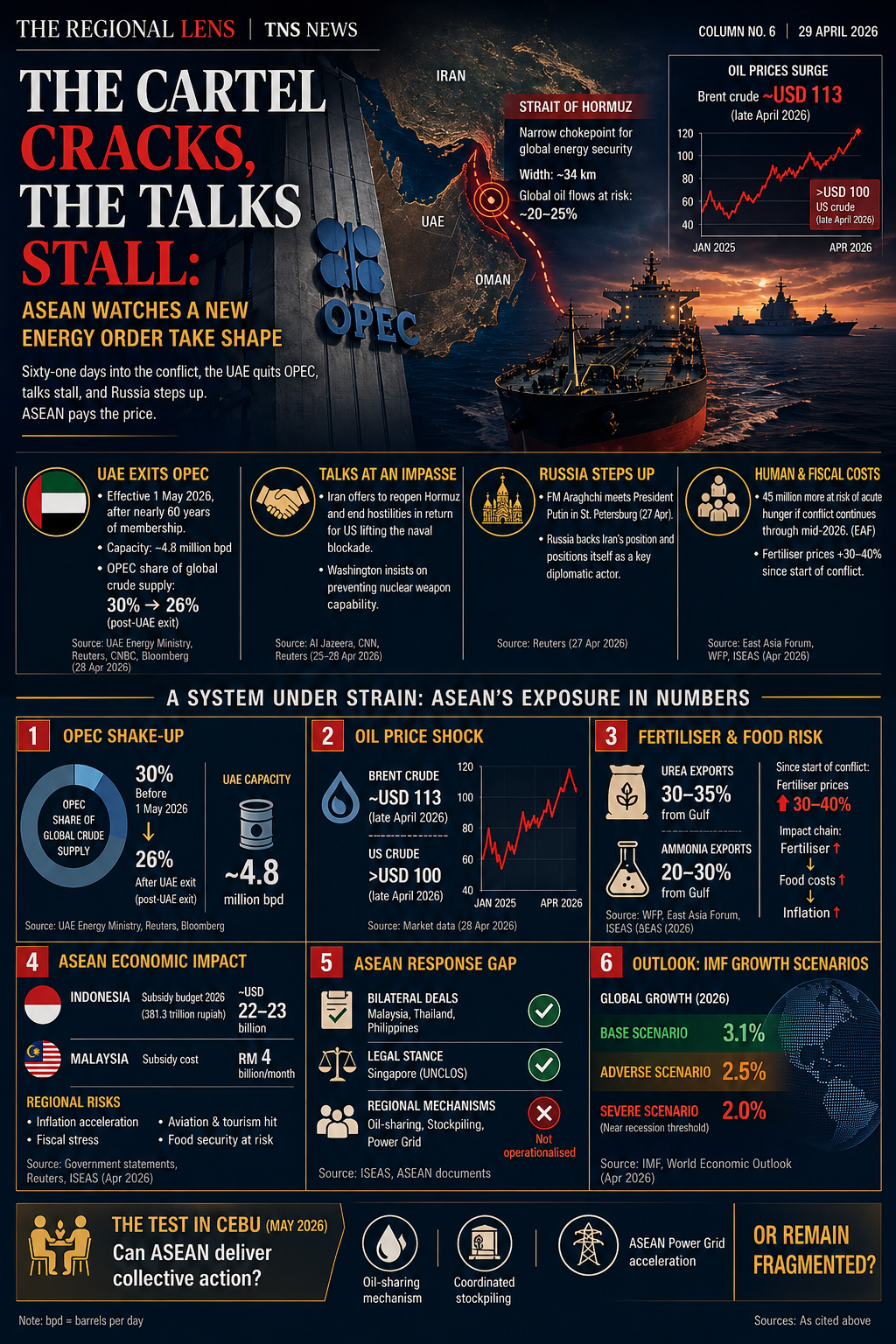
Iran’s Deputy Parliament Speaker Ali Nikzad stated publicly last week that by controlling the Strait of Hormuz and Bab al-Mandab simultaneously, Iran could affect 25 percent of the global economy. It was an unusually candid articulation of Tehran’s strategic leverage. Brent crude, which had fallen sharply on the 17 April ceasefire announcement, climbed back above USD 107 per barrel on Sunday 27 April after Iran’s signals of continued restrictions. US crude was above USD 96. The brief window of relief that Southeast Asian governments had hoped would ease their energy crisis has closed again.
The Fertiliser Dimension: A Hidden Food Security Crisis
Amid the focus on oil and LNG, a slower-moving crisis is deepening across Southeast Asia that has received less attention but carries profound consequences: the disruption to fertiliser supply. The Persian Gulf typically accounts for roughly 30 to 35 percent of global urea exports and between 20 and 30 percent of ammonia exports under normal conditions. With the strait effectively closed since 28 February, these flows have been severed. In Southeast Asia, where agriculture remains the primary livelihood for a large share of the rural population, the timing could not be worse. The spring planting season across parts of the region coincides directly with the supply disruption. Iran agreed on 27 March to allow UN-facilitated humanitarian and fertiliser shipments through the strait to address the crisis, but volumes have remained constrained and unpredictable.
The transmission mechanism is direct and well-documented: higher fertiliser costs raise food production costs, which raise food prices, which disproportionately affect lower-income households that spend a greater share of income on food. Vietnam’s inflation rose to 4.7 percent in March, up sharply from 3.4 percent in February, driven in significant part by energy and food input costs, according to data published by FocusEconomics. Across ASEAN, the Credit Agricole economic research team has warned that the energy shock is spreading into agricultural inputs and transport costs, with Thailand, Malaysia, and the Philippines where tourism accounts for between 15 and 20 percent of GDP particularly exposed to the combined hit of fuel costs and reduced visitor arrivals amid disrupted aviation fuel supply chains.
Ian Storey of ISEAS–Yusof Ishak Institute has noted in a recent ISEAS Perspective that even if the truce holds and the strait reopens, restoring normal flows of oil, gas, and fertilisers will take months, while repairing the damage to the Middle East’s critical energy infrastructure could take years. “As a result,” Storey writes, “the effects of the conflict are likely to persist for at least the rest of this year and probably into 2027.” For Southeast Asia, that is not a forecast. It is a planning assumption.
What ASEAN Is Doing and What It Is Not
The practical responses across ASEAN member states have been extensive and, in several cases, creative. Malaysia, Thailand, and the Philippines each negotiated directly with Tehran to secure passage for their flagged vessels through the strait, a pragmatic bilateral approach that Singapore declined to follow, maintaining that transit passage through international straits is guaranteed under the 1982 UN Convention on the Law of the Sea (UNCLOS), and that paying de facto tolls would imply recognition of Iranian control over the waterway. The two positions illustrate a broader tension within ASEAN between pragmatic energy security and principled commitment to international maritime law.
Across the region, governments have moved to reduce fuel consumption and manage the fiscal damage. Indonesia has mandated civil servant work-from-home arrangements and is rationing fuel. Vietnam has accelerated its E10 biofuel rollout. Thailand has recorded record pump prices and is managing electricity tariffs through state intervention. The Philippines, which declared a national energy emergency on 24 March, has pivoted to Russian crude imports and moved toward a four-day work week. Myanmar, already under civil war and in severe fuel shortage, has restricted private vehicle use to alternate days.
What ASEAN has not done is convert this crisis into durable institutional change at the regional level. The call by Philippine President Ferdinand Marcos Jr. for a joint ASEAN oil-sharing mechanism and coordinated stockpiling has not been operationalised. The ASEAN Emergency Petroleum Sharing Scheme and the ASEAN+3 Oil Stockpiling Road Map both exist as frameworks but have not been activated at the scale the crisis demands. Prof. Geoffrey Williams of Williams Business Consultancy, writing for TNS News, has observed that the crisis has exposed a fundamental gap between ASEAN’s rhetorical commitment to energy solidarity and the political will to operationalise it, particularly when domestic supply pressures make governments reluctant to share reserves across borders. Shan Saeed, Global Chief Economist at Juwai IQI, has argued in TNS News commentary that the prolonged disruption is accelerating structural changes in ASEAN’s energy import mix that will outlast the war including a faster pivot to Russian crude, US LNG, and Chinese-supplied renewables, each of which carries its own set of strategic dependencies.
“Even if the truce holds, restoring the flow of oil, gas and fertilisers through the Strait of Hormuz will take months, while repairing the damage inflicted on the Middle East’s critical energy infrastructure could take years.” Ian Storey, ISEAS, Yusof Ishak Institute, ISEAS Perspective, April 2026
The IMF’s Warning and the Region’s Fiscal Arithmetic
The International Monetary Fund’s April 2026 World Economic Outlook, released on 14 April, remains the most authoritative baseline for assessing where Southeast Asia stands. Under the reference forecast which assumes a conflict of limited duration with disruptions fading by mid-2026 global growth is projected at 3.1 percent, down from a pre-conflict projection of 3.4 percent, with global inflation rising to 4.4 percent. In the IMF’s adverse scenario, global growth falls to 2.5 percent. In the severe scenario, where supply disruptions extend into 2027, global growth falls to 2 percent a level the IMF describes as a near-threshold for global recession, reached only four times since 1980.
Given the events of the past week Trump cancelling his envoys’ Pakistan trip, Iran’s counter-proposal rejected by Rubio, Araghchi in Moscow with Putin, and Brent crude climbing back above USD 107 the IMF’s reference scenario of a short-lived conflict fading by mid-2026 looks increasingly optimistic. The adverse scenario is the more plausible planning baseline for Southeast Asia’s finance ministries right now. Indonesia, which set its 2026 fuel subsidy budget on an assumed oil price of USD 70 per barrel, faces a structural gap that its 381 trillion rupiah subsidy allocation — roughly USD 22–23 billion — may not be sufficient to bridge. Malaysia’s government is spending RM4 billion per month maintaining the subsidised RON95 fuel price. Vietnam, Thailand, and the Philippines are all managing some combination of subsidy expansion, rationing, and alternative supply sourcing, each of which carries a fiscal cost that was not budgeted for at the start of the year.
The Road to Cebu: Can ASEAN Find Its Voice?
The 48th ASEAN Leaders’ Summit is scheduled in Cebu in May, and the war will inevitably dominate its margins even if it does not formally headline the agenda. The Cebu summit will be the first major gathering of ASEAN leaders since the conflict entered its third month, and the pressure on the Philippines as Chair to articulate a coherent regional position will be significant. The July target for a South China Sea Code of Conduct already compressed by the bandwidth the energy crisis has consumed remains on the calendar. The DEFA digital economy framework, which had achieved substantial conclusion at the October 2025 summit, still targets a November signing.
But the war has created a new and more urgent agenda item that did not exist when these timelines were set: the institutional architecture of energy resilience. The ISEAS survey published earlier this month showed that 55.2 percent of Southeast Asian opinion leaders want stronger ASEAN unity to resist major power pressure. The Hormuz crisis has given that aspiration a concrete policy shape. If ASEAN leaves Cebu without actionable commitments on emergency petroleum sharing, coordinated stockpiling, and accelerated progress on the ASEAN Power Grid, it will have squandered the most powerful political mandate for collective action the region has had in a generation.
The dual blockade over the Strait of Hormuz is, at its core, a contest between two states with incompatible red lines. Southeast Asia did not create this crisis. But it is living inside it. And the decisions its governments make in the weeks between now and Cebu — about solidarity, about institution-building, about the kind of region they want ASEAN to be will shape the bloc’s relevance for years to come.
Tengku Noor Shamsiah Tengku Abdullah is Editor-in-Chief of TNS News, a journalist, editor and media strategist with over 30 years of experience across Malaysia and the region. The Regional Lens publishes weekly on TNS News.