


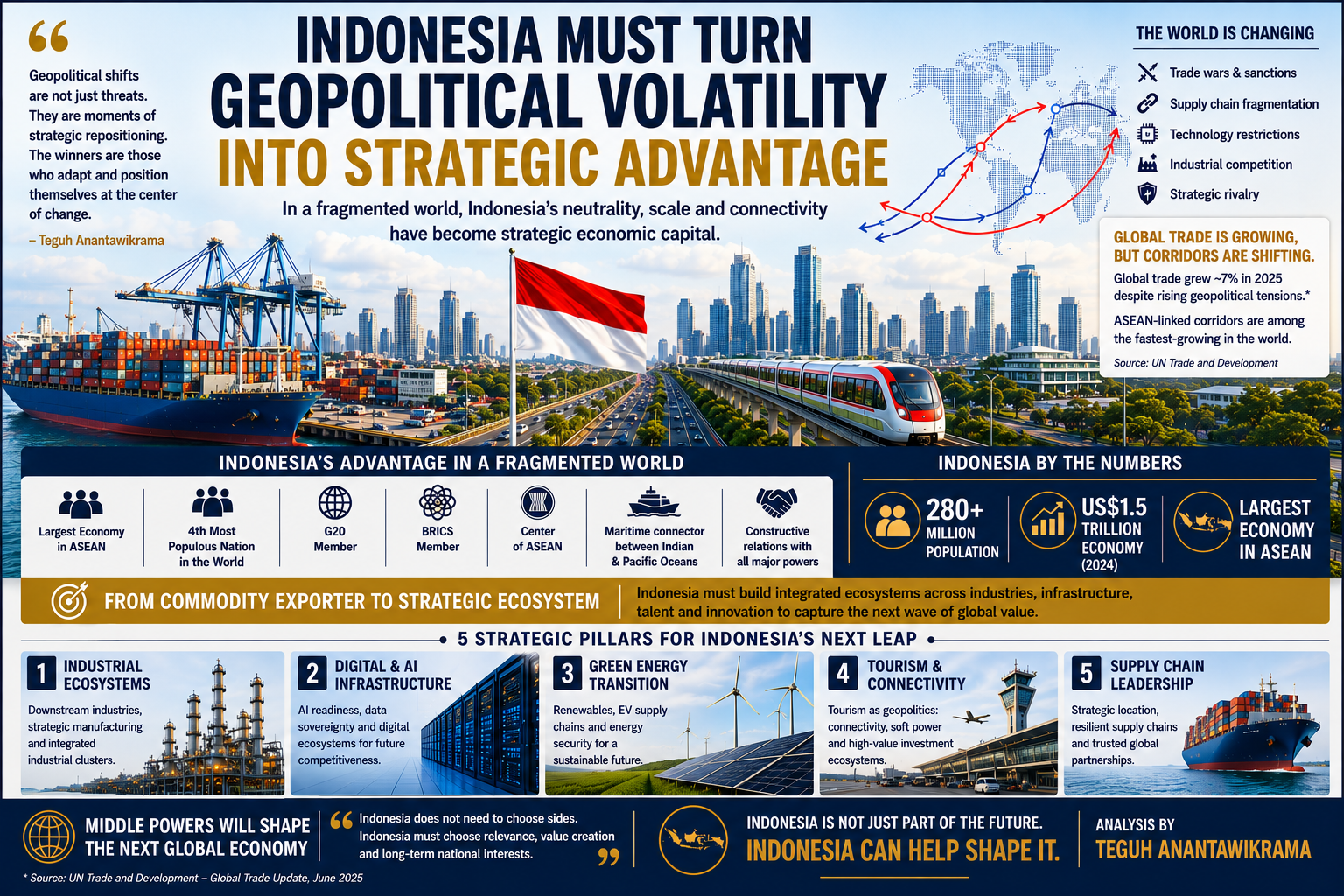
By Teguh Anantawikrama
JAKARTA, June 3 – For many countries and corporations, geopolitics today is viewed as a source of instability, uncertainty and risk. Trade wars, sanctions, industrial competition, technology restrictions, supply chain fragmentation and military tensions are reshaping the global economy faster than most policymakers can adapt.
But periods of geopolitical volatility are not merely threats. They are moments of strategic repositioning.
History shows that major shifts in global power create new winners. The countries that succeed are not necessarily the largest or strongest, but those agile enough to reposition themselves within the evolving architecture of global trade, investment, technology and diplomacy.
Indonesia is one of those countries.
Today, the world is entering a new economic era in which globalisation is no longer driven solely by efficiency and low costs. Nations and corporations increasingly prioritise resilience, trusted partnerships, supply chain diversification, food security, energy security, digital sovereignty and strategic neutrality.
This transformation presents a historic opportunity for Indonesia.
A recent McKinsey analysis estimates that by 2035, approximately US$14 trillion in global trade value could shift depending on how geopolitical trade corridors evolve. The question is simple: will Indonesia merely observe this shift, or position itself at its centre?
Indonesia must choose the second path.
Indonesia’s Advantage in a Fragmented World
Unlike many countries trapped within rigid geopolitical blocs, Indonesia possesses several strategic advantages simultaneously.
It is the largest economy in Southeast Asia, the fourth most populous nation in the world, a member of the G20 and BRICS, the centre of ASEAN, a maritime connector between the Indian and Pacific Oceans, and one of the few countries capable of maintaining constructive relations with all major powers.
In an increasingly polarised world, strategic neutrality is becoming economic capital.
Indonesia’s geopolitical position is therefore no longer merely a diplomatic asset. It is becoming an economic advantage.
As global corporations diversify supply chains away from concentration risks, they are searching for stable middle powers capable of serving as trusted production, logistics, digital and investment hubs. Indonesia naturally fits that role.
Global trade itself is not slowing. It is simply changing direction.
According to UN Trade and Development data, global trade grew by around seven per cent in 2025 despite rising geopolitical tensions. What changed was not the volume of trade, but the corridors through which it flowed.
This matters enormously for Indonesia.
ASEAN-linked trade corridors are now among the fastest-growing in the world. Supply chains are being reorganised around Southeast Asia as companies seek resilience and geopolitical balance. Indonesia should not view itself merely as a market within ASEAN. It must position itself as ASEAN’s strategic anchor.
From Commodity Exporter to Strategic Ecosystem
For decades, Indonesia was often viewed simply as a commodity supplier.
That era must end.
The future belongs to countries capable of building integrated strategic ecosystems.
Indonesia must move simultaneously across downstream industries, renewable energy, EV supply chains, AI infrastructure, food security, the digital economy, sovereign data ecosystems, tourism investment and strategic manufacturing.
The world has entered a new industrial-policy era. Governments are competing aggressively to attract strategic industries through incentives, infrastructure investment and regulatory alignment.
Indonesia cannot remain passive while this competition intensifies.
Its downstream mineral strategy has already demonstrated that the country can shape global industrial behaviour when resources are combined with political determination. The next step is to expand this strategy into integrated industrial ecosystems connected to logistics, tourism, digital infrastructure, education and green energy.
Tourism Is Also Geopolitics
Tourism is often underestimated as merely a hospitality and leisure industry.
In reality, tourism has become deeply geopolitical.
It influences international connectivity, infrastructure investment, aviation corridors, cultural influence, soft power, foreign exchange resilience and regional economic equality.
As geopolitical fragmentation increases, countries capable of offering stability, openness, sustainability and cultural trust will become preferred destinations not only for travellers, but also for investors.
Indonesia possesses extraordinary advantages, including natural beauty, cultural diversity, demographic strength, geopolitical neutrality and strategic geographic positioning.
However, Indonesia must stop promoting tourism solely as destinations. Tourism should be packaged as part of a broader investment ecosystem.
Future tourism investors no longer focus only on hotels and resorts. They evaluate logistics, energy reliability, digital infrastructure, sustainability, healthcare systems, local supply chains, ESG compliance, workforce quality and geopolitical resilience.
This is why Indonesia should pursue integrated tourism-economic clusters where infrastructure, SMEs, culture, sustainability, healthcare, food security and digital systems reinforce one another.
Middle Powers Will Shape the Next Global Economy
One of the biggest mistakes smaller nations make is assuming that geopolitical competition benefits only superpowers.
In reality, the rise of middle powers may become one of the defining economic stories of the next decade.
Countries such as Indonesia, India, Saudi Arabia, the United Arab Emirates, Brazil and Vietnam are becoming increasingly important because global investors are seeking diversification and balance.
Indonesia’s BRICS membership reflects this reality. It demonstrates that middle-power nations are no longer passive participants in the global system. They are becoming architects of a more multipolar world.
This creates opportunities for Indonesia to become a supply-chain diversification hub, a digital-economy bridge, a green industrial platform, a halal economic centre, a maritime logistics gateway and a strategic tourism corridor connecting Asia, the Middle East, Africa and Oceania.
Adaptability Is the New Competitive Advantage
The most important lesson from today’s geopolitical environment is simple: adaptability matters more than predictability.
The countries and corporations that thrive will not necessarily be those with the largest resources, but those capable of repositioning quickly as trade flows, technologies and alliances evolve.
Indonesia must therefore build not only infrastructure, but also strategic agility.
This requires faster regulatory adaptation, stronger geopolitical intelligence capabilities, improved investment coordination, digital governance readiness, resilient financial systems and long-term policy consistency.
It also requires deeper collaboration between government, business, academia and civil society because geopolitical competition today is no longer only military or diplomatic. It is economic, technological, industrial, financial and cultural.
Indonesia Must Think Bigger
Too often, Indonesia underestimates its own strategic importance.
The country should stop thinking merely as a domestic market of more than 280 million people. It must think of itself as a regional stabiliser, a geopolitical bridge, a trusted investment platform and a future economic centre of the Indo-Pacific era.
Geopolitical volatility is not temporary. It will shape the coming decades.
But for Indonesia, volatility does not have to become a crisis.
If managed wisely, it can become the country’s greatest strategic advantage.
- TNS NEWS
About the Author
Teguh Anantawikrama is Vice Chairman of the Indonesian Chamber of Commerce and Industry (KADIN), where he oversees initiatives in technology transformation, MSME development and digitalisation. He is also Founder and Chairman of the Indonesia Tourism Investors Club, which advocates greater investment, innovation and value creation across Indonesia’s tourism ecosystem.