


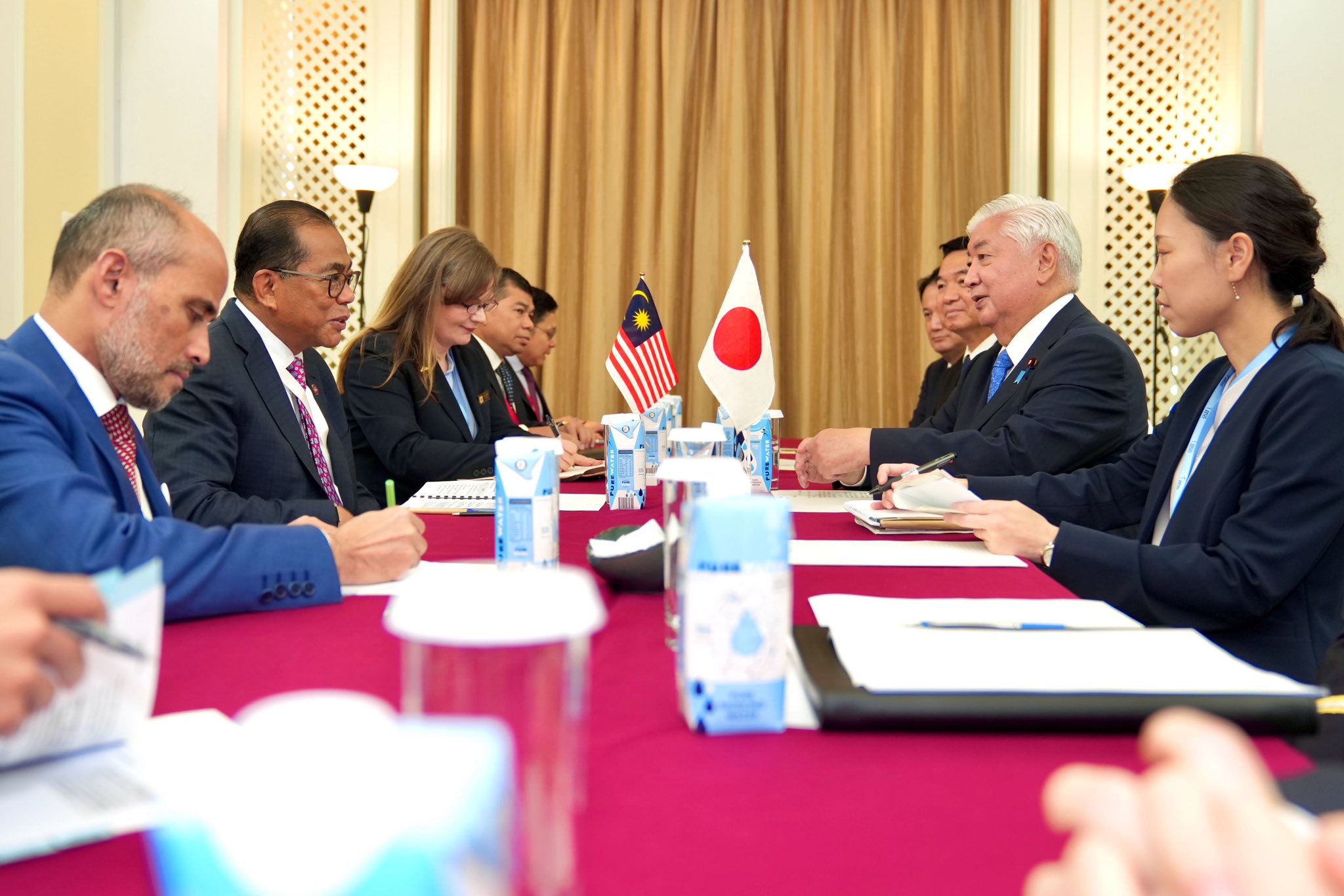

Defence Minister Datuk Seri Mohamed Khaled Nordin (2nd from the left) and Japan’s Defence Minister Gen Nakatani (2nd from the right)
At Shangri-La Dialogue 2025, Malaysia signals balanced diplomacy, deepens Indo-Pacific defence ties, and embraces ASEAN–EU cooperation.
By TENGKU NOOR SHAMSIAH TENGKU ABDULLAH
SINGAPORE, June 5 – At a time when global fault lines are redrawing the contours of regional security, Malaysia’s Defence Minister, Datuk Seri Mohamed Khaled Nordin, has projected a firm but balanced voice at the 22nd edition of the IISS Shangri-La Dialogue. His participation underscored Malaysia’s commitment to multilateralism, strategic autonomy, and deepening defence diplomacy across the Indo-Pacific.
Held annually in Singapore and organised by the International Institute for Strategic Studies (IISS), the Shangri-La Dialogue is the region’s most prominent inter-governmental defence summit. This year’s gathering, from May 30 to June 1, brought together more than 50 national delegations, including heads of government, defence ministers, and military chiefs.

In a historic first, French President Emmanuel Macron delivered the opening keynote—making him the first European leader to do so. His address called for strategic autonomy, the rejection of double standards, and strengthened ASEAN–EU cooperation—principles that closely align with Malaysia’s regional outlook.
Malaysia’s Firm Voice for Balanced Security
Minister Khaled’s core message to the forum was clear: Malaysia supports stability through inclusivity, not alignment.
“Malaysia takes a non-aligned, inclusive approach in its defence diplomacy,” he said. “We firmly reject the logic of bloc politics and spheres of influence.”

The message echoed Prime Minister Datuk Seri Anwar Ibrahim’s Special Address, in which he stressed ASEAN’s role as a platform for cooperation amid intensifying global competition. Anwar focused on regional resilience, sustainability, and employment generation, while highlighting ASEAN’s cautious stance on the South China Sea and Myanmar crises.
Strengthening Ties Across the Strategic Map
Minister Khaled used the sidelines of the Dialogue to strengthen Malaysia’s defence relationships through high-level bilateral meetings with counterparts from France, Japan, Australia, the United States, Sweden, Ukraine, and Singapore.

In talks with French Armed Forces Minister Sébastien Lecornu, both sides reaffirmed their commitment to enhancing defence industrial collaboration. The meeting built on Khaled’s March 2025 visit aboard the French Navy’s flagship aircraft carrier Charles de Gaulle when it passed through Malaysian waters.

In another key engagement, Khaled met Japan’s Defence Minister Gen Nakatani for their first official bilateral meeting. Japan committed continued support under its Official Security Assistance (OSA) programme—part of a broader defence partnership with ASEAN.
“Japan plays a key role in supporting our humanitarian and military readiness, particularly through HADR programs and capability-building efforts,” Khaled noted.

Khaled also met Australian Defence Minister and Deputy Prime Minister Richard Marles, congratulating him on his recent re-election. Their discussion reaffirmed the depth of the Australia–Malaysia relationship under the Five Power Defence Arrangements (FPDA).
“Our partnership with Australia remains both deeply rooted and forward-looking,” said Khaled.
Shaping an ASEAN–Europe Strategic Nexus
President Macron’s call for enhanced ASEAN–EU ties found strong support among European leaders present at the Dialogue. Most notably, Kaja Kallas, the EU High Representative for Foreign Affairs and Security Policy and Vice-President of the European Commission, reinforced Europe’s intent to be “a constructive and consistent partner in the Indo-Pacific.”

Kallas stressed that the EU’s strategic posture in the region is rooted in upholding international law, supporting open sea lanes, and resisting coercion—not in exporting blocs or imposing dominance.
“Europe is here not to impose, but to partner,” she stated, a sentiment that resonated with ASEAN member states like Malaysia.
Minister Khaled welcomed such expressions of parity and mutual respect, noting:
“Malaysia supports a balanced diplomacy that strengthens ASEAN’s engagement with Europe, without compromising our neutrality or coherence.”
The convergence of views among Malaysia, France, and the EU signals growing potential for a multilateral, rules-based security framework in the Indo-Pacific—one that ASEAN can help anchor.

Dialogue, Not Division
Datuk Seri Mohamed Khaled Nordin’s strong showing at the Shangri-La Dialogue confirms Malaysia’s role as a regional stabiliser—one that champions diplomacy, mutual respect, and defence partnerships built on sovereignty, not subservience.
“We must remain open, engaged, and prepared—not just for security threats, but for opportunities that strengthen our sovereignty, resilience, and unity,” he concluded.
Conclusion: Malaysia’s Strategic Balance in an Unbalanced World
At a time when global powers are recalibrating their positions and security partnerships are being tested, Malaysia—under the stewardship of Defence Minister Khaled Nordin—is charting a path grounded in realism, engagement, and regional solidarity.

Rather than aligning with competing blocs, Malaysia is doubling down on inclusive defence diplomacy, strengthening bilateral ties while upholding ASEAN centrality. The minister’s engagements at Shangri-La Dialogue 2025 not only affirmed Malaysia’s strategic maturity but also positioned the country as a credible voice for balance, sovereignty, and cooperation in an increasingly polarised Indo-Pacific.
As the geopolitical temperature rises, Malaysia’s message is clear: security must be pursued through partnership, not pressure—and regional stability depends not on power projection, but on shared purpose.
- TNS News
Image credits to Khaled Nordin FB and Malaysia’s Ministry of Defence