


PM Anwar urges Arab–Islamic world to move beyond rhetoric,
calling for suspension of ties and trade with Israel.

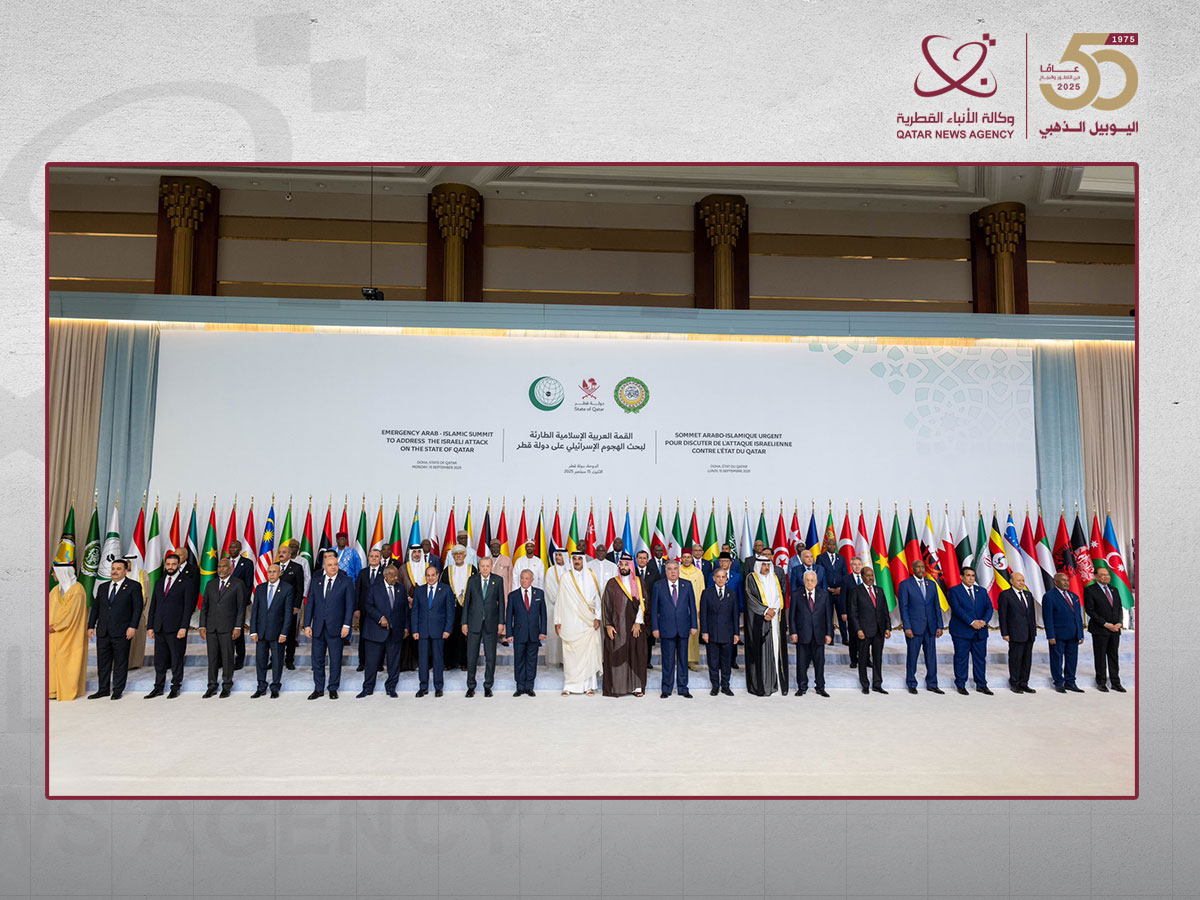
United front in Doha. Leaders of Arab & Islamic nations stand together against the Israeli strike on Qatar, reaffirming support for Palestine.
By TNS News Team
DOHA, Sept 19 — The Emergency Arab–Islamic Summit convened in Doha on 15 September 2025 brought together leaders and representatives from the Arab League and the Organisation of Islamic Cooperation (OIC) to condemn the Israeli strike on Qatar. While the final communiqué reaffirmed solidarity and collective positions, Malaysia’s Prime Minister Datuk Seri Anwar Ibrahim delivered one of the strongest addresses, urging Muslim nations to move beyond words and adopt tangible measures.
The summit followed the 9 September Israeli airstrike in Doha’s Leqtaifiya district that killed six people — five Hamas officials and a Qatari security officer — in a residential area home to embassies and schools. The attack came as Qatar was actively mediating ceasefire talks between Israel and Hamas. Qatar denounced the strike as “barbaric” and “state terrorism,” while the UN Security Council, with unusual support from the United States, condemned the violation of sovereignty.
In his statement at the summit, Anwar condemned the attack on Doha “in the strongest and most unequivocal terms,” describing it as “lawless, barbaric and indefensible.” He declared:
“To rain bombs on the capital of a sovereign state is an assault on Qatar’s sovereignty, a violation of international law, and a reckless provocation that endangers the security of the region.”
He stressed that striking Qatar, given its mediator role, was “to blatantly sabotage those very efforts for peace” and warned that the attack must be regarded as “an assault against us all.”
Anwar broadened his remarks to highlight the wider pattern of Israeli aggression: “Gaza continues to be crushed before our very eyes… families wiped out, hospitals reduced to ruins, children buried under rubble.” He noted that violence had spread to Lebanon, Syria, Yemen, Iraq and even Iran, describing it as “utter contempt for the very foundations of civilisation and international order.”
He also pointed to Israel’s outright rejection of Palestinian statehood, calling it “a declaration of permanent apartheid” and “a repudiation of every UN resolution and the right of self-determination.”
In a call to action, Anwar pressed his peers:
“Our people have become weary of words. They have watched us issue condemnation after condemnation, declaration after declaration, while Israel escalates with impunity… Condemnations will not stop the missiles. Declarations will not free Palestine. Severe punitive actions must be put in place. Diplomatic engagements must cease and so must trade relations.”
He further underscored the humanitarian dimension, referencing the flotilla sailing toward Gaza: “It is a mission of mercy, and we must do all in our power to see that it reaches its shore. To let it be turned back with violence is to betray the charge that our conscience have placed upon us: to defend the weak, to shelter the oppressed, to give food to the hungry.”
On the sidelines of the summit, Anwar also held brief discussions with the Crown Prince of Saudi Arabia, the President of Türkiye, the King of Jordan, the Prime Minister of Pakistan and the Crown Prince of Kuwait, focusing on unity in defending Qatar’s sovereignty and advancing the Palestinian cause.

The summit’s final communiqué condemned Israel’s “blatant aggression” in the strongest terms, reaffirmed support for Qatar and its mediation role, and called for adherence to international law and the UN Charter. The Gulf Cooperation Council pledged to activate its collective defense mechanism, with military consultations planned under its Unified Military Command in Doha.
Several states, including Türkiye and Pakistan, advocated economic and legal measures, from international court action to broader boycotts. Yet the communiqué stopped short of imposing sanctions or cutting ties, highlighting the gap between rhetoric and concrete action.
For Malaysia, however, the summit provided a powerful platform. Anwar’s uncompromising tone reflected Kuala Lumpur’s determination to press for accountability and link solidarity with Qatar to the broader Palestinian struggle. His intervention also captured the impatience of Muslim populations worldwide who see endless condemnations as insufficient in the face of continuing violence.
The Doha summit may be remembered less for the measures it enacted than for the shift it represented: a region increasingly unwilling to tolerate assaults on sovereignty and mediation efforts. Whether leaders follow through will determine if this moment marks a turning point — or another cycle of words without action.
– TNS NEWS