


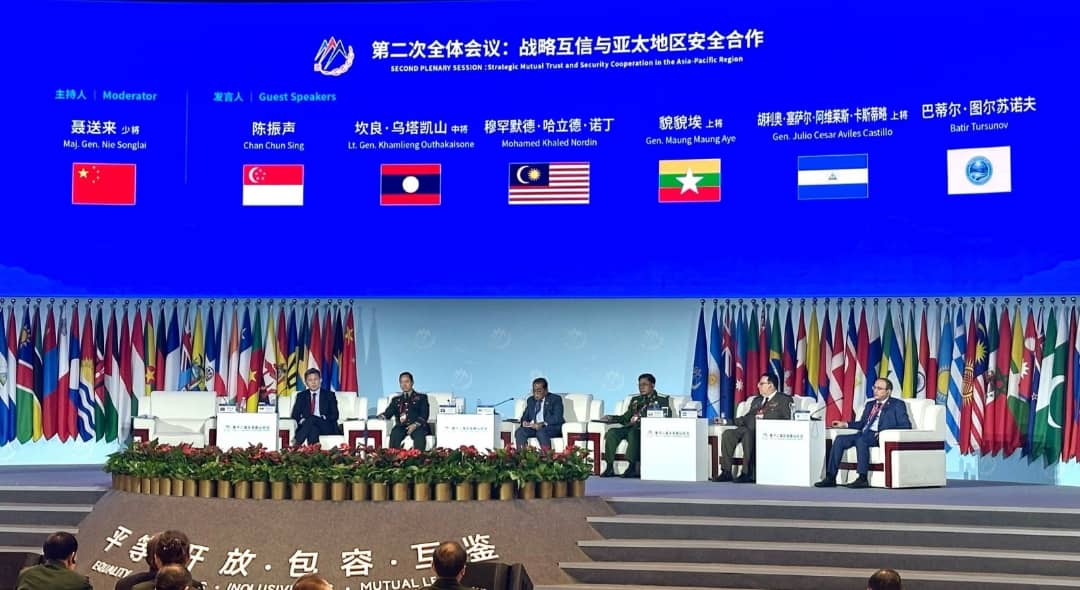

Defence Minister Datuk Seri Mohamed Khaled Nordin at the 2nd Plenary Session of the 12th Beijing Xiangshan Forum
By TENGKU NOOR SHAMSIAH TENGKU ABDULLAH
Beijing, Sept 20 – Malaysia’s Defence Minister Datuk Seri Mohamed Khaled Nordin has called for stronger ASEAN unity and respect for international law in navigating Asia-Pacific security challenges, during his maiden official visit to China as Defence Minister.
Khaled, who arrived in Beijing earlier this week for a four-day working visit, addressed the 2nd Plenary Session of the 12th Beijing Xiangshan Forum, themed “Strategic Mutual Trust and Security Cooperation in the Asia-Pacific Region.” The high-level forum gathered leaders and delegations from over 100 countries under the banner “Upholding International Order and Promoting Peaceful Development Together.”

Defence Datuk Seri Mohamed Khaled Nordin (Second from the right)
South China Sea: A Global Artery
In his speech, Khaled underscored the South China Sea’s critical role as a maritime lifeline for global trade and prosperity.
“Our shared security, regional and global, depends on keeping these sea lanes free, open and secure. Any action that can be detrimental or disruptive in the South China Sea must be avoided,” he said.
He reiterated Malaysia’s position that the 1982 United Nations Convention on the Law of the Sea (UNCLOS) must remain the “compass” for managing maritime disputes and safeguarding freedom of navigation.
ASEAN’s Three Security Principles
As ASEAN Chair in 2025, Malaysia framed regional security through ASEAN’s collective lens. Khaled outlined three guiding principles:
- Collective Security – Platforms such as the ASEAN Defence Ministers’ Meeting (ADMM) and ADMM-Plus should be the primary drivers of confidence-building and cooperation, keeping ASEAN at the heart of regional security.
- Strengthening Solidarity – Unity must be continuously reinforced through joint exercises, exchanges, and peaceful mediation, including efforts to address Myanmar’s ongoing crisis and guide Timor-Leste toward full ASEAN membership.
- Openness and Honesty – Trust must be built on frank and transparent dialogue, not empty rhetoric.
“Lasting trust cannot be built on jargon. ASEAN will continue to engage with sincerity and clarity so that cooperation can truly flourish,” Khaled stressed.
Beyond Defence: Shared Challenges
Khaled linked regional stability to wider global issues, from climate change and pandemics to food security and the digital economy. These, he argued, provide new grounds for building trust and cooperation beyond traditional defence concerns.
“Only collective problem-solving, inclusive rule-making and ASEAN’s neutrality can preserve autonomy and balance in the Asia-Pacific,” he said, urging countries to strengthen multilateralism while preserving ASEAN centrality.
Bilateral & Industrial Engagements in Beijing
Khaled’s working visit to China included a series of high-level bilateral meetings and industrial engagements across four days.

Defence Datuk Seri Mohamed Khaled Nordin made a courtesy call on Chen Ximing, Chairman of China Aerospace Science and Industry Corporation (CASIC)
On Sept 15, he paid a courtesy call on Chen Ximing, Chairman of China Aerospace Science and Industry Corporation (CASIC) at the group’s Beijing headquarters. CASIC, a state-owned enterprise and one of China’s leading defence players in rocketry, missile systems, air defence, satellites and space technology, discussed strengthening cooperation with Malaysia’s defence sector. Khaled noted that such collaboration could enrich Malaysia’s defence ecosystem and benefit the wider industry.

The following day, Sept 16, the minister visited Sinovac Biotech in Daxing, Beijing. Since 2019, Sinovac has partnered with Pharmaniaga Berhad, a subsidiary of Malaysia’s Armed Forces Fund Board (LTAT). Khaled highlighted that this strategic partnership not only bolstered Pharmaniaga’s role but also created value for LTAT and Malaysia’s armed forces veterans through dividends and long-term healthcare resilience. He underscored that preparedness must include facing non-traditional threats such as health crises, alongside military readiness.

On Sept 17, Khaled held a bilateral meeting with Admiral Dong Jun, China’s Minister of National Defence, at the Military Museum of the Chinese People’s Revolution in Beijing. The talks were described as cordial and constructive, reaffirming the long-standing defence and diplomatic relations between Malaysia and China. Both sides agreed that today’s global security challenges can only be met through closer cooperation, inclusive international governance, and a joint commitment to maintaining peace and stability.

On the same day, Khaled also met Pei Jinjia, China’s Minister of Veterans Affairs, where both sides exchanged experiences on strengthening veteran support systems. Malaysia and China agreed to enhance existing cooperation in veteran affairs for the benefit of military veterans in both countries.
Finally, on Sept 18, Khaled attended the Opening Ceremony of the 12th Beijing Xiangshan Forum, officiated by Admiral Dong Jun. In his remarks, Dong stressed the importance of global governance and cooperation as the foundation for peace and common development, while also highlighting current challenges such as instability and external interference. Malaysia echoed these views, reaffirming that peace and stability must be reinforced through dialogue, respect for sovereignty, and collective commitment to tackling global security challenges.
In addition to these meetings, Khaled also visited CPMIEC (China Precision Machinery Import-Export Corporation), a subsidiary under CASIC, to assess its defence and missile-related technologies. Local media also reported that he witnessed the signing of a memorandum of understanding involving Boustead Holdings Berhad and Chinese partners, further underlining the industrial and technological dimension of Malaysia-China defence cooperation.
Malaysia’s Defence Priorities in Line with ASEAN
Khaled emphasised that Malaysia’s Defence White Paper is fully aligned with ASEAN’s broader vision for peace and stability.
“Together, we will build a region of peace, stability and shared prosperity as one ASEAN. This is our duty, our responsibility, and our calling,” he concluded.
Significance of the Visit
Khaled’s first visit to China as Defence Minister balanced engagement with a major power and reaffirmation of ASEAN centrality. By placing ASEAN at the heart of his message, Malaysia signalled its intent to steer regional security debates towards dialogue, inclusivity, and a rules-based order during its ASEAN chairmanship.
- TNS NEWS