


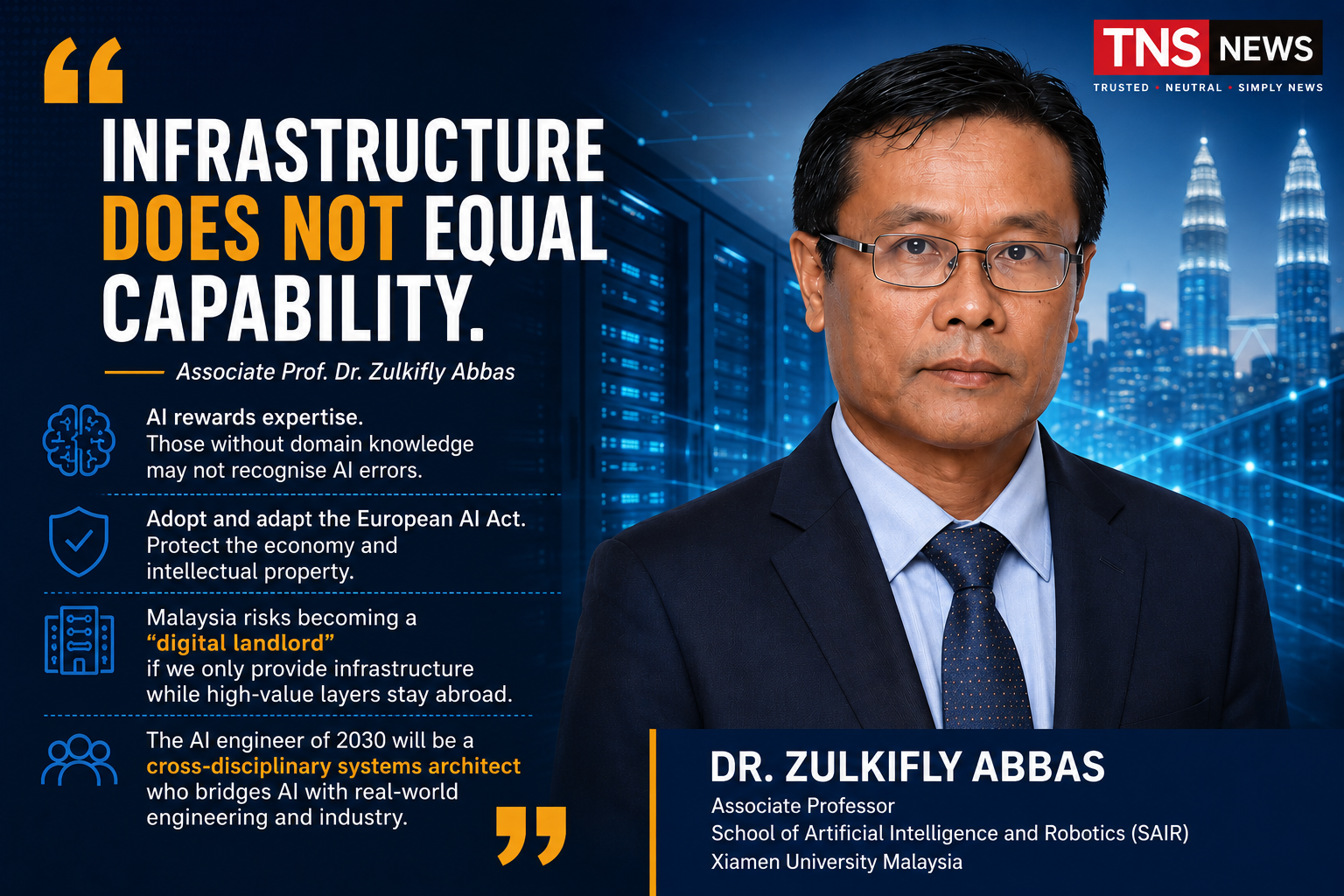
Dr. Zulkifly Abbas says AI benefits experts most, urges stronger focus on talent, intellectual property and local innovation rather than data centre investments alone
BY TENGKU NOOR SHAMSIAH TENGKU ABDULLAH
KUALA LUMPUR, June 5 — Artificial intelligence is most useful to people who already possess deep expertise in their respective fields, while those lacking such mastery may struggle to recognise errors generated by AI systems, according to Dr. Zulkifly Abbas, Associate Professor of Electrical and Electronics Engineering at the School of Artificial Intelligence and Robotics (SAIR), Xiamen University Malaysia (XMUM).
As governments and businesses race to adopt AI technologies, Dr. Zulkifly cautioned against viewing AI as a replacement for knowledge and critical thinking.
“AI is actually only useful to people who already have mastery over their respective fields,” he told TNS News.
“Those without this mastery cannot clearly distinguish the errors in AI-generated answers. For those who already have knowledge in their fields, AI accelerates their work.”
According to him, AI functions best as a productivity tool that enhances human expertise rather than replaces it.
“The more knowledgeable a person is in a subject, the more effective AI becomes. Without that foundation, there is a risk of accepting inaccurate information without realising it,” he said.
Focus on Intellectual Property, Not AI Politics
On AI governance, Dr. Zulkifly said Malaysia does not need to spend years developing an entirely new regulatory framework.
“The government only needs to adapt and slightly modify the European AI Act for Malaysia’s needs,” he said.
However, he stressed that policymakers should avoid becoming overly preoccupied with AI-related political narratives while neglecting broader economic priorities.
“The government must not get too busy with AI matters for political purposes. What is more important is the economy.”
A key priority, he said, should be protecting intellectual property (IP).
“We must ensure companies do not use AI to copy intellectual property because this could lead to legal issues.”
He warned that government agencies should also ensure AI-generated content used in project proposals does not inadvertently incorporate protected material belonging to third parties.
Similarly, Malaysian electronics companies should avoid using AI tools to replicate or plagiarise integrated circuit (IC) designs when developing new semiconductor products.
“Countries in the European Union already have AI regulations that place strong emphasis on intellectual property protection and safeguarding their economies. Malaysia cannot afford to ignore these issues.”
Risk of Becoming a Digital Landlord
Despite attracting billions of ringgit in data centre investments, Dr. Zulkifly said Malaysia risks remaining a provider of infrastructure rather than a creator of technology.
“Malaysia is currently building high-tech real estate for other nations’ artificial intelligence,” he said.
While local companies participate in construction, engineering, power distribution and facility management, the most valuable elements of the AI ecosystem remain largely imported.
“The high-value layers, including AI chips, large language models, specialised software and advanced AI systems, are still controlled by foreign companies.”
Without stronger domestic participation in these areas, Malaysia risks becoming what he describes as a “digital landlord” — hosting infrastructure while capturing only a small portion of the economic value created.
To change this, he believes Malaysia should secure greater access to computing resources from global technology companies operating within the country.
“Malaysia should not simply host AI infrastructure. Local universities, researchers and software companies should also have access to some of the computing power being deployed here.”
Such an approach, he said, would help develop local capabilities and support the growth of a domestic AI ecosystem.
Infrastructure Alone Will Not Create an AI Nation
For Dr. Zulkifly, one misconception continues to dominate discussions on AI development.
“If there is one fundamental reality policymakers must understand, it is this: infrastructure does not equal capability.”
He said data centres, power capacity and physical infrastructure are important enablers, but they do not automatically create technological leadership.
“Real value is generated through applications, intellectual property, proprietary models and highly skilled engineers.”
As a result, he believes Malaysia should measure success not merely by the number of data centres built or the amount of foreign investment secured, but by indicators such as domestic patents, locally developed AI systems and the retention of highly skilled talent.
“We should stop measuring success solely through the number of data centres built or the volume of investment announced. What matters is whether we are creating our own technology, talent and intellectual property.”
Talent and Technical Challenges
Dr. Zulkifly also highlighted a growing shortage of specialised expertise needed to support advanced AI infrastructure.
Modern AI data centres increasingly rely on sophisticated liquid-cooling systems that require knowledge in thermodynamics, fluid dynamics and chemical engineering.
“The installation of advanced hardware is progressing faster than the development of local operational expertise.”
As a result, many facilities continue to depend heavily on foreign specialists for maintenance, troubleshooting and system optimisation.
“This creates a situation where the hardware is here, but the deeper operational knowledge still resides elsewhere.”
He also pointed to technical challenges facing the national power grid as more high-density data centres come online.
“The real concern is not just electricity supply but power quality.”
Large AI facilities consume enormous amounts of power and can place additional strain on electrical infrastructure if not properly managed.
“When many of these facilities are concentrated in areas such as Johor and Cyberjaya, careful planning becomes essential to ensure grid stability and reliability.”
Bridging the Graduate Readiness Gap
Dr. Zulkifly said Malaysia’s universities are producing graduates with strong theoretical foundations, but industry increasingly requires professionals capable of deploying AI solutions in real-world environments.
“Universities traditionally focus on mathematical foundations, algorithm development and simulation environments, while industry needs engineers who can work with messy real-world data, deploy AI systems and integrate them into existing operational environments,” he said.
According to him, one of the biggest challenges facing the industry is the gap between academic training and production-grade engineering.
Companies today require professionals who can build Machine Learning Operations (MLOps) pipelines, integrate AI systems with legacy infrastructure, and deploy solutions efficiently under real-world constraints.
Dr. Zulkifly said XMUM’s School of Artificial Intelligence and Robotics is working to address this challenge by combining software development with practical exposure to robotics, embedded systems and edge-computing applications.
“Students do not just develop algorithms. They also learn how to deploy AI solutions on physical platforms and industrial systems,” he said.
This hands-on approach helps prepare graduates to become system architects capable of designing end-to-end solutions rather than merely writing code.
Building Capabilities, Not Chasing Scale
While welcoming government efforts to support AI development, Dr. Zulkifly said Malaysia should focus on developing specialised strengths rather than attempting to compete directly with global technology giants.
“A single state-of-the-art AI computing cluster can consume billions of ringgit in hardware costs alone.”
Instead, he believes Malaysia should prioritise smaller, highly efficient AI models tailored for Bahasa Melayu, local dialects, regional regulatory requirements and Southeast Asian business needs.
“True AI sovereignty does not mean trying to outspend the world’s largest technology companies. It means developing capabilities that are uniquely relevant to Malaysia and the region.”
He added that Malaysia should focus on areas where it can build competitive advantages rather than attempting to replicate the scale of global technology leaders.
The Risk of an Asymmetric Data Drain
Dr. Zulkifly also warned of what he described as an “asymmetric data drain”, where valuable data generated in Malaysia ultimately creates economic value elsewhere.
“Malaysia risks exporting its raw digital resources and then buying them back in the form of expensive foreign software and services.”
He described this as a modern digital equivalent of exporting raw commodities while importing higher-value finished products.
To address this, he called for stronger collaboration between global technology firms and Malaysian institutions, greater support for local AI innovation, and policies that ensure more value generated from domestic data remains within the country.
Among the measures he suggested are stronger local-content requirements, joint research and development initiatives, and mechanisms that channel benefits from Malaysia’s growing digital economy into local talent and innovation.
The AI Engineer of 2030
Looking ahead, Dr. Zulkifly believes routine coding tasks will increasingly be automated by generative AI tools.
The professionals most in demand, he said, will be those capable of combining AI expertise with deep knowledge of engineering, manufacturing, healthcare, energy and industrial systems.
“The successful AI engineer of 2030 will be a cross-disciplinary systems architect.”
These professionals must understand both advanced machine learning and real-world operational environments.
“Malaysia is currently not producing enough of these individuals. Our educational system remains too siloed.”
Universities, industry and policymakers, he said, must work together to produce graduates who can integrate AI into practical applications rather than simply develop software in isolation.
Focus on Capability, Not Concrete
Ultimately, Dr. Zulkifly said Malaysia’s success in AI will depend less on the number of data centres it builds and more on its ability to develop talent, intellectual property and homegrown innovation.
The country’s challenge is not attracting infrastructure investment, but ensuring that such investments translate into meaningful domestic capabilities.
“Digital value is created at the top of the technology stack,” he said.
“Infrastructure is important, but infrastructure alone does not make a country an AI powerhouse.”
For policymakers, he added, the message is straightforward:
“Infrastructure does not equal capability.”
- TNS NEWS
Disclaimer: The views and opinions expressed in this article are solely those of Dr. Zulkifly Abbas and do not necessarily reflect the views or positions of Xiamen University Malaysia.