


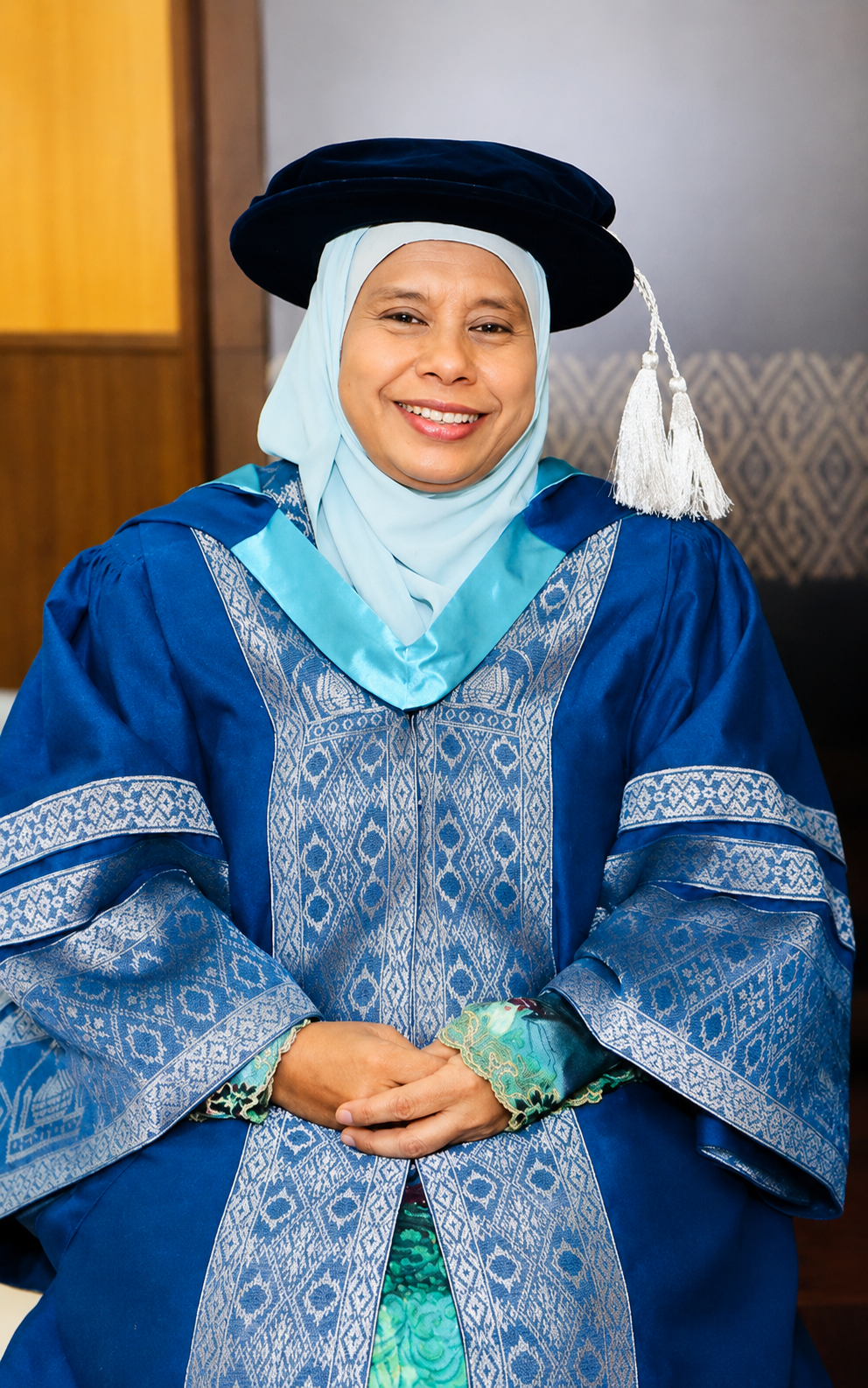
Professor Emerita Dato’ Dr Roshada Hashim reflects on fish farming, academic leadership, university reform and why higher education risks losing its soul when metrics become more important than meaning.
BY TENGKU NOOR SHAMSIAH TENGKU ABDULLAH
She calls herself “The Accidental Academic”, the phrase of someone who drifted into a profession rather than chose it. Spend any time with Professor Emerita Dato’ Dr Roshada Hashim, though, and the word “accidental” begins to read like the modesty of a woman who has, in truth, spent more than three decades making very deliberate choices about what matters.
If anything became accidental and then deliberate, it was the calling itself.
“The turning point for me was realising that academia gave me the rare opportunity to spend my life working on things I genuinely cared about, teaching subjects that interested me and pursuing research that felt meaningful, rather than simply doing work because it was expected of me,” said Prof. Roshada, who currently serves as a Budi Fellow at the Faculty of Science and Technology, Universiti Sains Islam Malaysia (USIM).
That instinct, to chase meaning over expectation, surfaces earliest in an unlikely place: fish. As a young scientist, she could have built a comfortable career around commercially valuable species, the ones that attract grants and good press. She went looking for the underdog instead.
“I think I was always drawn to work that could make a real difference to ordinary people, the underdog,” she says. “I could have focused on commercially valuable fish species, but somehow I found myself more interested in indigenous species that small-scale farmers in Malaysia depended on.”
“At the end of the day we are measured not by what’s in the CV but the impact on others and the integrity with which we conduct ourselves.”

Professor Emerita Dato’ Dr Roshada Hashim says the true measure of an academic is not titles or metrics, but impact, integrity and service to society
A Sungai Petani Childhood
Prof. Roshada was born in Sungai Petani, Kedah, on Aug. 20, 1960, the youngest of five children. Hers was, by her own account, an ordinary schooling, attending what she describes as “normal” schools rather than the residential institutions that groom much of Malaysia’s elite. That changed when she was selected for secondary school in Alor Setar, before frequent illness brought her home to complete her education in Sungai Petani.
Home was modest but secure. Her father, a Chief Clerk at the Health Office, was “a very gentle and loving man”; her mother, a Nursing Sister, was the family disciplinarian. Neither was wealthy, but both prized education, especially her mother.
“My mother, especially, constantly reminded us that education could change our future. I was the only one among my siblings to eventually go to university, and I think that meant a great deal to her,” Prof. Roshada recalls.
The lesson stuck, but not as ambition for its own sake.
“It taught me that education was not simply about getting qualifications, but about improving oneself. Somehow, I loved teaching even from a very young age.”
She also took from her parents a quieter inheritance.
“From them, I learnt the true meaning of marriage, not just loving one another, but treating each other with respect, patience and dignity even during difficult times,” she says.
From Biochemistry to Fish Ponds
Prof. Roshada read for both her first degree and her doctorate at the University of Salford in the United Kingdom, training as a clinical biochemist. Early in her career, she made a quiet pivot into fish nutrition, a move that would define everything that followed.
Across a 34-year academic career spanning 1986 to her retirement in 2020, she spent 27 years at Universiti Sains Malaysia (USM) before moving to Universiti Sains Islam Malaysia (USIM) in 2013, where she served until retirement.
She established and led USM’s Aquaculture Research Group from 2006, graduated 11 PhD and 15 Master’s students, and secured more than RM8 million across over 20 research grants. She has published more than 70 papers, holds an H-index of 24 and has written five books.
In 2012, her research group commercialised the Portable Canvas Tank system for fish production, a low-cost concept still used by Malaysian fish farmers today.
But the figures, she would be the first to insist, are not the point.
Her work concentrated on feed products with low environmental impact and on outreach to small-scale producers, an agenda she ties explicitly to the United Nations Sustainable Development Goals on poverty, hunger and life below water. The fish were always a means to a more human end: the livelihoods of rural communities.
“I could have focused on commercially valuable fish species, but somehow I found myself more interested in indigenous species that small-scale farmers in Malaysia depended on.”
A University with a Soul
If aquaculture gave Prof. Roshada her science, leadership gave her a cause.
At USM she served as Dean of the Institute of Postgraduate Studies and chaired the Malaysian Council of Postgraduate Deans. At USIM she became Founding Director of USIM Alamiyyah, launching Internationalisation@Home and the Global Islamic School Network, before her appointment in December 2016 as Deputy Vice-Chancellor for Research and Innovation.
It was there that she pressed her most distinctive idea: that a university’s research could be measured against the Maqasid Shariah, the higher objectives of Islamic law, and not metrics alone.
Under her watch, USIM built a research audit instrument incorporating those elements, established the country’s first Open Access Policy at a public university, and set up a centre to drive the sustainability agenda on campus.
Ask her what makes a true academic and the leader and scientist answer together.
“Being an academic is not about titles or evaluation metrics, what more KPIs, although these are important,” she says.
“A true academic must remain curious, continue learning and use their knowledge beyond the boundaries of their institution.”
The reward, for her, has always been concrete.
“I get a lot of satisfaction when I see a student grasping difficult concepts in biochemistry or when I am able to help a fish farmer.”
And then the line that could serve as her epitaph:
“At the end of the day we are measured not by what’s in the CV but the impact on others and the integrity with which we conduct ourselves.”
The Straitjacket
For all her institutional success, Prof. Roshada is unsparing about the direction of travel.
The freedoms she enjoyed as a young academic, to decide what to teach, what to research and how to contribute, have, she argues, narrowed into something more confined. She reaches for the image of a “straitjacket” of regulations, rankings and administrative demands.
Has modern academia become too KPI-driven, at the expense of curiosity and humanity?
Her answer is a single word:
“Definitely.”
The problem, as she frames it, is not measurement itself but its dominance.
“The challenge is not to abandon KPIs, but to ensure that they serve the mission of a university rather than define it.”
The cost, she fears, is something harder to quantify.
“Some universities may have slowly lost part of their academic soul and sense of purpose,” she says.
Research funding spread too thinly across small projects, she adds, makes it difficult to build the long-term programmes that produce real impact, while younger academics are asked to publish, win grants, teach and administer almost from the day they arrive.
On the perennial promise of university-industry collaboration, she is equally direct, diagnosing a “misalignment between the universities’ goals and those of industry”: research takes time, industry wants speed, and Malaysian firms, largely end-users rather than developers, rarely invest in or properly reward the work universities do.
What She Would Change
Pressed on the one reform she would make immediately, Prof. Roshada chooses the hardest.
She would, she says, “make higher education independent of politics so that the appointments of university leaders and senior management are driven by intellectual leadership, academic maturity, and the long-term interests of the university rather than politics, personalities, or short-term agendas.”
It is, she believes, the single change that would most profoundly reshape Malaysian academia.
Retirement has not dulled the concern.
What keeps her intellectually engaged now, she says, are two anxieties that have outlived her job titles: “the future of higher education in Malaysia and the other is the state of food production for food security.”
She still reads, thinks and writes about academia, aquaculture and the society both are meant to serve.
The Measure of a Life
For someone with a 34-year ledger of grants, papers and titles, Prof. Roshada is strikingly uninterested in monuments.
“I am not looking at a legacy per se,” she says.
“I am contented to see how successful my former students are and that my research work has had some impact not only in Malaysian aquaculture but also in other developing countries.”
“Some of my former students are now Vice-Chancellors and top researchers in their respective countries,” she says, proof, she suggests, of the “intangible training” that never appears on a transcript.
Her advice to the young academics she still mentors carries the same conviction that meaning must precede metrics.
“If you genuinely have the passion for academia, then you have already come a long way,” she says.
But a career in academia is a long journey, and remaining in it “requires a conscious effort to grow into the role; it is beyond fulfilling KPIs, not just in expertise, but in the values, discipline and sense of responsibility that come with being an academic.”
It is a philosophy she has carried since Sungai Petani, and one she sums up in a single sentence that doubles as a life motto:
“Challenge yourself and make good things happen without hurting others.”
The accident, it turns out, was no accident at all.
- TNS NEWS