


AN ANALYSIS

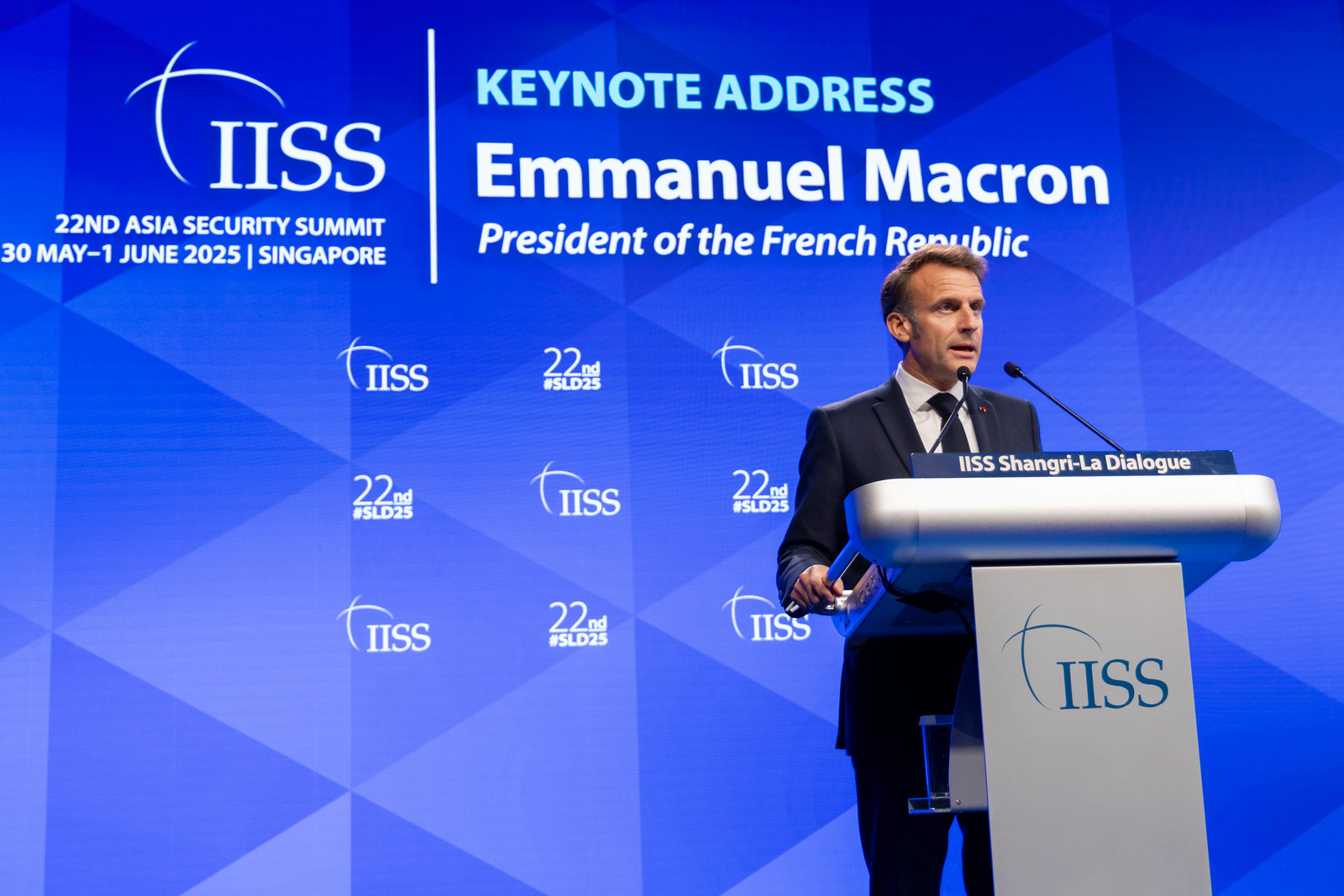
French President Emmanuel Macron delivering a keynote address
The IISS Shangri-La Dialogue 2025 showcased competing visions, deepened European engagement, and ASEAN’s call for unity in a tense Indo-Pacific.
By TENGKU NOOR SHAMSIAH TENGKU ABDULLAH
SINGAPORE, June 3 — The IISS Shangri-La Dialogue 2025 concluded in Singapore last weekend, affirming its place as the Indo-Pacific’s most pivotal strategic forum amidst sharpening geopolitical fault lines.
Held from May 30 to June 1, and hosted by the International Institute for Strategic Studies (IISS), the three-day summit brought together defence ministers, heads of government, military chiefs, and policy experts from over 50 nations. Yet, the event’s undercurrent was unmistakably shaped by what — and who — was missing.
Absence and Presence: China’s Silent Seat, America’s Bold Voice
One of the most talked-about developments was the absence of China’s Defence Minister Dong Jun, making this the first time since 2019 that Beijing has opted not to send its top defence official. Instead, China was represented by Rear-Admiral Hu Gangfeng of the People’s Liberation Army’s National Defence University, signalling a strategic retreat from direct multilateral engagement at a time of rising maritime tension in the South China Sea and Taiwan Strait.

U.S. Defense Secretary Pete Hegseth
In stark contrast, U.S. Defense Secretary Pete Hegseth delivered a forceful opening plenary speech outlining America’s Indo-Pacific vision. Under the banner of “Peace Through Strength”, Hegseth reaffirmed U.S. commitments to its allies, unveiled plans to enhance forward military presence, and called for “open lines of military communication” — a pointed message aimed at Beijing.
“This is the decisive decade for the Indo-Pacific. The United States will not stand by while aggression threatens the freedom and prosperity of this region,” Hegseth said.
His address was both a signal of deterrence and a diplomatic overture — one left unreciprocated by China at this forum.
Macron’s Middle Way: Europe Steps Into the Indo-Pacific
The Dialogue’s keynote address was delivered by French President Emmanuel Macron at the opening dinner. He championed “strategic autonomy”, rejecting the binary logic of U.S.-China rivalry and proposing a third axis of principled, rules-based engagement.
“The rules-based order is not a Western invention — it’s a shared good. If we let it erode in one region, it will collapse in another,” Macron warned.
His speech was a bold assertion of European stakes in Indo-Pacific security, urging both Asian and European partners to build coalitions of sovereignty and reject dependency on any one superpower.
EU’s Emerging Role: Kaja Kallas Calls for Deeper Indo-Pacific Commitment

Kaja Kallas, the EU’s High Representative for Foreign Affairs and Security Policy, reinforced Macron’s message during the second plenary session titled “Ensuring Stability in a Competitive World.”
She warned of maritime coercion in the South China Sea and emphasised Europe’s increasing interdependence with the Indo-Pacific in terms of digital security, energy transition, and maritime trade.
“Europe cannot afford to be passive in the Indo-Pacific. Our prosperity, our resilience, and our democratic values depend on the security of this region,” said Kallas.
Her remarks marked a notable deepening of the EU’s strategic identity in the Indo-Pacific, moving beyond declarations into a framework of concrete partnerships with ASEAN, Japan, and India.
Anwar Ibrahim: ASEAN Must Be More Than a Neutral Actor

In a Special Address, Malaysian Prime Minister Dato’ Seri Anwar Ibrahim delivered a spirited defence of ASEAN centrality, arguing that the bloc must evolve from passive consensus into proactive multilateralism.
“We cannot speak of an Indo-Pacific future without ASEAN at its centre — not as a passive recipient of power plays, but as a co-author of peace, prosperity, and principled multilateralism,” Anwar declared.
As ASEAN Chair for 2025, Malaysia has adopted the theme “Inclusivity and Sustainability”, aligning economic integration, climate action, and security cooperation into a unified framework. Anwar’s message was an implicit call for ASEAN to shed its rigidity and confront emerging challenges with strategic boldness.

Future Threats: Space, Cyber and Undersea Domains Take Centre Stage
The fourth plenary session — “Cyber, Undersea, and Outer-Space Defence Challenges” — brought together defence leaders from New Zealand, France, and Finland. Discussions ranged from subsea cable protection to satellite security and AI-driven cyber defence, areas where international norms remain underdeveloped.
The dialogue highlighted a growing consensus: future Indo-Pacific security threats may emerge not on battlefields, but through fibre-optic cables, orbital constellations, and algorithmic warfare.

Conclusion: Towards a Multipolar Indo-Pacific Order
The Shangri-La Dialogue 2025 laid bare the contours of a rapidly transforming Indo-Pacific — one marked by militarised competition, strategic mistrust, and widening diplomatic asymmetries. Yet amid these tensions, the forum also revealed new poles of agency.
Macron’s “strategic autonomy,” Hegseth’s assertive reassurance, Kallas’s European resolve, and Anwar’s ASEAN realism all point toward a region unwilling to be defined by old binaries. Instead, a new phase of strategic pluralism is taking root — where legitimacy, agility, and cooperation, not just hard power, will determine who shapes the Indo-Pacific’s future.
If this Dialogue achieved anything, it was to reinforce a simple truth: no one country holds the key to Indo-Pacific security. Only through partnerships of purpose can the region chart a stable and inclusive path forward.
- TNS News
Notes: Image credit to IISS flickr