


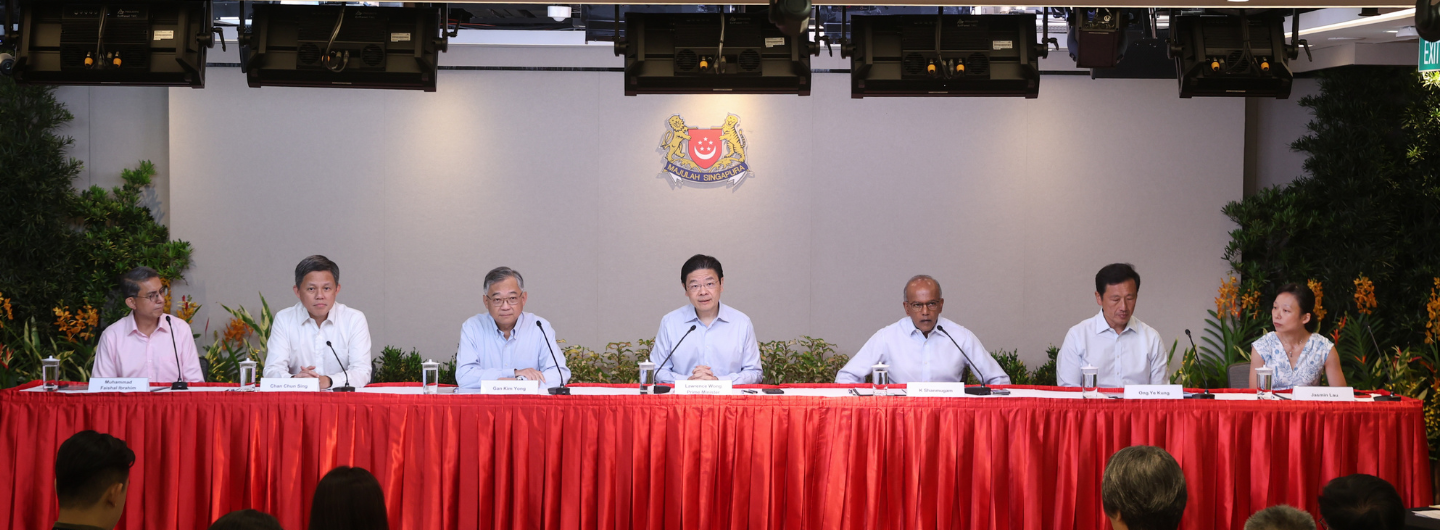

Lawrence Wong’s new Cabinet signals a generational shift, prioritizing policy coherence, future-ready governance, and trust in rising talent. Image credit PMO
By TNS News Analysis Desk
SINGAPORE, May 22, 2025 — With his first full Cabinet line-up following the general election, Lawrence Wong has not only reinforced the People’s Action Party’s (PAP) legacy of methodical leadership transition but also marked a significant pivot toward 4G+ leadership maturity.
His appointments reflect a calculated approach to maintaining continuity in critical portfolios while injecting fresh energy into ministries navigating rapid technological, economic, and social change.
A Coordinated Leadership Core
The most notable structural shift is the appointment of three new Coordinating Ministers — K. Shanmugam (National Security), Chan Chun Sing (Public Services), and Ong Ye Kung (Social Policies). This decentralised yet integrated model mirrors Singapore’s administrative ethos: coordinated governance anchored in domain-specific depth.
Deputy Prime Minister Gan Kim Yong retains economic oversight, but now also steers climate and population policy — an expansion signalling Singapore’s embrace of longer-horizon planning.
This configuration demonstrates Wong’s intent to avoid centralised bottlenecks while ensuring strategic clarity across ministries. It also gives senior leaders operational autonomy while preparing successors through overlapping mentorship.
Retirements Mark the End of an Era
The exit of Heng Swee Keat, Teo Chee Hean, Ng Eng Hen, and Maliki Osman, among others, is both symbolic and substantive. These figures were instrumental in steering Singapore through global crises — from the Global Financial Crisis to COVID-19. Their departure paves the way for a younger, more agile leadership cohort to define the PAP’s next chapter.
Promotion with Purpose
The promotion of Faishal Ibrahim to Acting Minister-in-charge of Muslim Affairs and elevation of new faces like David Neo and Jeffrey Siow reflects confidence in the 4G+ and incoming 5G leadership tier. The Cabinet now boasts one of the largest contingents of new officeholders in recent memory, signalling boldness in renewal.
At the same time, key portfolios such as Finance, Foreign Affairs, Manpower, and Health remain under seasoned ministers. This balance provides policy stability in a volatile global climate while future-proofing governance for emerging challenges — from AI regulation to clean energy and geopolitical realignments.
Wong’s Cabinet line-up marks one of the most significant in recent Singaporean history, balancing experience and renewal, and positioning a new generation of leaders to take on growing responsibilities.
A Future-Focused Agenda
Wong’s government appears squarely focused on executing the Forward Singapore roadmap: economic resilience, climate transition, lifelong learning, digital innovation, and social mobility. New coordinating portfolios, like Public Services and Social Policies, suggest a more integrated approach to citizen experience and social equity.
The line-up also strengthens the state’s capability in emergent domains: Tan See Leng takes charge of Energy and S&T; Josephine Teo steers AI and Smart Nation strategies; Desmond Lee shifts to education to cement the pipeline of future-ready talent.
Conclusion: Technocratic Trust with a Human Touch
If the Lee Hsien Loong era was about managing Singapore’s rise and resilience, the Wong administration seems defined by renewal and recalibration. The Cabinet reflects a team deeply grounded in policy rigour, but increasingly attuned to public engagement and participatory governance.
The message from Wong is clear: Singapore’s stability lies not in resisting change, but in managing it with discipline, foresight, and trust in its next-generation leaders.
- TNS News
TNS News will continue to track policy directions and leadership developments across ASEAN and beyond.