


Operation Epic Fury Enters Week Two
TODAY’S TOP 14 DEVELOPMENTS
As of Monday, 9 March 2026 – The tenth day of Operation Epic Fury.
Iran has named Mojtaba Khamenei, second son of the slain Supreme Leader Ayatollah Ali Khamenei as the Islamic Republic’s new Supreme Leader. Military and political leaders, including President Masoud Pezeshkian, have pledged allegiance. The Assembly of Experts selected him on 8 March 2026.
US combat deaths have risen to eight. Six Army reservists of the 103rd Sustainment Command were killed in an Iranian drone strike on a command centre at Port Shuaiba, Kuwait, on 1 March. A seventh soldier wounded in an Iranian attack on US troops in Saudi Arabia later succumbed to injuries on Saturday. The eighth death was confirmed on Day 10. All casualties were US Army personnel.
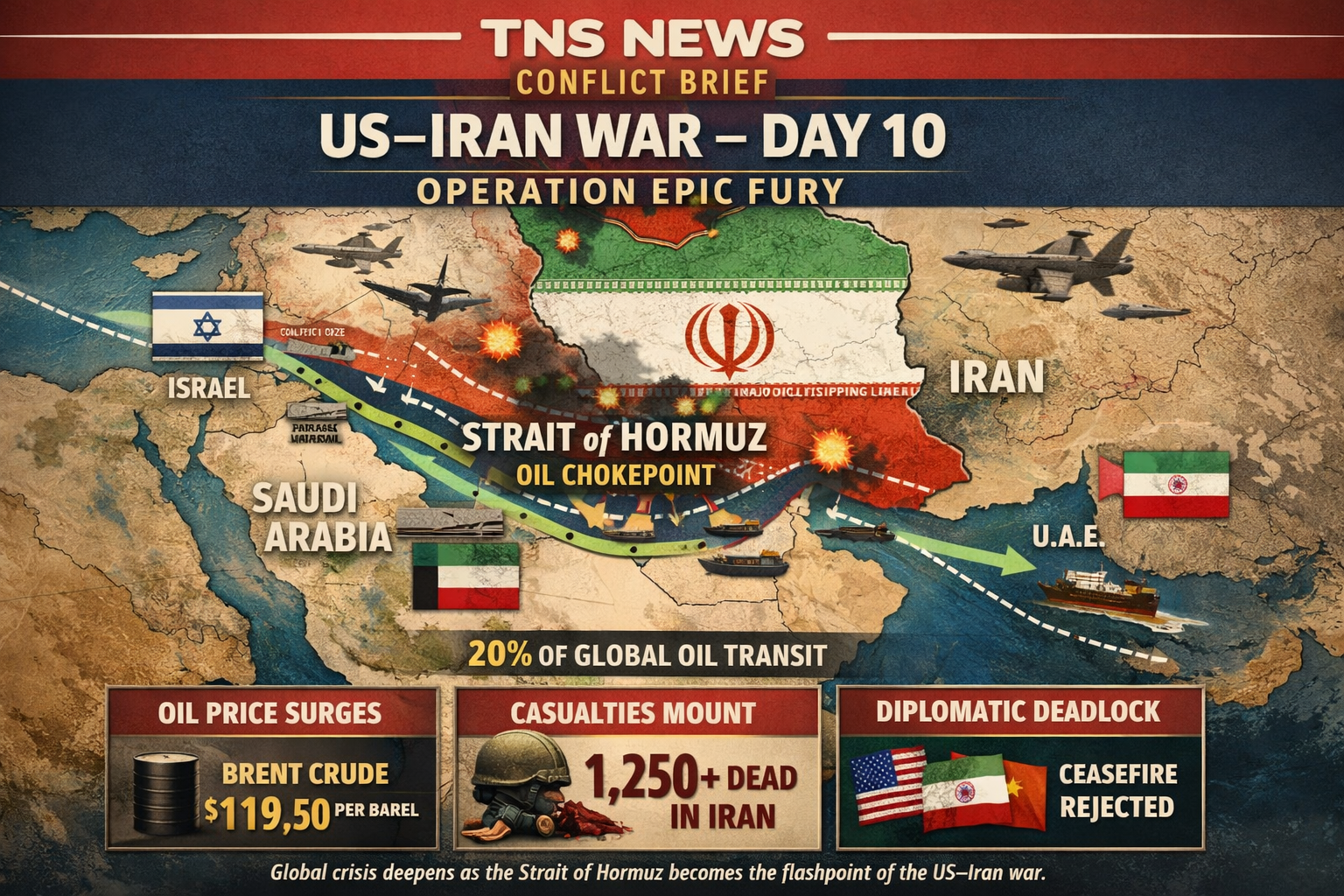
Brent crude surged to US$119.50 per barrel on Sunday before retreating to around US$112.98 in early Monday trading, according to Al Jazeera, and later stabilising near US$104 during the day, Bloomberg reported. Oil prices remain well above the US$100 threshold breached for the first time since Russia’s invasion of Ukraine in 2022. Since the conflict began on 28 February, crude prices have risen by roughly 50 percent.
Israel struck what it described as “wide-scale” targets in Tehran and other areas, including destroying the headquarters of the IRGC’s air force. Strikes on oil storage sites sent toxic smoke across the capital, with a CNN team reporting “blackened rain” falling on parts of the city. Israel also struck the Ghobeiry municipality in Beirut, Lebanon.
Iranian Foreign Minister Abbas Araghchi ruled out a ceasefire, telling NBC News:
“We are not asking for a ceasefire, and we don’t see any reason why we should negotiate.”
He warned that a US ground invasion would be “a big disaster” for American forces.
Iranian attacks on Gulf states hosting US forces continued overnight. Qatar intercepted missiles targeting the state at around 3 a.m. Monday. Saudi Arabia’s Ministry of Defence said it intercepted a drone heading for the Shaybah oilfield. In Al-Kharj, Saudi Arabia, a projectile struck a residential facility, killing two Bangladeshi nationals and injuring 12 others, the first reported deaths in the kingdom since the war began. Bahrain’s Bapco Energies declared force majeure, while Kuwait reported two firefighters killed while on duty.
Asian financial markets fell sharply. South Korea’s KOSPI closed down 6 percent after plunging as much as 8 percent intraday and triggering circuit breakers for the second time since the conflict began. Japan’s Nikkei 225 fell more than 5 percent, while Hong Kong’s Hang Seng declined 1.35 percent. US S&P 500 futures dropped 1.7 percent and Nasdaq futures fell 1.9 percent.
Approximately 9 million barrels of oil per day are currently off the market, according to Rystad Energy, due to damaged facilities and precautionary production cuts. Iraq, Kuwait and the UAE have reduced output as storage fills rapidly. Qatar’s Energy Minister Saad al-Kaabi warned that oil prices could reach US$150 per barrel by the end of March if traffic through the Strait of Hormuz does not resume.
Human Rights Watch reported evidence of white phosphorus use in residential areas of southern Lebanon earlier in the conflict, alleging violations of international humanitarian law. At least 394 people, including 83 children, have been killed in Lebanon since Hezbollah entered the war on 2 March.
Donald Trump issued fresh warnings to Iran’s new leadership, saying the new Supreme Leader “is not going to last long” without US support. Trump dismissed the surge in oil prices as “a very small price to pay” and reiterated that Washington would accept nothing short of “unconditional surrender.”
China renewed its call for an immediate ceasefire. Foreign Minister Wang Yi described the conflict as “a war that should never have happened and benefits no one.” Beijing has dispatched its Middle East envoy Zhai Jun to the region in an effort to encourage de-escalation.
Malaysia’s Prime Minister Anwar Ibrahim pledged to maintain the RON95 petrol price cap at RM1.99 per litre, stating that the government would do its best to shield Malaysians from the shock of global oil price volatility. Malaysia has also been among the most vocal Southeast Asian governments condemning the US–Israeli operation.
The United Nations has declared the conflict a major humanitarian emergency, noting that affected regions already host nearly 25 million displaced persons. US Central Command reported more than 3,000 targets struck in Iran as of 7 March.
Controversy persists over a US airstrike near Bandar Abbas on the first day of the war. A missile struck a nearby girls’ school after targeting a naval facility in Minab. ACLED reported nearly 170 children killed. Newly verified video footage released by CNN confirmed the school’s proximity to the military target.
DAY 10 WRAP-UP
A four-part assessment of the conflict as it enters its second week.
I. Military Situation
Ten days into the war, the US–Israel campaign has achieved near-complete air dominance over Iran. The Pentagon states that Iran’s air force and navy have been largely neutralised, while US Central Command reports strikes on more than 3,000 targets.
However, Iran’s missile and drone capabilities remain active. The Islamic Revolutionary Guard Corps claims to have launched over 500 ballistic missiles and nearly 2,000 drones since 28 February. Although launch rates slowed by 4 March, analysts say this reflects both material depletion and deliberate rationing of remaining arsenals.
The war has also expanded geographically. Hezbollah has launched rockets into Israel from Lebanon, while Israeli ground forces have entered southern Lebanon. Two Israeli soldiers were killed there on Sunday — the first Israeli military fatalities of the conflict.
Commercial shipping through the Strait of Hormuz remains effectively frozen, with dozens of tankers waiting outside the waterway.
II. Economic Impact
The breach of the US$100 oil threshold has become the most consequential economic development of the conflict’s tenth day.
Brent crude has surged roughly 50 percent since the war began, briefly reaching US$119.50 before stabilising near US$104–113.
Storage facilities across the Gulf are rapidly filling, forcing production cuts in Iraq, Kuwait, Saudi Arabia and potentially the UAE. If the Strait of Hormuz remains closed to commercial traffic, analysts warn that oil prices could climb to US$150 per barrel within weeks.
Asian economies are bearing the heaviest burden. Southeast Asia imports roughly 60 percent of its crude oil from the Middle East, leaving the region highly vulnerable to supply disruptions.
Malaysia, while a net energy producer, faces fiscal pressure as the government maintains fuel subsidies and price controls to shield consumers from inflation.
III. Diplomatic Moves
Diplomacy on Day 10 is marked by maximum rhetoric and minimal traction.
Iran has rejected ceasefire negotiations, while Washington continues to demand unconditional surrender.
China and Russia remain the most vocal advocates for de-escalation, though neither has yet produced a credible diplomatic breakthrough. The United Nations Security Council remains divided, preventing coordinated international action.
Turkey has also attempted mediation, but no progress has been reported.
IV. Regional Outlook
As the conflict enters its second week, the future of the Strait of Hormuz has become the single most important variable.
Every additional day that shipping remains disrupted increases global economic damage, raises inflation risks, and intensifies fiscal pressure on governments attempting to protect their populations from rising energy costs.
For Southeast Asia, the war has already become a major economic shock.
Malaysia faces the dual challenge of managing domestic economic pressures while projecting regional leadership amid growing geopolitical instability.
The appointment of Mojtaba Khamenei as Iran’s new Supreme Leader introduces a major new variable. Leadership change during wartime could either open the door to negotiations or harden Tehran’s determination to resist.
The next 48 to 72 hours may determine whether a diplomatic opening emerges — or whether the conflict hardens into a prolonged regional siege.
TNS News Conflict Desk
Day 10 Brief | 9 March 2026
Sources: Al Jazeera, CNN, NBC News, Reuters, Bloomberg, AP, NPR, CBS News, South China Morning Post, ACLED, Rystad Energy, Eurasia Group, Morgan Stanley and official government statements