


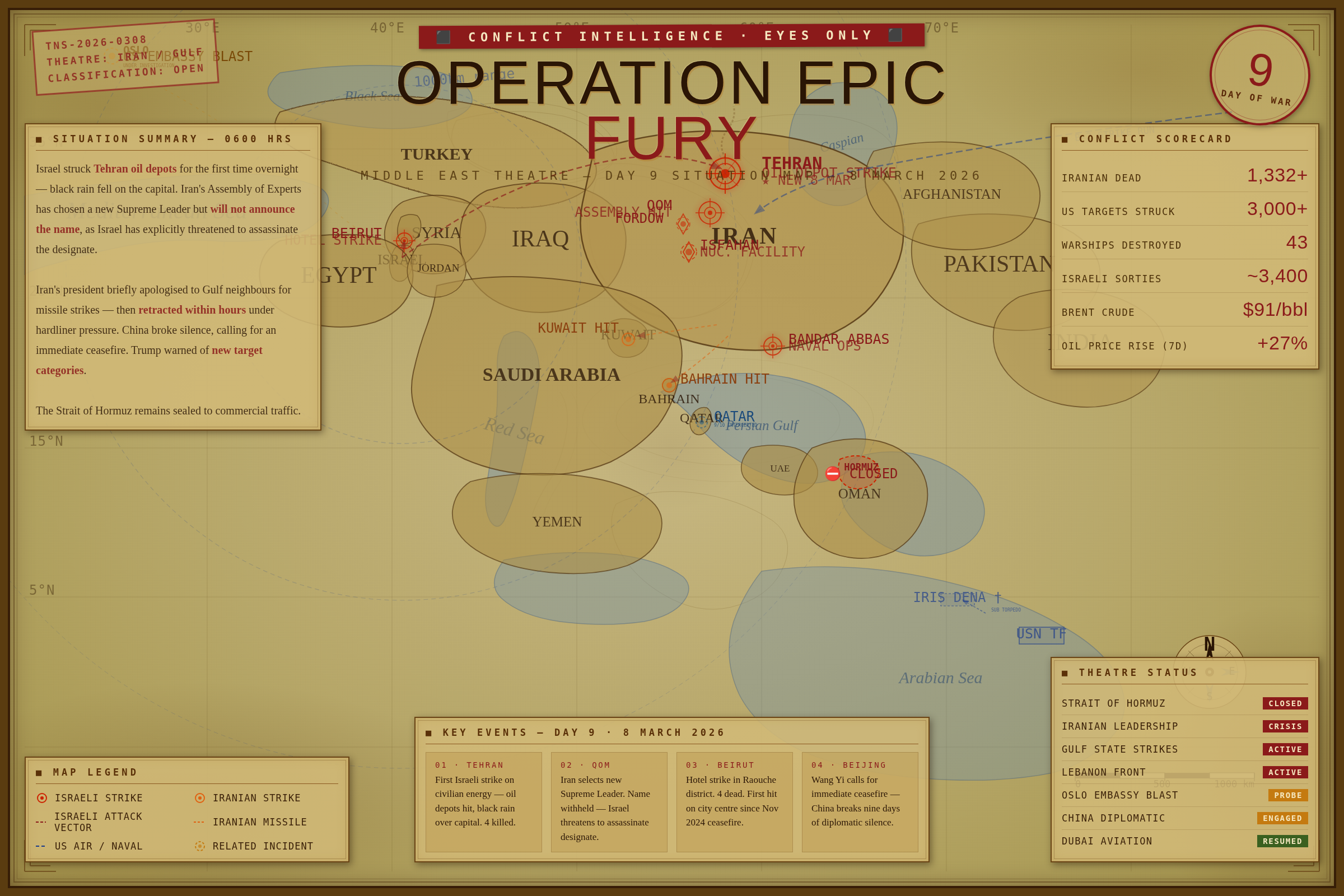
SUNDAY, 8 MARCH 2026 • DAY 9 OF OPERATION EPIC FURY
EDITOR’S SUMMARY
Nine days into Operation Epic Fury, the war is widening rather than winding down. Israel struck Iranian oil depots for the first time overnight, sending black rain over Tehran. Iran’s Assembly of Experts has reached a consensus on a new Supreme Leader but has not named the candidate — as Israel vows to target whoever is chosen. Iran’s president apologised to Gulf neighbours for missile strikes, then quickly backtracked. China publicly called for a ceasefire for the first time. Trump warned that new target categories are under consideration. There is no peace horizon.
CONFLICT SCORECARD — AS OF 8 MARCH 2026
| 1,332+ Killed in Iran Iranian Red Crescent | 3,000+ US Targets Struck CENTCOM, Day 8 | 43 Warships Destroyed CENTCOM | $91/bbl Brent Crude +27% in 7 days |
⚔ Military & Strikes
1. Israel Hits Tehran Oil Depots — First Strike on Civilian Energy Infrastructure
In a major escalation overnight into 8 March, Israel struck multiple oil storage depots and fuel transfer facilities in Tehran and the adjacent Alborz province for the first time in the nine-day campaign. CNN’s team on the ground reported that residents of the capital woke to thick black clouds and showers of oil-saturated rain a consequence of the fires burning at petroleum storage sites in northeastern Tehran. Iranian state media confirmed four people, described as tanker drivers, were killed in strikes on four oil storage facilities and one fuel transfer centre. The Israeli military said the sites had been used to support Iranian armed forces operations. Total Israeli strike count now stands at approximately 3,400 sorties deploying roughly 7,500 munitions since 28 February.
◆ Source: NPR, CNN, CBS News, AFP — 8 March 2026
2. CENTCOM: 3,000+ Targets Struck, 43 Iranian Warships Destroyed
US Central Command updated its operational figures on day eight, confirming more than 3,000 targets struck inside Iran and 43 Iranian warships destroyed since the campaign began. Iran has disputed these figures and separately claimed significant US losses — all of which CENTCOM has publicly rejected as disinformation, including Iranian claims to have sunk an American aircraft carrier. The US has deployed B-2 stealth bombers dropping 2,000-pound bombs on buried Iranian ballistic missile launcher sites; Washington claims Iranian missile attack capacity has been reduced by approximately 90 percent as a result of those strikes.
◆ Source: Al Jazeera, CENTCOM — 7-8 March 2026
3. Israeli Strike Hits Central Beirut Hotel — Four Dead, First Strike on City Centre
An Israeli airstrike early on 8 March struck a hotel in the Raouche seafront district of central Beirut, an area untouched since the November 2024 ceasefire. Lebanon’s health ministry confirmed at least four killed and ten wounded. Israel said it had targeted Quds Force commanders planning attacks against Israel. Lebanon’s government reports nearly 300 people killed and tens of thousands displaced since Hezbollah entered the conflict on 2 March by firing rockets into northern Israel.
◆ Source: CBS News, NPR, Lebanese Health Ministry — 8 March 2026
4. Gulf Strikes Continue — Bahrain Desalination Plant Hit, Kuwait Fuel Depot Targeted
Despite President Pezeshkian’s brief public apology to Gulf neighbours, Iranian strikes on the Gulf continued into 8 March. A drone attack damaged a water desalination plant in Bahrain injuring three people, while Kuwait reported a government building and fuel depot struck. Qatar’s air defence systems intercepted nine of ten Iranian drones launched at the country on 7 March. Gulf states continue to walk a careful line — hosting US military facilities that Iran is targeting, while avoiding being seen as active war participants.
◆ Source: Al Jazeera, CNN, Bahrain Ministry of Interior — 8 March 2026
🏛 Political & Diplomatic
5. Iran’s Assembly of Experts Reaches Consensus on New Supreme Leader — Name Withheld
Iran’s 88-member Assembly of Experts announced on 8 March that it had reached a majority consensus on a successor to Ayatollah Ali Khamenei, killed on the first day of the war. Assembly member Ayatollah Mohammad-Mahdi Mirbagheri confirmed the decision to Iran’s Mehr news agency, though noted some procedural obstacles remained. No name has been publicly disclosed. Legal experts noted the constitution requires at least two-thirds of Assembly members to deliberate in person a requirement complicated by the threat of Israeli airstrikes targeting the convening body in Qom. Officials say the chosen candidate was selected on Khamenei’s own reported dying instruction: the successor should be someone ‘hated by the enemy.’
◆ Source: Al Jazeera, CNN, NBC News, Mehr News Agency — 8 March 2026
6. Israel Vows to Target Iran’s New Supreme Leader and Anyone Who Selects Him
The IDF issued an explicit warning: Israel would pursue and strike whoever is chosen as supreme leader, as well as any member of the Assembly of Experts participating in the selection. Prime Minister Netanyahu said at a press conference that Israel seeks to destabilise the Iranian regime and enable change. Defence Minister Katz separately warned that if the successor continued Iran’s posture toward Israel, he would be an unequivocal target for elimination. Israel also bombed the Assembly of Experts building in Tehran earlier in the war as members were convening to begin the process
◆ Source: NBC News, Al Jazeera, CBS News — 8 March 2026
7. Pezeshkian Apologises to Gulf Neighbours — Then Backtracks Within Hours
President Pezeshkian issued a public apology on state television on 7 March to neighbouring countries struck by Iranian missiles and drones, saying Iran had no intention of aggression against brotherly neighbours. Internal backlash was immediate. Within hours, Pezeshkian posted a follow-up social media statement walking back the apology, emphasising Iran’s right to self-defence and blaming misinterpretation. Security chief Ali Larijani then addressed the nation calling for unity and denying any leadership rift even as the contradiction between the apology and its retraction drew international attention as evidence of internal fracture.
◆ Source: NPR, CNN, Al Jazeera — 7-8 March 2026
8. Trump Warns of Expanded Target List, Dismisses Iranian Threats
Trump escalated his rhetoric, posting on Truth Social that Iran would be hit very hard and that areas and groups not previously targeted were now under serious consideration without elaboration. In a CBS News phone interview, he dismissed Ali Larijani by name, saying he had no idea who Larijani was and could not care less about his threats. On 7 March, Trump attended a dignified transfer at Dover Air Force Base for the six killed US service members, identified by the Department of Defense as: Captain Cody A. Khork (35), Sergeant First Class Noah L. Tietjens (42), Sergeant First Class Nicole M. Amor (39), Sergeant Declan J. Coady (20), Major Jeffrey O’Brien (45), and Chief Warrant Officer 3 Robert M. Marzan.
◆ Source: CBS News, NPR, DoD — 7-8 March 2026
9. China Breaks Silence — Wang Yi Calls for Immediate Ceasefire
China’s Foreign Minister Wang Yi publicly called for an end to the war for the first time, warning that the flames of war risked spreading and that the conflict was one that should never have happened and benefited no one. Speaking at China’s annual two sessions gathering in Beijing, Wang urged all parties to return to the negotiating table through equal dialogue. The statement is significant: China is Iran’s largest oil buyer, holds deep economic interests in Gulf stability, and President Xi is preparing to host Trump in Beijing. Beijing’s public entry into the diplomatic arena signals growing concern that a prolonged conflict is incompatible with China’s regional and energy interests.
◆ Source: CNN — 8 March 2026
📈 Energy, Markets & Global Impact
10. Brent Posts Biggest Weekly Gain Since COVID-19; Strait of Hormuz Remains Shut
Brent crude surged 27 percent in the first week of the war — the largest single-week gain since the pandemic lockdowns of 2020 — reaching US$91 per barrel. The Strait of Hormuz remains effectively closed to commercial tanker traffic. Major maritime insurers including Gard and Skuld have issued war-risk coverage cancellation notices effective 5 March, meaning commercial operators are legally unable to transit the Persian Gulf without indemnity. Energy analysts warn that a sustained Hormuz closure could push Brent to US$130 per barrel if maritime flows are fully obstructed. Kuwait has already begun cutting oil production after running out of storage capacity.
◆ Source: Al Jazeera, CNN, Wall Street Journal, ADI Analytics — 7-8 March 2026
11. Russia Profits; Kremlin Reports Surge in Demand for Russian Energy
The Kremlin publicly acknowledged a significant increase in global demand for Russian energy products — a direct consequence of the Hormuz shutdown removing Iranian oil from world markets and redirecting buyers toward Russian supply. The US separately granted India a 30-day waiver on Iranian oil imports to cushion the shock, underscoring Washington’s awareness of the dislocation the war is causing across Asian economies. Russia, which is also supplying Iran with battlefield intelligence on US troop and ship movements, stands positioned as a dual beneficiary — strategically and economically — of a prolonged conflict.
◆ Source: CNN, Al Jazeera — 7-8 March 2026
12. Emirates Resumes Dubai Flights; Aviation Chaos Eases Partially
Emirates airline resumed operations at Dubai International Airport on 7-8 March, with Etihad Airways offering free rebooking on all tickets issued before 28 February for travel until 21 March. However, broader Middle Eastern aviation remains disrupted as Iranian strikes periodically threaten Gulf hub airports. Separately, India reported that Iranian naval vessel IRIS Lavan had docked in Kochi after mechanical problems, following the US sinking of the IRIS Dena by submarine torpedo in the Indian Ocean — the first such engagement by an American submarine since the Second World War.
◆ Source: Gulf News, India TV, Newsweek — 7-8 March 2026
🔎 Intelligence & Analysis
13. US Intel Report: Large-Scale Assault Unlikely to Topple Iran’s Government
A US National Intelligence Council report cited by the Washington Post found that a large-scale US-led military assault on Iran was unlikely to bring down the government, and the prospect of the fragmented Iranian opposition taking control was assessed as unlikely. The finding sits in direct tension with the stated strategic logic of Operation Epic Fury. Human Rights Watch separately called for an international investigation into the Minab school strike — which killed at least 160 people, most of them schoolchildren — characterising it as a potential war crime warranting independent inquiry.
◆ Source: Washington Post, Al Jazeera, Human Rights Watch — 7-8 March 2026
14. Oslo: Explosion at US Embassy Under Investigation as Possible Linked Attack
Norwegian police are investigating an overnight explosion at the US Embassy compound in Oslo, occurring at approximately 1am local time on 8 March. Police described it as a possible deliberate attack linked to the current security situation and said they were examining several hypotheses with no suspects yet identified. No casualties were reported. If confirmed as an attack, it would mark the first targeting of a US diplomatic facility in a European capital since the war began — broadening the geographic footprint of the conflict’s security fallout beyond the Middle East.
◆ Source: NBC News, Reuters — 8 March 2026
TNS NEWS EDITORIAL WRAP DAY 9 — SUNDAY, 8 MARCH 2026
THE STORY OF THE DAY
The single most consequential development of Day 9 is not the oil depot strikes, dramatic as they are. It is the succession crisis unfolding inside Iran while bombs continue to fall. Iran’s Assembly of Experts has quietly chosen a new Supreme Leader the most powerful position in the Islamic Republic yet cannot or will not announce the name, because Israel has explicitly threatened to assassinate whoever is selected. Think about what that means: a sovereign nation of 90 million people is attempting to determine its own head of state, and a foreign military power has publicly promised to kill that person before they can take office. This is historically unprecedented. It is also the clearest sign yet that Israel’s objective is not just the degradation of Iran’s military capacity, it is the decapitation of the Islamic Republic as a governing structure.
DIRECTION OF TRAVEL
After nine days, the trajectory is clear: this war is escalating in scope, not narrowing toward resolution. Each day has introduced a new category of target — leadership, nuclear sites, naval assets, proxy forces, and now civilian energy infrastructure. The logical next step in that progression is broad economic warfare: refineries, power grids, financial infrastructure. That is the direction Trump’s warning about expanded target categories is pointing. The US National Intelligence Council’s own assessment — that military action is unlikely to topple the government — suggests Washington either does not share that view, or has accepted a prolonged campaign as the price of attempting it. Neither reading is reassuring.
WHAT PEZESHKIAN’S APOLOGY TELLS US
Iranian President Pezeshkian’s brief apology to Gulf neighbours and its immediate retraction under internal pressure is more revealing than any military communiqué issued today. It tells us two things simultaneously: first, that Iran’s civilian leadership is aware the Gulf state strikes are diplomatically and strategically costly, alienating the very neighbours Iran needs to avoid total encirclement. Second, that the hardline security establishment led by figures like Ali Larijani retains the power to override the president in real time. Iran is not speaking with one voice. That internal fracture, if it deepens, is potentially the most significant variable in the war’s outcome — more so than any single airstrike.
WHAT THIS MEANS FOR MALAYSIA AND ASEAN
Malaysia enters the second week of this war in a structurally paradoxical position. As a net energy exporter, Petronas and the federal government benefit in the short term from oil at US$91 per barrel – analysts at Nomura and MUFG both identify Malaysia as the relative beneficiary among ASEAN nations in a sustained oil price shock. But the ringgit is behaving less like a petrocurrency and more like a high-beta emerging market currency under dollar pressure, currently trading around RM3.94 to the US dollar with Bank Muamalat’s chief economist noting that de-escalation is proving elusive. Shipping and war-risk insurance costs are rising for Malaysian exporters. Aviation disruption continues to affect Malaysian carriers and passengers transiting Middle Eastern hubs. And the Hormuz closure – if it extends beyond weeks into months will eventually reach Malaysia through demand destruction in export markets in Europe and Asia. Bank Negara is watching. So should we all.
TOMORROW’S WATCH LIST — MONDAY, 9 MARCH 2026
▸ Iran’s new Supreme Leader: Will the name be announced? Will Israel act on its threat to target the selection process or its outcome?
▸ Oil at US$91 — and rising?: Watch for any signal of Hormuz negotiation. A sustained closure risks pushing Brent to US$130, per energy analysts.
▸ China’s next move: Does Wang Yi’s ceasefire call translate into a concrete diplomatic initiative — or remain a statement of preference?
▸ Ringgit and Bursa Malaysia: Monday open will reflect a full week of war pricing. Watch Bank Negara for any guidance signal.
▸ Malaysia’s official position: PM Anwar called the strikes a path to catastrophe on Day 1. Has Malaysia’s diplomatic posture evolved? Will Putrajaya issue a Day 9 statement?
▸ Oslo Embassy blast: Confirmation or denial of deliberate attack. If confirmed as Iran-linked, watch NATO Article 5 discussions accelerate.
Compiled and written by TNS News Team. | Next briefing: Monday, 9 March 2026, closing edition | Sources verified against named publications | © TNS News 2026. All rights reserved.