


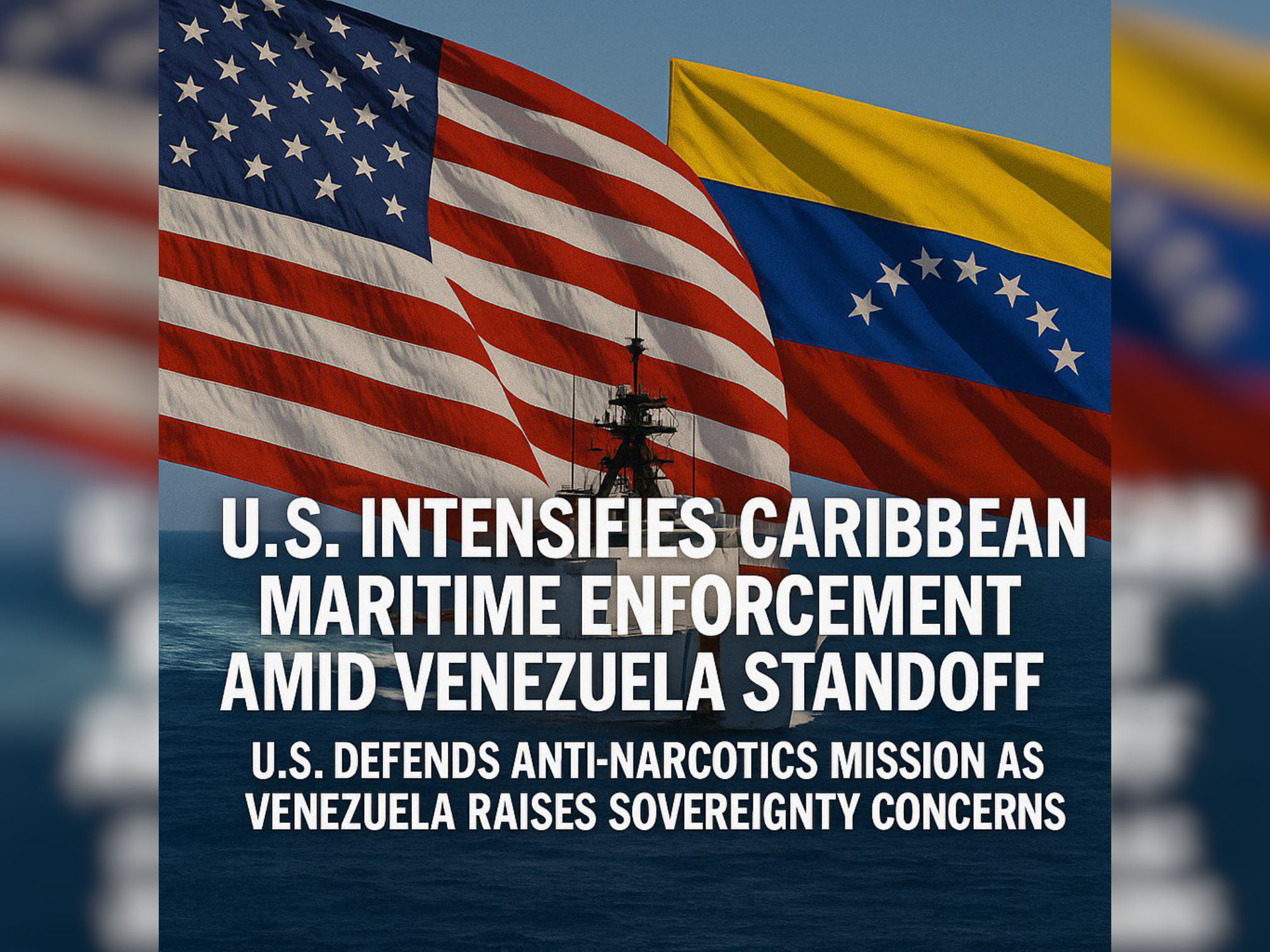
U.S. Intensifies Caribbean Maritime Enforcement Amid Venezuela Standoff
By TNS News Team
CARACAS / WASHINGTON – Tensions between the United States and Venezuela have escalated sharply following a series of deadly maritime operations by U.S. forces on vessels Washington claims were involved in narcotics trafficking, according to multiple international media reports.
International news sources report that since early September 2025, American authorities have conducted multiple operations against boats traveling through drug-smuggling corridors in the Caribbean and eastern Pacific. Foreign media cite U.S. officials as stating that dozens have been killed in multiple strikes, with the operations now framed as part of a national-security campaign rather than routine law enforcement.
Washington has described the effort as a crackdown on what it calls “narco-terror networks” allegedly linked to senior figures in Caracas—accusations Venezuela firmly rejects, according to international reporting.
Military Operations and Casualties
According to international news agencies, the Trump administration has alleged that the vessels were operated by groups it designated as narcoterrorists, though international media note the administration has not publicly released evidence for these allegations.
Foreign media report that the first strike occurred in early September 2025, when a speedboat allegedly smuggling drugs from Venezuela was destroyed. International sources quoted President Trump as announcing the operation and claiming the vessel was carrying narcotics. All aboard were reportedly killed, according to foreign news reports.
International media report that strikes have expanded from the Caribbean Sea to include the Eastern Pacific Ocean, with operations continuing through December 2025.
Defense Secretary’s Remarks
U.S. Secretary of Defense Pete Hegseth, speaking at the Reagan National Defense Forum in early December 2025, defended the actions as necessary to protect Americans, according to foreign media coverage of the event.
International news outlets quoted Hegseth as stating: “If you’re working for a designated terrorist organization and you bring drugs to this country in a boat, we will find you and we will sink you. Let there be no doubt about it.” Foreign media also reported he said that “President Trump can and will take decisive military action as he sees fit to defend our nation’s interests”.
According to international reporting, Hegseth dismissed criticism of the strikes and likened the fight to the war on terror following the September 11, 2001 attacks, though international news sources noted that experts have questioned the comparison.
Foreign media report that the administration has designated several groups it links to Venezuela’s criminal underworld as terrorist organizations, expanding Washington’s authority to conduct interdiction operations.
Venezuela’s Response
Caracas has responded angrily, accusing the United States of using the drug war as a pretext for political pressure and intervention, according to international news coverage.
According to foreign media reports, Venezuela’s National Assembly has launched a formal investigation into what Venezuelan officials describe as “extrajudicial killings,” condemning U.S. strikes as violations of sovereignty.
International media quoted Venezuela’s ambassador to the United Nations, Samuel Moncada, as denouncing the strikes during a UN session, declaring that “there is a killer roaming around the Caribbean” and that the United States “is killing everyone who is in the sea working”.
President Nicolás Maduro has rejected Washington’s accusations, insisting his government is actively combating drug trafficking and warning that Venezuela “will never submit to foreign intimidation,” according to international news sources.
Foreign media reported that in mid-September 2025, Venezuela launched large-scale naval and air exercises, while President Maduro ordered the mobilization of the Bolivarian militia.
Military Buildup
International news agencies report that in late August 2025, the United States began a naval buildup in the southern Caribbean with the stated goal of combating drug trafficking. Foreign media describe the deployment as substantial, with multiple warships and thousands of personnel positioned in the region.
According to foreign reports, three Aegis guided-missile destroyers, along with three amphibious assault ships carrying thousands of sailors and Marines, were deployed to waters in the Caribbean. International media also report additional assets including spy planes, submarines, and fighter aircraft stationed in Puerto Rico.
International Concerns and Legal Questions
International media quoted United Nations human rights experts as warning that the strikes could violate fundamental international norms, with foreign news sources reporting they argued that “international law does not allow governments to simply murder alleged drug traffickers” and that all states must “respect the right to life, including when acting on the high seas or in foreign territory”.
Human rights organizations have raised serious concerns about the legality of the U.S. approach, according to international media investigations. Foreign reports describe at least one incident that allegedly involved survivors in the water after an initial strike, followed by a second attack. International news sources report that the repeated use of lethal force in maritime operations has blurred the line between law enforcement and armed conflict, according to legal experts cited in foreign media.
Legal experts quoted in international media have characterized the strikes as potentially violating both U.S. and international law. One analyst quoted in foreign media warned that reclassifying drug smugglers as combatants represents “a dangerous shift from law enforcement into warfare without declared conflict.”
International news outlets reported that Gustavo Petro, President of Colombia, initially suggested that any attack on Venezuela would equate to an attack on Latin America and the Caribbean. Foreign media subsequently reported he addressed the UN General Assembly to call for a “criminal process” to be opened against Donald Trump for U.S. strikes in the Caribbean.
Regional Implications
Security analysts interviewed by international media caution that the standoff could destabilize the wider region. Foreign news sources report that Colombia convened an extraordinary virtual meeting of the Community of Latin American and Caribbean States in September 2025, which concluded with an expression of “deep concern” over foreign intervention in the region.
According to international media reports, some analysts have suggested the campaign’s goal includes cutting off drug revenue that allegedly sustains loyalty among Venezuela’s senior military and police commanders.
Foreign media have reported that Venezuelan opposition figures, Trump administration sources and independent political analysts have suggested various motives for U.S. operations, though Washington maintains the operations are focused on drug interdiction, according to international news coverage.
Historical Context
The confrontation represents the latest chapter in an increasingly hostile relationship spanning more than two decades, according to international media analysis. Since the presidency of Hugo Chávez, ties between Washington and Caracas have deteriorated over political ideology, oil policy, and regional alliances, foreign reports indicate.
International media report that in 2020, U.S. prosecutors formally charged senior Venezuelan officials with narcotics-related offenses. Foreign news sources describe the current operations as marking a severe escalation, moving beyond sanctions into direct military enforcement at sea.
International media quoted President Trump as signaling his intention to escalate beyond maritime attacks, saying at a cabinet meeting that additional measures may be considered.
Accountability Questions
According to foreign reports, U.S. lawmakers have demanded clearer explanations on the legal basis for the strikes and whether the targeted vessels posed imminent threats. International media report that as of November 2025, the U.S. Senate had rejected resolutions that would limit the administration’s authority to continue military action.
Foreign news sources report that calls are growing for greater accountability and transparency, particularly regarding rules of engagement and evidence supporting allegations that vessels were engaged in drug trafficking.
Humanitarian Concerns
International aid organizations and analysts cited in foreign media have expressed concern about humanitarian fallout. Millions of Venezuelans already face economic hardship, with inflation, migration, and healthcare shortages continuing to strain daily life, according to international reporting. Observers quoted in foreign media warn renewed confrontation may worsen conditions by disrupting aid flows, trade links, and regional stability.
Competing Narratives
According to international media coverage, all parties deny wrongdoing.
Foreign reports indicate Washington maintains the operations are defensive in nature and necessary to combat narco-terrorism. International media report that Venezuela insists the operations are illegal acts of aggression and violations of international law.
Whether the confrontation remains maritime or expands into broader measures may shape the region’s future, according to analysts interviewed by international media.
Editor’s Note & Disclaimer: This article is based on international news reporting and publicly available sources. TNS News has not independently verified the information contained in this report. All statements, allegations, and claims are attributed to foreign media sources. Views expressed do not represent the editorial position of TNS News.