


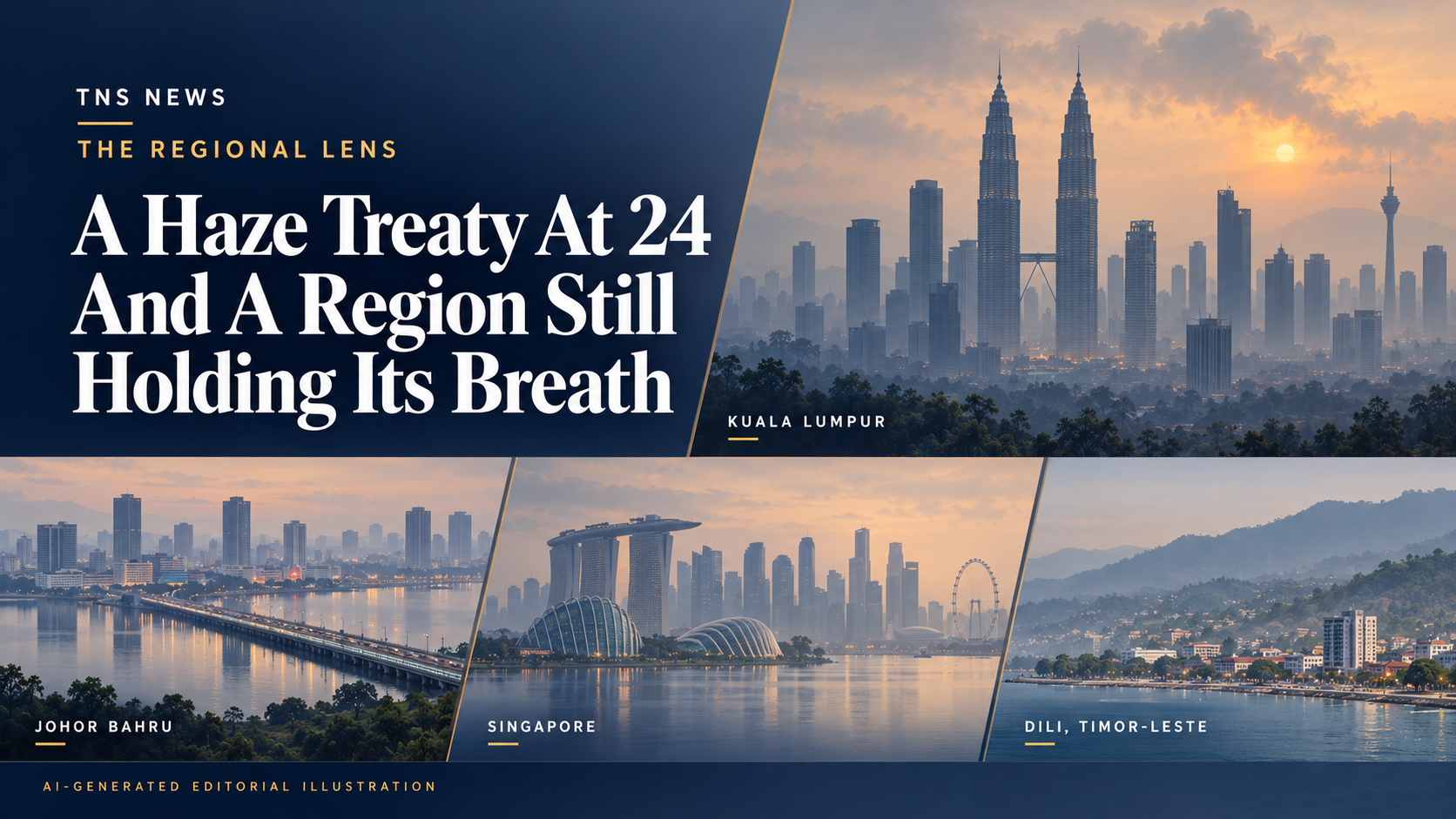
Indonesia has approved foreign firefighting help. ASEAN should use November’s meetings to turn its existing haze commitments into a faster, more dependable regional response.
By TENGKU NOOR SHAMSIAH TENGKU ABDULLAH
KUALA LUMPUR, Oct 18 – There is a particular silence that falls over a Malaysian school compound when classes are called off for haze. No rain, no flood, no public holiday. Only a grey, metallic sky and an Air Pollutant Index reading telling parents their children are safer at home.
Since 9 October it has fallen over schools in Kuala Lumpur, Putrajaya, Selangor, Pahang and Melaka, among other areas. Many have since reopened, but with assemblies, sport and outdoor lessons suspended, and on Friday Pasir Gudang and Larkin in Johor were still logging “very unhealthy” readings.
The disruption extends well beyond Malaysia. Timor-Leste suspended in-person classes nationwide for three days, while four people battling a wildfire in East Java’s Bromo Tengger Semeru National Park died on 15 October.
In Singapore, the National Environment Agency reported a 24-hour Pollutant Standards Index of 109–192 at 6pm on 18 October, within the unhealthy range. Some improvement in air quality has brought relief, but not an end to the regional emergency.
There has, at last, been movement. On 15 October, Indonesian Foreign Minister Arrmanatha Nasir said President Prabowo Subianto had approved foreign assistance, with technical arrangements being discussed. Malaysia had offered an aircraft, three helicopters and 52 personnel in September.
Singapore, meanwhile, said it would issue preventive measure notices to seven companies linked to fires on land in Indonesia. Malaysia has also announced that it will raise haze at the ASEAN foreign ministers’ meeting ahead of November’s 49th ASEAN Summit in Manila.
A Treaty Older Than The Children It Is Failing
None of this should be read as a story about one unlucky dry season. ASEAN members signed the Agreement on Transboundary Haze Pollution in Kuala Lumpur on 10 June 2002, after the catastrophic fires of 1997 and 1998. It came into force in November 2003, the first regional pact anywhere to bind neighbouring states to act against smoke from land and forest fires.
Indonesia, where most of the fires begin, took twelve years to ratify it, its parliament approving the treaty only in September 2014. Singapore, unwilling to wait, passed its own Transboundary Haze Pollution Act that year so it could pursue companies linked to fires abroad. This week’s notices are that law being put to use. It is telling, too, that the haze-related medical subsidies Singapore switched back on from 12 October had not been needed since 2015.
So the region has had a treaty for 24 years, along with a coordinating centre, a ministerial Conference of the Parties, a peatland strategy and a dedicated fund. A child born the year it was signed has since finished school and university. And still, schools close.
ASEAN has built machinery for earthquakes, floods and typhoons. It also has procedures for haze. The question is why regional assistance remains so difficult to mobilise when the need is evident.
The Gap Wisma Putra Has Identified
Foreign Minister Datuk Seri Mohamad Hasan identified an important operational gap on 12 October when he said haze was not covered by ASEAN’s existing natural disaster mechanisms. His intervention deserves attention, but it should not be mistaken for evidence that ASEAN has no haze response framework.
The ASEAN Agreement on Transboundary Haze Pollution already provides for joint emergency assistance. ASEAN has also developed standard operating procedures for monitoring, assessment and joint emergency response. Assistance requires the receiving country’s consent.
The weakness, therefore, is how reliably these arrangements translate into action, and how effectively they connect with the broader disaster response capacity built under the ASEAN Agreement on Disaster Management and Emergency Response, or AADMER, and the AHA Centre.
The delay in this crisis shows what that weakness costs. Malaysia offered aircraft and personnel in September; Indonesia’s approval of foreign help came only in mid-October. Malaysia said on 16 October that the assets offered would need reassessment because conditions had changed. Technical discussions are necessary, particularly where visibility makes flying dangerous. But needs assessments, deployment plans and arrangements for accepting help should be prepared before a regional emergency deepens. Approval is welcome; the next test is effective assistance on the ground.
Shaming Will Not Put Out A Peat Fire
When the air outside is unbreathable, it is tempting to reach for sharper language. The anger is understandable, but isolating Indonesia would achieve little. These fires feed on drained peatland that can smoulder underground for weeks, prolonged dry weather and land-clearing practices whose commercial incentives extend beyond Indonesia’s borders. Firefighters face dangerous conditions, as the deaths in East Java made painfully clear.
Fairness also means looking closer to home. On 16 October, government spokesman Fahmi Fadzil said checks had found that fires had largely started outside Malaysian companies’ plantation concessions in Indonesia. That is an official assessment, not a substitute for independently verifiable evidence. Published concession maps and land-use records would allow scrutiny of where fires begin, how they spread and who holds responsibility for the affected land. Trust across the Straits of Malacca will rest on evidence as well as assurances.
What November Should Deliver
November’s meetings offer an opportunity to agree practical changes while the disruption is still fresh. The Philippine chairmanship should seek commitments that can be measured before the next dry season. Three steps would make a difference.
First, connect the existing haze framework more closely with ASEAN’s wider disaster response capacity. Agreed pollution thresholds should trigger joint assessments and preparations for assistance, with national consent and deployment arrangements settled as far as possible in advance.
Second, make the evidence public. Regional hotspot information is already available; accessible concession maps and land-use records would help establish responsibility. Third, publish comparable national data on haze-related illness, lost school days and transport disruption, with clear methods and limits. The public needs to see the human cost as well as the pollution readings.
ASEAN does not lack a haze treaty or emergency procedures. It needs to make those commitments work quickly enough to protect the people breathing the smoke. Twenty-four years after the agreement was signed in Kuala Lumpur, the region’s leaders should go to Manila determined to have a more dependable response in place before the 2027 dry season.
- TNS NEWS