


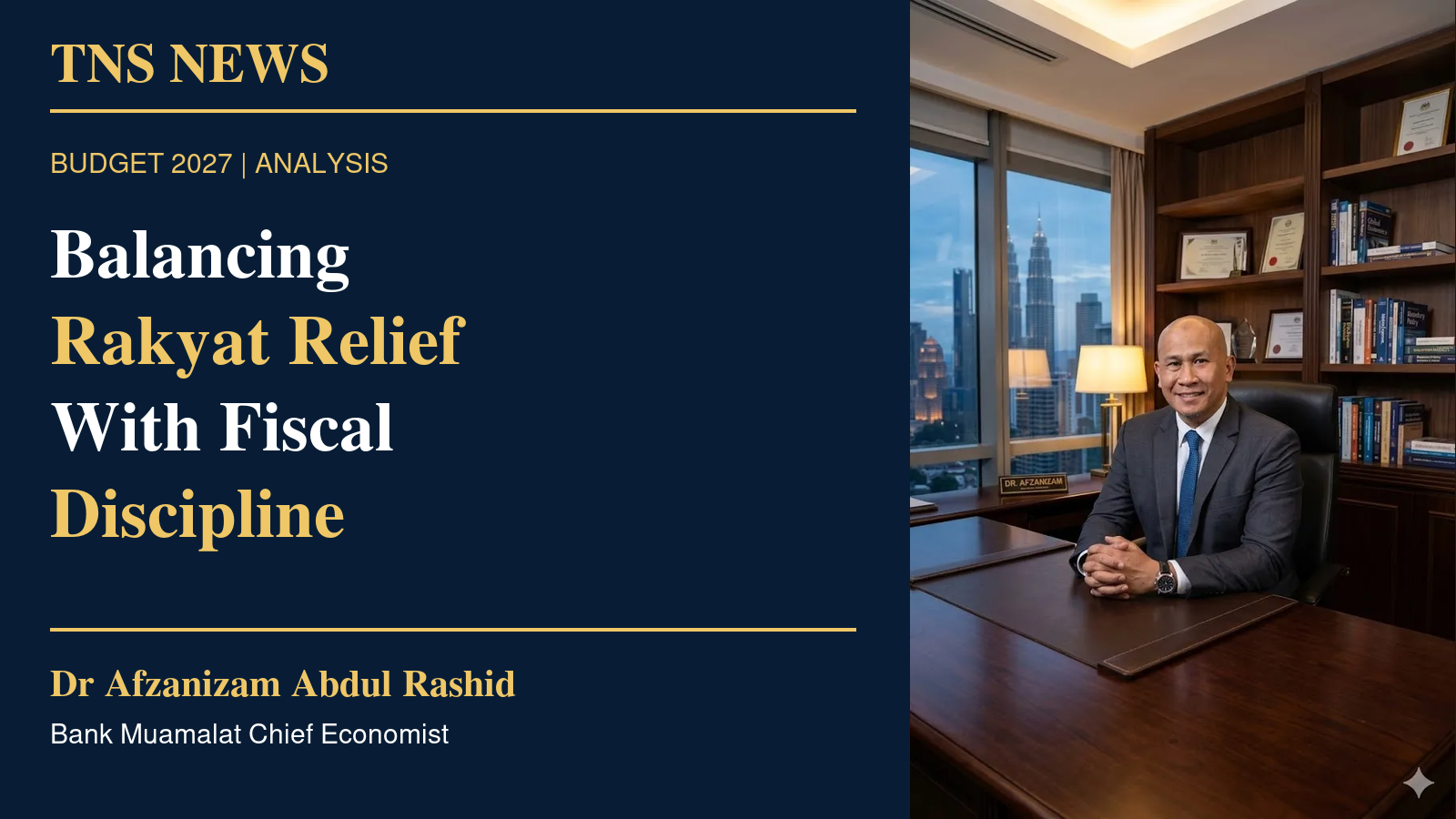
Dr Afzanizam Abdul Rashid says household support will sustain spending as growth moderates and inflation rises, while deficit reduction could strengthen market confidence
By TENGKU NOOR SHAMSIAH TENGKU ABDULLAH
KUALA LUMPUR, Oct 12 – Budget 2027 takes a pragmatic approach to supporting households and businesses as economic growth moderates and inflation rises, while maintaining fiscal discipline, Bank Muamalat Chief Economist Dr Afzanizam Abdul Rashid said.
He said higher personal tax relief, wage increases, tax reductions and cash assistance would help sustain domestic demand, alongside incentives supporting business investment.
“Overall, the government is adopting a pragmatic approach,” he told TNS News in written responses.
Afzanizam said the government was balancing its commitment to reducing the fiscal deficit with measures intended to ease the rakyat’s financial burden.
DOMESTIC DEMAND TO SUPPORT GROWTH
Prime Minister Datuk Seri Anwar Ibrahim, who is also Finance Minister, tabled Budget 2027 in the Dewan Rakyat on Friday, Oct 9, outlining total resources of RM510 billion.
The total includes RM376.8 billion in federal operating expenditure and RM83 billion in development expenditure, alongside other investment commitments.
The government forecasts gross domestic product growth of 4.2 to 5.2 per cent in 2027, compared with an estimated 4.8 to 5.3 per cent in 2026.
Afzanizam said the lower forecast range indicated that economic growth could slow next year, explaining the budget’s emphasis on supporting domestic consumption and investment.
“Hence, the measures are directed towards bolstering the domestic demand component such as consumption and investment,” he said.
He identified higher personal tax relief, the RM2,000 minimum wage, tax reductions for middle-income earners and cash transfers as measures expected to sustain consumer spending.
Under Budget 2027, individual tax relief rises from RM9,000 to RM12,000. Resident individual income-tax rates will fall by one percentage point to 18 per cent for chargeable income between RM70,001 and RM100,000, and to 24 per cent for RM100,001 to RM150,000.
The minimum wage will increase from RM1,700 to RM2,000 a month from June 2027, with micro, small and medium enterprises recording annual sales below RM50 million exempted from the new rate.
The combined allocation for Sumbangan Tunai Rahmah and Sumbangan Asas Rahmah will rise to RM16 billion.
CUSHIONING HIGHER INFLATION
Afzanizam said the government had factored higher inflation into its planning for 2027.
He cited a projected inflation range of 1.8 to 2.8 per cent next year, compared with an estimated 1.5 to 2.5 per cent in 2026.
“So in that sense, the govt has built in higher inflation next year when they craft the budget,” he said.
Afzanizam said cash transfers, subsidies, tax reductions and the higher minimum wage were expected to minimise the impact on households.
The measures would help cushion living-cost pressures while supporting the consumer spending needed to sustain economic activity, he said.
BUSINESS INCENTIVES COMPLEMENT HOUSEHOLD RELIEF
Afzanizam said support for businesses would complement the measures directed at consumers.
He highlighted tax reductions for SMEs, investment tax allowances for green technology and lower stamp duties as measures expected to improve company profitability.
Budget 2027 reduces the MSME income-tax rate by one percentage point for the first two taxable-income bands.
The rate on the first RM150,000 will decline to 14 per cent, while the rate for taxable income between RM150,001 and RM600,000 will fall to 16 per cent.
Afzanizam’s assessment places these measures within the wider effort to sustain investment as the pace of economic growth moderates.
REVENUE HELPS SUPPORT THE PACKAGE
Afzanizam also identified sales and service tax collections and PETRONAS dividends as important sources of revenue supporting the government’s spending plans.
In his response, he cited projected SST collections of RM73.3 billion and a PETRONAS dividend of RM32 billion in 2027, compared with RM27 billion in 2026.
“So in that sense, the govt does have the fiscal head room,” he said.
He said the revenue outlook provided room for the government to support households and businesses while pursuing fiscal consolidation.
The government targets a reduction in the fiscal deficit to 3.3 per cent of GDP in 2027, from a projected 3.6 per cent in 2026.
FISCAL COMMITMENT SUPPORTS CONFIDENCE
Afzanizam said maintaining fiscal discipline was positive for market confidence, including amid speculation that a general election could take place next year.
He viewed the budget’s funding and policy direction as reasons for a constructive market assessment.
“The budget is well funded and the govt is clear on what they want to achieve,” he said.
“So, that could help improve the market confidence.”
- TNS NEWS