


By TENGKU NOOR SHAMSIAH TENGKU ABDULLAH
March 7, 2026
KUALA LUMPUR — As tensions between the United States and Iran intensify, economists and geopolitical analysts warn that the confrontation could generate economic ripple effects far beyond the Middle East, potentially reshaping global energy markets, supply chains and financial stability.
The crisis escalated after strikes on Feb. 28 reportedly killed several senior Iranian figures, including Supreme Leader Ali Khamenei, triggering retaliatory missile attacks and raising fears of a wider regional confrontation.
Although the military situation remains fluid, the economic consequences of a prolonged conflict could be significant if instability spreads across West Asia.
Here are five key risks analysts say the global economy should watch closely.
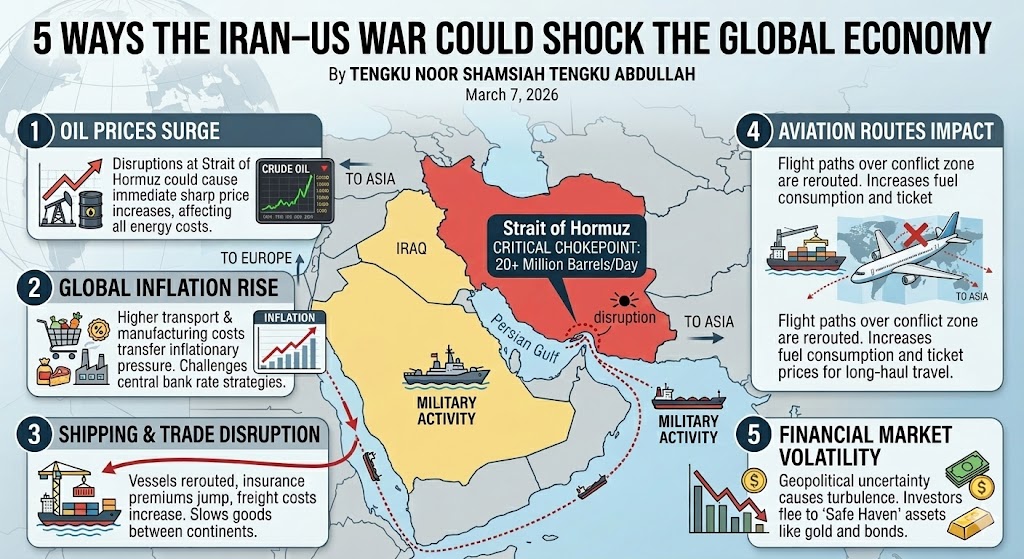
Oil Prices Could Surge
The most immediate concern lies in global energy markets.
Much of the world’s oil supply passes through the Strait of Hormuz, the narrow maritime corridor between Iran and Oman that serves as one of the world’s most critical energy chokepoints.
More than 20 million barrels of crude oil and petroleum products move through the strait each day. Any disruption to tanker traffic — whether from military activity, shipping restrictions or insurance constraints — could quickly push oil prices sharply higher.
Such a spike would have immediate consequences for global energy costs.
Global Inflation Could Rise Again
Energy prices play a central role in inflation dynamics.
Higher oil prices increase transportation costs, manufacturing expenses and food prices, transmitting inflationary pressure across economies worldwide.
For central banks that have spent years trying to contain inflation following pandemic-era disruptions, a renewed energy shock could complicate interest-rate strategies and economic recovery plans.
Shipping and Global Trade Could Be Disrupted
The Persian Gulf remains one of the world’s most important maritime corridors.
If security risks increase, shipping companies may reroute vessels or face sharply higher war-risk insurance premiums. Such developments would raise freight costs and slow the movement of goods between Asia, Europe and the Middle East.
Global supply chains — already strained by geopolitical tensions and trade realignments — could face renewed disruptions.
Aviation Routes Could Become Longer and Costlier
Air travel is another sector vulnerable to geopolitical conflict.
Missile activity and airspace security concerns across parts of West Asia have already prompted airlines to reroute some long-haul flights connecting Asia and Europe.
Longer routes increase fuel consumption, tighten scheduling constraints and may eventually translate into higher ticket prices for international travellers.
Financial Markets Could Turn Volatile
Geopolitical shocks often trigger turbulence in financial markets.
Periods of heightened uncertainty tend to drive investors toward safer assets such as gold, government bonds and the US dollar. Equity markets — particularly in emerging economies — can experience significant volatility as investors reassess geopolitical risk.
If the conflict escalates further, financial markets may face heightened instability.
A Conflict With Global Consequences
Although the confrontation remains centred in West Asia, its economic implications extend worldwide.
Energy markets, shipping networks, aviation routes and financial systems are deeply interconnected, meaning disruptions in one region can quickly cascade across the global economy.
Whether the crisis remains contained or expands into a broader regional conflict will determine how severe these economic consequences ultimately become.
For now, governments, investors and industries across the world are watching developments closely. – TNS NEWS