


By TENGKU NOOR SHAMSIAH TENGKU ABDULLAH
JAKARTA, Sept 14 (TNS News) – ASEAN must continually earn its centrality through its ability to bring countries together, manage differences and deliver collective action as geopolitical competition intensifies and the regional architecture becomes increasingly complex, Secretary-General of ASEAN Dr Kao Kim Hourn said Monday.
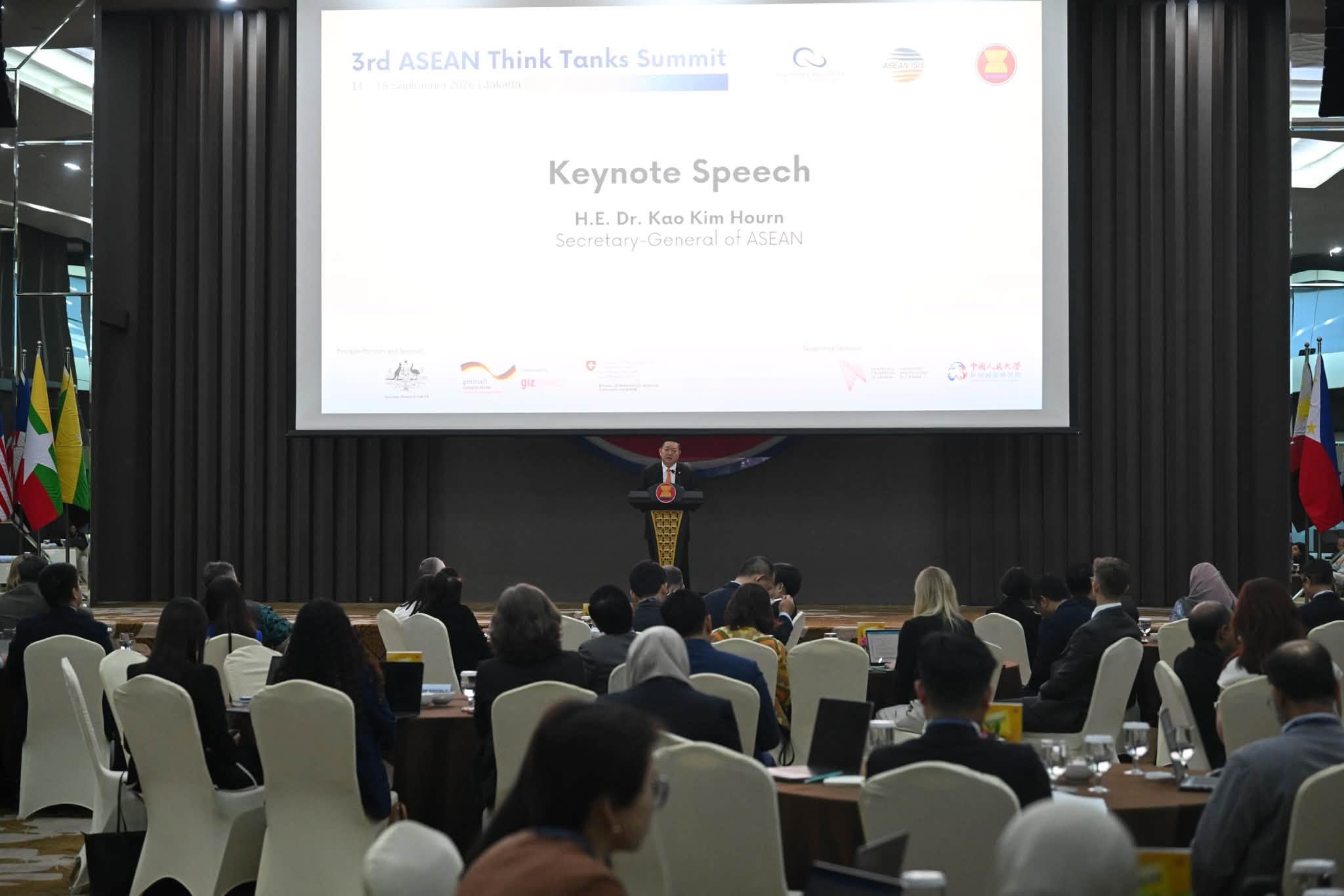
Delivering the keynote address at the opening of the 3rd ASEAN Think Tanks Summit (ATTS) at the ASEAN Headquarters/ASEAN Secretariat in Jakarta, Dr Kao said ASEAN was operating in a regional and international environment that had become “more contested, complex and unpredictable.”
The challenge, he said, was not simply to navigate these pressures, but to do so without losing ASEAN’s unity, solidarity, centrality and sense of direction as it advances the ASEAN Community Vision 2045: Our Shared Future.
“Centrality, after all, cannot rest on institutional inheritance alone; it must be earned continually through ASEAN’s ability to bring countries together, manage differences, and enable collective action where it matters,” Dr Kao said.

ASEAN Secretary-General Dr Kao Kim Hourn joins representatives of the ASEAN-ISIS Network and regional think tanks at the 3rd ASEAN Think Tanks Summit at the ASEAN Headquarters/ASEAN Secretariat in Jakarta on Sept 14, 2026.
Think Tanks Must Challenge Old Assumptions
As ASEAN begins implementing its Community Vision 2045 and prepares to mark its 60th anniversary in 2027, Dr Kao challenged the region’s think tanks to do more than generate recommendations.
“Frameworks alone will not build the ASEAN Community,” he said, stressing that the Vision would ultimately be judged by the collective choices ASEAN makes and the results those choices deliver.
Good policymaking, he said, requires rigorous analysis of a rapidly changing region, innovative ideas that are both ambitious and workable, and an honest assessment of what succeeds and what does not.
Think tanks and Track 2 diplomacy can provide intellectual space for “candour, foresight and constructive challenge” by questioning established assumptions, confronting difficult trade-offs and testing new ideas before they enter the formal policy process.
Dr Kao said they could also help ASEAN examine whether institutions, policies and approaches that served the grouping well in the past remain fit for the challenges ahead.

Delegates, policy experts and representatives from ASEAN Member States and partner countries gather at the 3rd ASEAN Think Tanks Summit at the ASEAN Headquarters/ASEAN Secretariat in Jakarta on Sept 14, 2026.
From Frameworks To Outcomes
Dr Kao identified four areas where such thinking would be particularly important: peace and dialogue, economic resilience, inclusion in the digital age and transnational security.
On peace and dialogue, he said intensifying geopolitical competition required ASEAN to continue investing in diplomacy as an instrument of first resort.
But sharper strategic rivalry, proliferating institutions and the growing use of issue-based coalitions and minilateral arrangements raise questions about whether ASEAN-led processes can retain their coherence, relevance and convening power.
On economic resilience, Dr Kao said energy security, food security and sustainability could no longer be treated as separate agendas because disruption in one could cascade into others, affecting competitiveness, social stability and ASEAN’s ability to withstand external shocks.
ASEAN already possesses much of the necessary architecture, including the ASEAN Power Grid, Trans-ASEAN Gas Pipeline, ASEAN Petroleum Security Agreement and ASEAN Plus Three Emergency Rice Reserve.
“The urgency now lies in moving from frameworks to outcomes,” he said.
Crucially, Dr Kao cautioned against equating resilience with retreat from the openness and integration that have underpinned ASEAN’s prosperity.
“The task is therefore not to reduce interdependence, but to make it safer through diversification, redundancy, stronger regional capacity, and a greater ability to absorb and recover from shocks.”
AI Growth Must Also Be Inclusive
Artificial intelligence and emerging technologies will shape ASEAN’s next phase of economic transformation, Dr Kao said, but their benefits will not automatically be distributed evenly.
Differences in digital infrastructure, skills, access to capital, data and technological capabilities could reinforce existing disparities unless deliberately addressed.
ASEAN has been laying the foundations through the ASEAN Digital Masterplan, ASEAN Guide on AI Governance and Ethics and the soon-to-be-signed ASEAN Digital Economy Framework Agreement.
“The harder task is to ensure that integration does not outpace inclusion,” Dr Kao said, particularly for micro, small and medium enterprises.
The objective should be not merely a more digital ASEAN, he added, but one in which technological progress advances economic convergence and social cohesion.
Two-Day Summit Brings Together Regional Policy Community
The two-day summit, running from Sept 14–15, is an ASEAN-ISIS initiative coordinated by the Singapore Institute of International Affairs (SIIA) and supported by the ASEAN Secretariat. The ASEAN-ISIS network brings together think tanks from across ASEAN to contribute independent Track 2 perspectives and policy recommendations on regional challenges.
Among prominent figures at the opening were SIIA Chairman Professor Simon Tay; ASEAN-ISIS Network Chair Professor Antoinette Raquiza; Australian Ambassador to ASEAN Tiffany McDonald; German Ambassador to Indonesia, ASEAN and Timor-Leste Ralf Beste; and Mathias Domenig, Deputy Head of Mission at the Embassy of Switzerland in Jakarta.
The summit follows preparatory policy work on issues including AI skilling for Southeast Asian SMEs and ASEAN energy security, economic resilience and regional integration. An August energy focus group, convened by SIIA and the Economic Research Institute for ASEAN and East Asia, examined implementation gaps and ways to strengthen regional energy preparedness and connectivity.
Recommendations from the summit process are expected to contribute to the 3rd ATTS Policy Memorandum, which is to be submitted to the ASEAN Secretariat and Permanent Representatives of ASEAN Member States for consideration ahead of the ASEAN Summit in November.
ASEAN At 60: A Time To Take Stock
With ASEAN marking its 60th anniversary under Singapore’s chairmanship in 2027, Dr Kao said the milestone should provide an opportunity to assess six decades of region-building and whether ASEAN’s assumptions, institutions and modes of cooperation remain suited to a very different strategic environment.
He called on the think-tank community to bring three qualities to that process: “candour with purpose”, “rigour with practical value” and “a strong sense of ASEAN ownership.”
Engagement with partners, he stressed, should strengthen rather than substitute ASEAN’s own capacity to define its interests and make its choices.
“ASEAN has never advanced by standing still. It has advanced by adapting – by thinking together, making choices together, and finding ways to move forward together.”
As ASEAN begins its long journey towards 2045, its ability to adapt and to question whether yesterday’s assumptions remain adequate for tomorrow’s challenges may prove as important as the institutions it has spent nearly six decades building.
- TNS News