


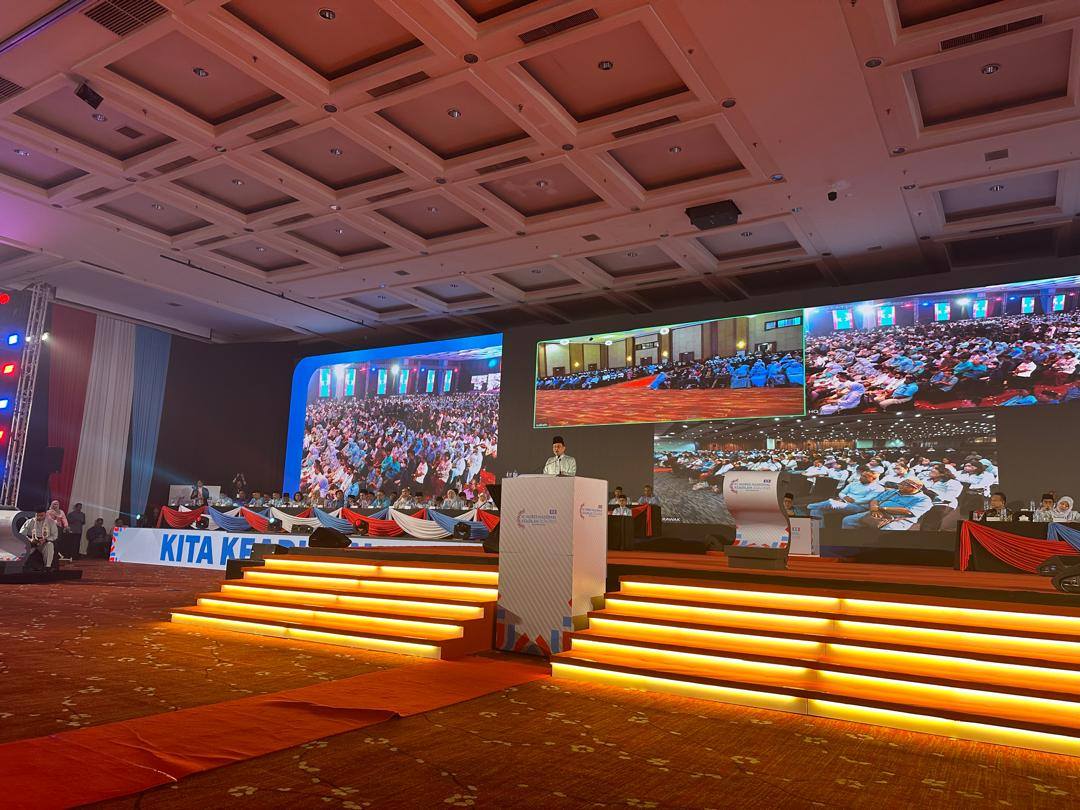

PKR National Congress. Image credit Anthony Loke Facebook
Nurul Izzah’s rise reflects a decades-long reform legacy — and a pivotal chance for PKR to unite two of its brightest minds in shaping Malaysia’s next generation of leadership.
By TENGKU NOOR SHAMSIAH TENGKU ABDULLAH
KUALA LUMPUR, MAY 24 – The recent Parti Keadilan Rakyat (PKR) party elections concluded with a defining result: Nurul Izzah Anwar’s commanding victory over incumbent Rafizi Ramli for the post of Deputy President. The outcome, placing the daughter of Prime Minister Datuk Seri Anwar Ibrahim in PKR’s second-highest position, has inevitably reignited long-standing debates around nepotism and dynastic politics in Malaysia.
Critics were quick to weigh in, questioning the optics of a party president’s daughter assuming such a senior role. The scenario echoes past controversies involving familial ties in political hierarchies, particularly given that Nurul Izzah previously served as Senior Advisor to the Prime Minister on Economics and Finance (a pro bono appointment that also drew scrutiny). Though she has consistently dismissed such criticisms, sceptics argue that influence within party ranks—even via legitimate elections—can shape perceptions of fairness and internal democracy.

Beyond the Name: A Mandate Earned
To frame her win solely through the lens of nepotism, however, is to miss a much larger truth. Nurul Izzah won with 9,803 votes, securing 71.72% of the vote against Rafizi’s 28.28%. Her popularity among grassroots members reflects years of groundwork, political maturity, and unwavering commitment to party values.
Often referred to as the “Reformasi Princess,” Nurul Izzah is no stranger to Malaysian politics. A co-founder of PKR in 1999, she has spent more than two decades championing justice, equity, and democratic reform.
As a three-term Member of Parliament representing Lembah Pantai and later Permatang Pauh, she left a tangible legacy—from founding free tuition centers for low-income families to spearheading the Multidimensional Poverty Index report in 2021, now adopted by the federal government.
With a background in Electrical Engineering and a Master’s in International Relations, her academic credentials match her policy track record. Crucially, she has repeatedly stated that she is not seeking a Cabinet position, instead choosing to focus on party-building and institutional renewal.
Speaking after the announcement of her win at the PKR National Congress in Johor Baru, she said:
“My main focus will be on integrating all efforts within the party, implementing internal reforms, and moving towards the next general election. I also ask for your prayers as my husband and I will be heading for Mecca to perform the haj after the party congress.”
Turning the Page on Political Cynicism
Malaysia now stands at a turning point. If the country hopes to move forward, it must do more than dwell on old narratives of political patronage. The next generation of leaders—especially those with experience, education, and grassroots appeal—must be supported, not sidelined.
Why shouldn’t Nurul Izzah be given a chance to prove her leadership? Why must Malaysia continue to discredit young leaders before they’ve even had the opportunity to serve meaningfully?
Countries like Singapore provide useful parallels. The orderly transition from Lee Hsien Loong to Lawrence Wong was not just an exercise in stability—it was a strategic investment in leadership succession. Malaysia, too, must begin building political depth through youth development, mentorship, and the creation of viable succession paths.
Her victory also reflects strong support from within the party: both PKR’s Wanita and Youth wings, as well as several state chapters, had publicly endorsed her candidacy prior to the vote. Observers had predicted her win for weeks, citing waning sentiment among grassroots members toward Rafizi.

Rafizi Ramli with Anthony Loke at PKR National Congress. Picture credit Anthony Loke Facebook
Rafizi Ramli: A Pillar Still Standing
This outcome is not a personal defeat for Rafizi Ramli, who remains one of the country’s most capable reformists. As Minister of Economy, his contributions—particularly in championing policy innovation and accountability—have earned him wide respect. His establishment of Invoke Malaysia and his role as a prominent whistleblower underscore his commitment to systemic reform.
In this light, the post-election moment must not be defined by division but by collaboration. Rafizi and Nurul Izzah, both reform-minded leaders, are well-positioned to complement one another in advancing PKR’s vision and serving the broader national interest.
When asked for comment after the official results, Rafizi said simply:
“The focus should be on Nurul Izzah now, not me.”
PKR’s Next Chapter: GE16 and Beyond
The new PKR leadership team, elected to serve from 2025 to 2028, will likely steer the party into the 16th General Election, expected in early 2028. Besides Nurul Izzah, vice-presidency posts were clinched by Datuk Seri Amirudin Shari, Datuk Seri Aminuddin Harun, Chang Lih Kang, and Datuk Seri R. Ramanan. Prominent youth voices such as Fahmi Fadzil, Adam Adli, and Chan Ming Kai also secured top votes for the party’s central committee.
With fresh leadership at the helm, PKR now faces the challenge of consolidating support, driving reform, and proving that its next generation is ready not just to inherit the mantle of leadership—but to reshape it.
Conclusion: A Defining Opportunity
Nurul Izzah’s victory—achieved through an open, democratic process—marks more than just a personal milestone. It signals an opportunity for Malaysia to reimagine its political future. By supporting leaders like her, the country can lay the foundations for a more dynamic, inclusive, and future-ready leadership landscape.
In this critical decade, where social, economic, and global shifts are reshaping governance models worldwide, Malaysia must decide: Will it cling to suspicion, or will it nurture its emerging leaders with vision and courage?
In the end, it is not her surname that will define her leadership—but what she chooses to do with it.
- TNS News