


By TENGKU NOOR SHAMSIAH TENGKU ABDULLAH
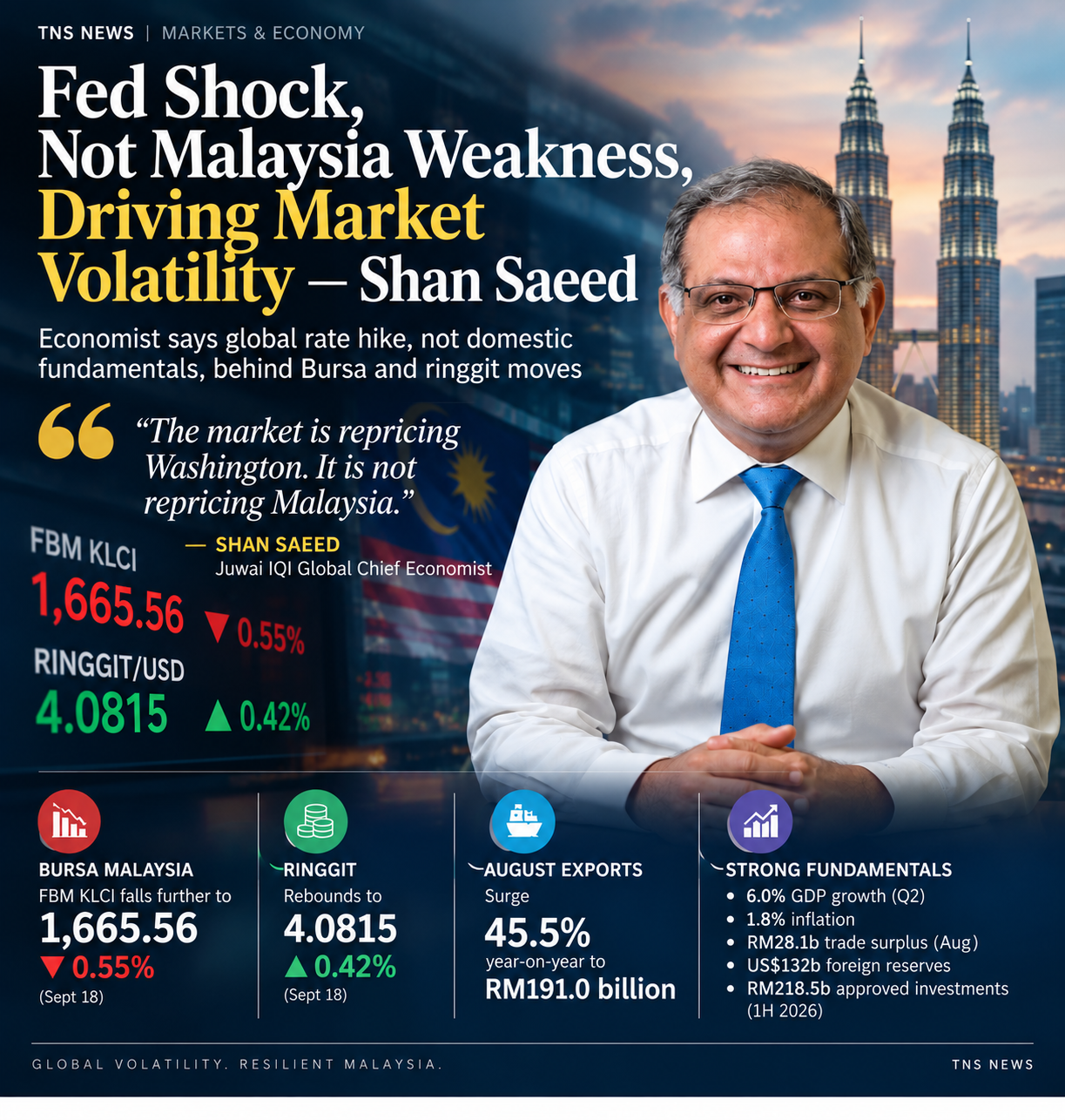
KUALA LUMPUR, Sept 19 – The renewed pressure on Bursa Malaysia following the US Federal Reserve’s first interest-rate increase in more than three years reflects a global repricing of capital rather than a deterioration in Malaysia’s economic fundamentals, according to Juwai IQI Global Chief Economist Shan Saeed.
Malaysian financial markets were jolted on Thursday after the Fed raised its benchmark rate by 25 basis points to 3.75%–4.00% on Sept 16 and signalled that further tightening could follow as US inflation remains elevated. The move pushed US Treasury yields higher and strengthened the dollar, increasing pressure on emerging-market currencies and equities.
The FBM KLCI closed Thursday 0.26% lower at 1,674.74, while the ringgit weakened to around 4.0965 against the US dollar.
The pressure on equities persisted on Friday, with the benchmark index falling a further 9.18 points, or 0.55%, to 1,665.56, bringing its decline for the week to about 1.25%.
The currency picture, however, improved. The ringgit reversed Thursday’s decline to strengthen 0.42% to 4.0815 against the US dollar on Friday as oil prices and US Treasury yields eased.
For Shan, the distinction is critical.
“Today’s move is principally a global cost-of-capital shock – not a Malaysia-specific confidence event,” he told TNS News in response to questions on the market volatility.
“The market is repricing Washington. It is not repricing Malaysia.”
Higher US Rates Reprice Emerging Markets
Shan said the combination of higher US interest rates, elevated Treasury yields and a stronger dollar had mechanically tightened global financial conditions and increased the discount rate applied to emerging-market assets.
The Fed’s Sept 16 decision marked its first rate increase in more than three years. US policymakers also indicated that another increase could come before the end of 2026, while raising their inflation projections.
US Treasury yields initially moved higher following the decision, with the benchmark 10-year yield around the 5% level, increasing the relative attractiveness of US assets and putting pressure on emerging markets.
Shan said the relatively contained decline in the FBM KLCI immediately following the Fed decision looked more like a portfolio adjustment than a reassessment of Malaysia’s sovereign or macroeconomic credibility.
Malaysia’s domestic economic data, he said, continued to provide a strong counterweight to global financial volatility.
The economy expanded 6.0% year-on-year in the second quarter, lifting first-half growth to 5.7% from 4.5% in the corresponding period of 2025.
Manufacturing expanded 7.3%, services 5.9% and construction 6.5%, while exports of goods and services rose 17%. Electrical, electronic and optical manufacturing grew 14.4%.
“The domestic numbers remain powerful,” Shan said.
Fresh Trade Data Reinforce External Resilience
New trade figures released on Friday provide further context to that argument.
Malaysia’s exports surged 45.5% year-on-year to RM191.0 billion in August, while total trade climbed 43.4% to RM354.0 billion.
Imports rose 41.1% to RM163.0 billion, leaving Malaysia with a RM28.1 billion trade surplus, 77.1% larger than a year earlier.
For the first eight months of 2026, Malaysia’s total trade reached RM2.5 trillion, while the cumulative trade surplus climbed 127.6% to RM198.7 billion.
The latest figures add weight to Shan’s argument that Malaysia is confronting tighter global financial conditions with a comparatively strong external position.
Bank Negara Malaysia’s international reserves stood at US$132.0 billion as at Aug 28.
Ringgit Movement Points To Dollar Story
Shan said Thursday’s currency movements were particularly revealing because the ringgit weakened against the US dollar while strengthening against several other major currencies.
“A currency suffering a genuine domestic confidence shock would normally weaken more broadly,” he said.
“Instead, this is predominantly a dollar-duration story driven by US monetary policy.”
That argument received further support on Friday when the ringgit recovered against the greenback as US Treasury yields and oil prices eased.
Brent crude fell to around US$104.82 a barrel, while the US two-year and 10-year Treasury yields declined by about seven basis points to 4.67% and 4.94%, respectively, improving risk sentiment.
Shan said Malaysia’s combination of economic growth, contained inflation, labour-market stability and external surpluses did not point to an economy experiencing macroeconomic dislocation.
“It is the profile of an economy absorbing an external monetary shock from a position of relative strength,” he said.
Sensitivity Does Not Mean Vulnerability
Higher US interest rates nevertheless raise the risk of capital being drawn towards dollar-denominated assets, particularly when global investors become more risk-averse.
Shan acknowledged that Malaysia would remain exposed to such portfolio rotations because of the depth and liquidity of its financial markets.
But he cautioned against equating that sensitivity with structural vulnerability.
“Malaysia will always be sensitive to global portfolio rotations because its capital markets are deep and liquid. But sensitivity is not vulnerability,” he said.
Even amid recent equity-market volatility, international investors continue to hold substantial Malaysian assets, while longer-term investment commitments remain strong.
Malaysia recorded RM218.5 billion in approved investments in the first half of 2026, up 11.7% year-on-year.
Foreign investment accounted for RM126.9 billion, or 58.1% of the total, rising 18.5%, while the 2,746 approved projects are expected to create more than 99,000 jobs once implemented.
“Portfolio flows can reverse in days; FDI and productive capital reflect multi-year conviction,” Shan said.
Productivity Emerging As Another Signal
Shan said Malaysia’s improving productivity performance was another factor global investors should consider when assessing the economy’s longer-term trajectory.
Manufacturing labour productivity per hour worked increased 7.1% in the second quarter, while productivity in electrical, electronic and optical products jumped 14.9%.
“That is precisely the type of productivity deepening global investors want to see in an economy moving further up the value chain,” he said.
The figures are significant as Malaysia seeks to translate large investments in semiconductors, data centres, cloud computing and advanced manufacturing into higher-value economic activity rather than relying solely on investment volumes.
What Markets Should Watch Next
Shan identified four variables that would determine the next phase for Malaysian financial markets: US Treasury yields, the US dollar, oil prices, and the trajectory of Malaysian corporate earnings and investment.
“If US yields stabilise, the dollar loses momentum and the Fed’s tightening path becomes more predictable, pressure on Asian currencies and equity valuations should moderate,” he said.
Friday’s movements offered an early illustration of that relationship: US Treasury yields and oil prices eased, the ringgit strengthened, although the FBM KLCI remained under pressure from selling in selected heavyweight stocks.
Shan cautioned that another sharp increase in US yields, renewed dollar appreciation, prolonged geopolitical stress or a disorderly rise in global energy prices could produce further portfolio volatility.
But he said these external risks should be distinguished from Malaysia’s underlying economic position.
“Malaysia is experiencing global financial-market volatility against a backdrop of improving domestic economic fundamentals,” Shan said.
“Growth is accelerating. Investment is expanding. Inflation remains contained. The external account remains in surplus. Foreign direct investment continues to enter the economy, and international capital remains materially invested in Malaysian sovereign debt.”
For Shan, the current market turbulence is ultimately about the changing global price of money rather than a loss of confidence in Malaysia.
“The current volatility is therefore better understood as a repricing of the global cost of capital — not a repricing of Malaysia’s economic credibility.”
- TNS NEWS