


By TENGKU NOOR SHAMSIAH TENGKU ABDULLAH
KUALA LUMPUR, Sept 15 (TNS NEWS) – The next global oil shock may not begin with crude. It may begin inside the world’s refineries.
Diesel refining margins have exploded to record levels across Europe and the United States, exposing a critical weakness in the global energy system: having crude oil is no longer enough when the capacity to convert it into the fuel that moves trucks, ships, farms, mines and supply chains becomes scarce.
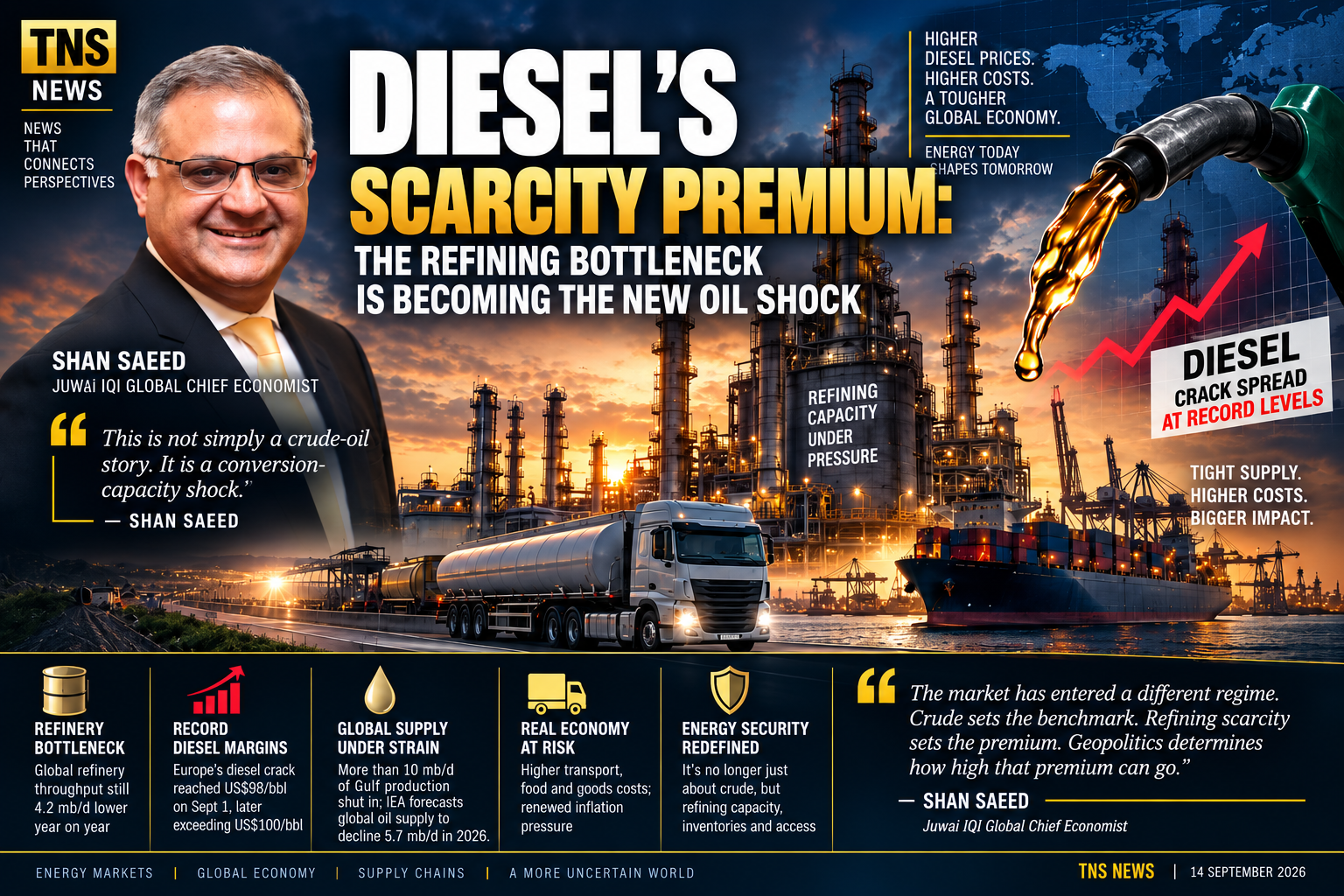
“This is not simply a crude-oil story. It is a conversion-capacity shock,” Shan Saeed, Juwai IQI Global Chief Economist, told TNS News.
The extraordinary widening of diesel refining margins is increasingly signalling that the marginal cost of usable energy is being determined not simply at the oil well, but downstream by refinery capacity, middle-distillate inventories, shipping routes and geopolitical access.
For the global economy, that distinction matters enormously.
Diesel Cracks Are Flashing A Warning
One of the clearest indicators of the structural break is the diesel crack spread — broadly, the margin between the value of the refined fuel and the crude oil from which it is produced.
Europe’s ICE gasoil crack spread has surged to levels rarely, if ever, seen in modern markets.
In the physical market, the Amsterdam-Rotterdam-Antwerp diesel crack reached a record US$98 a barrel on September 1, compared with monthly averages of US$80.50 in August, US$71.71 in July and only US$44.75 in June.
The squeeze subsequently intensified in southern Europe, where diesel refining margins moved above US$100 a barrel, with the Financial Times reporting a record US$104.08 a barrel.
The United States has experienced an even more dramatic dislocation. Diesel crack spreads reached a record US$112.17 a barrel, while average retail diesel prices crossed US$6 a gallon for the first time.
Brent crude, meanwhile, settled at US$104.61 a barrel on September 11.
The significance lies not merely in the absolute price of oil, but in the widening gap between crude and the refined fuels required by the real economy.
“The market message is unequivocal: crude availability alone no longer defines energy security,” Shan said.
“Refining capacity, middle-distillate inventories, freight routes and geopolitical access now determine the marginal barrel of usable energy.”
The Refinery Has Become The Bottleneck
For decades, global oil-market analysis has concentrated overwhelmingly on upstream supply.
Markets watched OPEC production, Saudi spare capacity, U.S. shale output, geopolitical disruption and movements in Brent and West Texas Intermediate.
But crude oil is an input, not the final fuel consumed by most businesses.
Before a barrel can power a truck, tractor, excavator or industrial machine, it must be processed through a refinery capable of producing the required petroleum products.
That conversion system is now under severe strain.
The International Energy Agency estimated global refinery throughput at 81.4 million barrels per day in August, still 4.2 million barrels per day below the level a year earlier.
Refining margins consequently reached record levels across the Atlantic Basin, led by diesel.
The pressure reflects a convergence of disruptions rather than a single supply shock: reduced refinery availability, geopolitical instability, constrained product flows, shipping insecurity and increasingly depleted inventories.
That combination has created a market in which the availability of crude somewhere in the global system no longer guarantees adequate supplies of diesel where and when economies need it.
For Shan, this represents an important change in the architecture of energy security.
“This is not simply a crude-oil story. It is a conversion-capacity shock,” he said.
The World’s Oil Buffer Is Being Eroded
The refining squeeze is also occurring against a backdrop of rapidly declining global oil inventories.
Observed global oil inventories fell another 95 million barrels in August, bringing cumulative draws since February to approximately 507 million barrels.
At the same time, more than 10 million barrels per day of Gulf production remained shut in, prompting the IEA to forecast a 5.7 million barrels-per-day decline in global oil supply during 2026.
These numbers matter because inventories are the shock absorbers of the energy system.
When stocks are abundant, refiners, traders and governments have greater capacity to compensate for interrupted production, refinery outages or shipping disruptions.
When inventories are depleted, the system becomes increasingly sensitive to every lost cargo, damaged facility or disrupted trade route.
The result is a scarcity premium that can persist even when movements in headline crude prices appear less dramatic.
Diesel Is Where The Oil Shock Meets The Real Economy
The macroeconomic consequences of diesel scarcity are potentially more significant than the commodity-market headlines suggest.
Unlike some petroleum products, diesel is embedded directly in the machinery of economic activity.
“Diesel sits inside the real economy — trucking, agriculture, mining, construction, shipping and industrial logistics,” Shan said.
“A sustained diesel premium therefore behaves like a tax on the global supply chain, transmitting the energy shock directly into freight rates, food costs and inflation expectations.”
The transmission mechanism is straightforward.
Higher diesel prices increase the cost of moving goods by road. Agricultural producers pay more to operate machinery. Mining and construction companies face higher equipment and transportation expenses. Shipping and logistics operators absorb additional fuel costs.
Those increases eventually move through supply chains.
Businesses must either accept narrower margins or pass the additional costs to customers.
In that sense, the diesel shock can migrate from the refinery into the supermarket, construction site, factory and ultimately the consumer-price index.
The chain can be expressed simply:
Energy Shock → Transport Costs → Production Costs → Food And Goods Prices → Inflation Expectations → Monetary-Policy Pressure
This is why the diesel crack spread deserves attention far beyond commodity trading desks.
It can become a macroeconomic early-warning indicator.
The Oil Shock Has Acquired A Second Layer
With Brent above US$100 a barrel and diesel refining premiums themselves approaching or exceeding US$100 in some markets, the global economy is confronting two layers of energy stress simultaneously.
The first is the price of crude.
The second is the scarcity premium required to transform that crude into usable fuel.
That distinction changes the way energy security needs to be understood.
Strategic petroleum reserves and domestic crude production remain important, but they are only part of the equation.
Refinery configuration, middle-distillate inventories, storage capacity, shipping access, freight costs and diversified sources of refined products have become strategic economic assets in their own right.
A country may theoretically have access to crude oil and still confront a serious fuel-security problem if it lacks sufficient refining capacity or reliable access to refined-product markets.
As Shan put it: “Crude availability alone no longer defines energy security.”
Geopolitics Is Moving Downstream
The new refining shock also demonstrates how geopolitical risk is moving deeper into the energy supply chain.
Wars and sanctions can disrupt crude production, but they can also affect refineries, pipelines, shipping lanes, insurance costs and the international trade in refined petroleum products.
That creates multiple points at which a geopolitical event can raise the ultimate cost of energy.
A disruption no longer has to remove millions of barrels of crude permanently from the market to inflict economic damage.
It may instead reduce refinery throughput, lengthen shipping routes, increase insurance premiums, fragment product markets or prevent diesel from reaching the regions where it is most urgently required.
This helps explain why refined-product prices can remain severely stressed even when crude markets temporarily stabilise.
The critical variable is no longer simply how much oil exists.
It is increasingly where that oil is located, whether it can be refined, what products the refinery can produce and whether those products can reach consumers economically and securely.
Asia Cannot Ignore The Diesel Squeeze
The implications are particularly important for Asia.
The region sits at the centre of global manufacturing and merchandise trade and depends heavily on road freight, shipping, construction and industrial logistics.
Many Asian economies are also significant net energy importers.
A prolonged diesel scarcity premium could therefore reach the region through several channels simultaneously — higher freight costs, more expensive imported energy, renewed inflationary pressure, weaker household purchasing power and deteriorating trade balances.
Malaysia has some insulation through its domestic energy resources and refining infrastructure, but it remains deeply integrated into regional manufacturing networks and international trade.
The country cannot therefore be completely separated from a global increase in logistics and refined-product costs.
For businesses and policymakers, the relevant energy-market question is consequently becoming broader than where Brent trades from one day to the next.
They must increasingly consider whether the global refining and logistics system can reliably deliver sufficient middle distillates at economically sustainable prices.
From Oil Security To Usable-Energy Security
The structural lesson from the current diesel dislocation is that energy security itself may require a broader definition.
For much of the modern oil era, security was largely associated with access to sufficient crude supplies.
The emerging challenge is usable-energy security.
That means maintaining adequate crude supply while simultaneously ensuring sufficient refinery capacity, resilient infrastructure, adequate inventories, diversified trade routes and reliable access to the fuels required by transportation, agriculture and industry.
The distinction may prove increasingly important as geopolitical fragmentation reshapes energy flows and countries place greater emphasis on strategic resilience.
For energy-importing economies in particular, refining capacity and product inventories can become as strategically important as crude reserves.
The New Oil Shock Is Downstream
The global oil market has entered a different regime.
Crude remains fundamental. But the extraordinary movement in diesel crack spreads shows that the price of the raw barrel no longer tells the entire energy story.
The refinery — once treated largely as the industrial bridge between crude production and final consumption — is becoming a critical point of scarcity.
And because diesel sits at the intersection of transportation, agriculture, construction, mining, shipping and industrial production, the consequences can migrate quickly from energy markets into inflation, corporate margins, household purchasing power and monetary policy.
For Shan, the market’s message can be reduced to three sentences.
“The market has entered a different regime,” he said.
“Crude sets the benchmark. Refining scarcity sets the premium. Geopolitics determines how high that premium can go.”
That may ultimately be the defining characteristic of the emerging oil shock: the world is not simply paying more for crude.
It is paying an extraordinary premium to turn crude into the fuel that keeps the global economy moving.
- TNS NEWS