


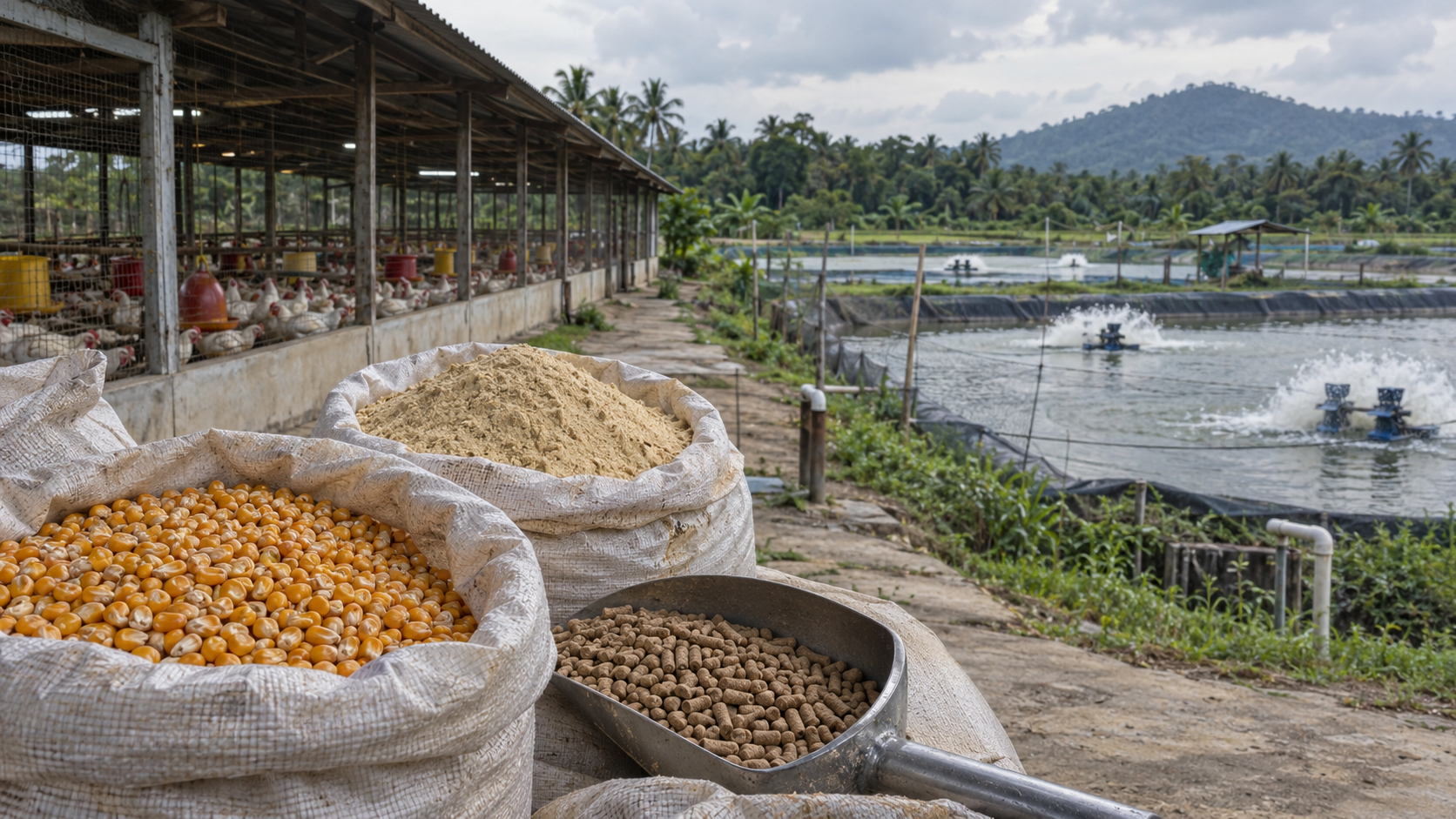
Malaysia produces most of its chicken and is close to 90% self-sufficient in fish. Yet Professor Emerita Dato’ Dr Roshada Hashim warns that this apparent strength rests on imported feed. Her prescription: build a smaller, smarter aquaculture system around affordable fish and locally sourced ingredients.
IN BRIEF: Malaysia produces most of its chicken, eggs and farmed fish, but depends heavily on imported feed, particularly maize, soybean meal and fishmeal.
Chicken is Roshada’s greatest concern because it is Malaysia’s most affordable and widely consumed animal protein, and its production costs can track global feed prices within weeks.
The obstacle is not a lack of research. It is the missing commercial supply chain between promising local feed ingredients and the feed mill.
Her proposal: focus on catfish, tilapia and patin, test local-ingredient feeds through regional pilots, and measure success by affordability and resilience rather than tonnage alone.
BY TENGKU NOOR SHAMSIAH TENGKU ABDULLAH
KUALA LUMPUR, Sept 8 – Malaysia appears well supplied with protein. It produces about 94% of its chicken, has a surplus of eggs and, by fisheries-sector measures, is close to 90% self-sufficient in fish — among the country’s highest ratios for any food group.
Professor Emerita Dato’ Dr Roshada Hashim says those figures tell only part of the story.
The animals may be raised locally, but much of what they eat is imported. Malaysia’s poultry, livestock and farmed-fish sectors rely chiefly on imported maize, soybean meal and fishmeal, turning an apparent strength into a significant exposure. Domestic production is only as secure as the next feed shipment.
“High domestic production does not guarantee a secure protein supply, particularly when it relies heavily on imported feed ingredients, unstable costs and vulnerable global supply chains,” she told TNS News. In other words, a high self-sufficiency ratio can conceal the system’s underlying fragility.
Roshada, a Budi Fellow at the Faculty of Science and Technology at Universiti Sains Islam Malaysia, is a fish-nutrition scientist and higher-education leader. Her argument builds on Part One of this series: Malaysia focuses too heavily on how much food it produces and not enough on whether the system can withstand disruption. Protein, particularly farmed fish, exposes that gap.
Protein Security Is About Access, Not Just Supply
“Protein security means ensuring that all Malaysians have reliable access to enough safe, nutritious and affordable protein, even when prices rise or supply chains are disrupted,” Roshada said. “Having fish, chicken, meat and eggs in the market is not enough if people cannot afford to buy them.”
The distinction matters most to lower-income households. When protein becomes expensive, families may consume less of it and rely more heavily on cheaper, carbohydrate-rich foods. Shelves can remain full even as diets become less nutritious.
“Protein insecurity is therefore not only about hunger,” she said.
It can affect children’s growth, health and ability to learn, as well as the nutritional wellbeing of older adults.
Why Chicken Worries Her Most
Asked which protein concerns her most, Roshada does not hesitate: chicken, followed by eggs.
Poultry farming is intensive and depends on formulated feed rich in imported maize and soybean meal. “When global feed prices rise, production costs can increase within weeks,” she said, even if subsidies and price controls temporarily cushion consumers. “Chicken is my greatest concern because it is the most affordable and widely consumed animal protein in Malaysia.” A feed shock therefore threatens both producers and households’ ability to afford adequate protein.
Farmed fish face the same pressure, although the effects may emerge more slowly. When feed becomes more expensive, Roshada said, some farmers reduce rations or use cheaper, lower-quality supplements and by-products such as chicken offal. That may suppress costs temporarily, but can lead to slower growth, uneven quality, poorer water conditions and lower output. Wild-caught fish avoid the feed problem, but catches are finite and cannot simply expand to fill the gap.
Why Feed Research Stalls Before Commercialisation
Malaysian researchers have spent years testing local alternatives to imported feed ingredients, including black soldier fly larvae and chicken-processing by-products. Yet few have reached commercial feed mills. Roshada describes the impasse as a Catch-22.
“Feed companies will not reformulate their products without a reliable commercial supply, while processors are unlikely to invest in large-scale production without firm demand from feed companies,” she said. Each side waits for the other, leaving promising ingredients in the laboratory.
The size of Malaysia’s aquaculture market compounds the problem. The sector produces only about 300,000 tonnes of finfish annually, so demand for any single novel ingredient may be insufficient to support a dedicated processing plant, particularly when imported alternatives offer consistent specifications. One solution, she said, is to develop ingredients suitable for poultry and livestock feed as well, creating a market large enough to support commercial processing.
“The main gap is not a lack of scientific knowledge,” she said. “It is the lack of a commercially viable supply chain linking the source material to the feed mill.”
Closing that gap requires investment in the neglected middle stage between research and full commercial production. Roshada proposes selecting a small number of materials with dependable supply; involving waste producers, processors, feed mills and farmers from the outset; building pilot-scale processing capacity; setting clear quality specifications; and offering temporary support, such as shared facilities or guaranteed initial purchases, to reduce the risk of early commercial runs.
A Three-Fish Strategy
If designing a production programme from scratch, Roshada would not attempt to support every species. She would begin with three freshwater fish: catfish, tilapia and patin.
All three are familiar to farmers and consumers, grow quickly and tolerate varied conditions. Crucially, they can use feeds containing local ingredients more effectively than higher-value marine species such as siakap and grouper. The objective, she stressed, is not to produce premium fish, but a dependable and affordable source of protein for lower-income households.
Her proposed programme would cover the entire value chain: reliable hatcheries producing healthy, uniform fingerlings; genuine selective-breeding programmes; a short list of practical feeds using local ingredients; standard pond and tank protocols; farm clusters sharing hatcheries, feed and technical services; validation over several production cycles on working farms rather than only in research tanks; routine fish-health and water-quality monitoring; and firm market links. FAMA could help channel production to processors, retailers and food programmes serving B40 households.
Each stage would be measured against clear targets, including “production cost per kilogram, survival rate, feed-conversion ratio, farmer income, retail price and reliability of supply.” The test would be whether fish remains affordable and consistently available, not simply how many tonnes are produced.
No Single Farming Model Fits Everywhere
Roshada is cautious about fashionable solutions. A fundamental rethink of fish farming, she said, does not mean replacing intensive aquaculture with one supposedly universal alternative.
There is no single model that will work everywhere, she said.
She is particularly cautious about livestock-fish integration. Using animal waste to fertilise fish ponds may be technically possible, but raises concerns about food safety, water quality and consumer acceptance. “If consumers reject it, it will not work,” she said. For that reason, she does not see the model becoming a national solution.
Semi-intensive ponds hold greater promise. Natural pond food and supplementary feed can share the load, reducing reliance on imported formulated feed and helping farmers maintain production when imports become scarce or expensive. But ecological risks remain. Tilapia is biologically suited to these systems but invasive, and should be kept away from open waters, flood-prone areas and rice fields connected to natural waterways. African catfish is hardy but depends more heavily on external feed. Patin may be suitable but requires further study. Open-water cages, she noted, offer little protection from a feed disruption.
Rice-fish farming, discussed in Part One, may also have a role. But Roshada warned against importing another country’s model wholesale. Any Malaysian system must account for local pesticide use, irrigation and flooding, while preventing non-native fish from escaping into rivers.
The Goal Is Reform, Not Another Pilot
Malaysia has already studied livestock-fish-crop integration, rice-fish systems and semi-intensive ponds. The problem, she said, is that projects have remained small, local and detached from a national strategy. She proposes carefully controlled regional pilots comparing intensive and semi-intensive systems against common measures: feed dependence, resilience during disruption, production cost, consumer acceptance, environmental risk and, above all, whether the fish remains genuinely affordable.
Even successful pilots will fail without sustained support, she cautioned. That includes suitable production zones, long-term farmer training and financing – support that must continue beyond the initial grant.
“Too many initiatives disappear when the funding ends or the political leadership changes,” she said, capturing a persistent weakness in Malaysian agricultural development.
The Policy Belief Malaysia Must Abandon
If Malaysia gets the system right over the next decade, Roshada said, more families could regularly afford locally farmed freshwater fish. Affordability is not the only test: the fish must also be appealing and nutritious. For her, that means fish that is “not too fatty and free from the muddy taste that puts some consumers off,” achieved through good feed and clean water. Consistent quality would also allow processors to offer cleaned, portioned fish suited to busy households.
Her closing message to policymakers brings the article back to its central point.
“The one belief I would like policymakers to drop is that food security simply means producing enough food. It does not,” she said. “Food may be available in the country, but can ordinary families afford it? Can they get it regularly?”
Roshada said Malaysia still lacks a national blueprint connecting production, affordability and access. “We need to look beyond production figures and ask a more important question: Is nutritious food (in this case fish protein) actually reaching the people who need it, at a price they can afford?”
This is the second article in the TNS News Food Security Series. Part One examined why self-sufficiency ratios alone do not capture Malaysia’s food resilience.
- TNS NEWS: Food Security Series, Part 2 · tnsnews.com.my