


A Paris route reversal and legal challenges put the government’s public order response under scrutiny
By TENGKU NOOR SHAMSIAH TENGKU ABDULLAH
24 October 2026 – Morning in France
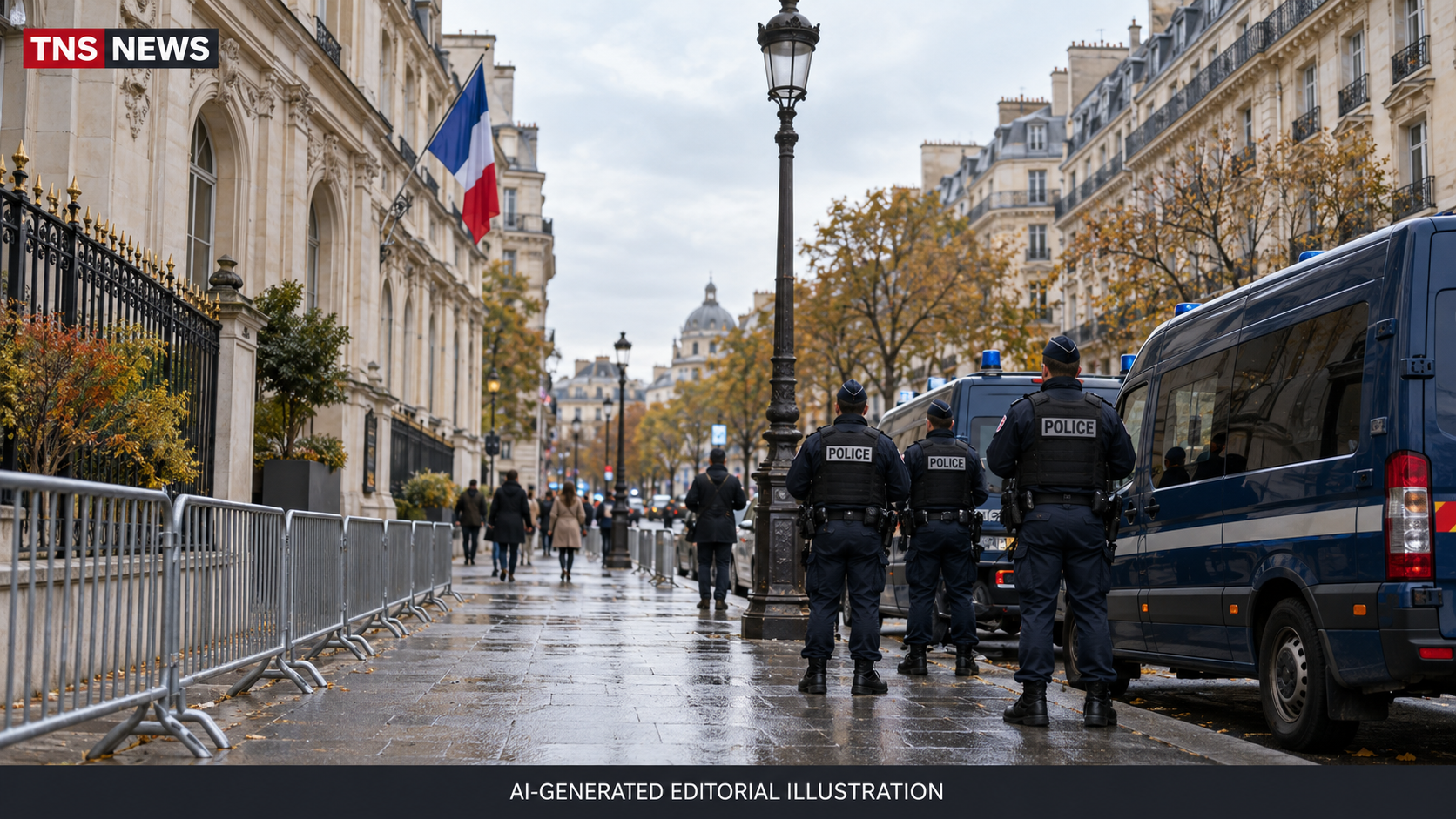
France prepared for renewed demonstrations on Saturday, 24 October, with Interior Minister Laurent Nuñez announcing a nationwide deployment of about 70,000 police officers and gendarmes, while restrictions on marches prompted opposition from unions and legal challenges.
The mobilisation comes a week after violence on the margins of demonstrations damaged businesses and public buildings. The government says its measures are needed to prevent further destruction; organisers argue that peaceful protesters must retain the right to march.
Nuñez said specialist intervention units would be involved, alongside conventional public order forces. Le Monde reported that the plan also placed greater emphasis on checks at stations and transport routes to detect equipment that could be used in violence. The announced total is a nationwide security figure, rather than the number assigned to a single demonstration.
Paris Route Reversed
The planned Paris march became a point of contention before Saturday began. A Bastille-to-Nation route had initially been accepted, while a proposed march towards Opéra was prohibited.
An order published on Friday evening then barred the Bastille-to-Nation itinerary. According to Le Parisien, the police prefecture proposed a route between Porte d’Italie and Porte de Vincennes instead, citing difficulties securing the original route and the risk of breakaway groups.
Unions and student organisations objected to the reversal. Le Monde reported that the inter-union group intended to retain its original route despite the prohibition. The dispute left the arrangements contested ahead of the scheduled afternoon mobilisation.
Elsewhere, local authorities imposed restrictions of differing scope. AFP reporting carried by Le Monde said Lyon’s order covered protest processions and gatherings on public roads from 10am to 11pm on Saturday. The measures varied by locality, with no uniform national ban.
Protest Rights Remain Contested
President Emmanuel Macron’s remarks on Thursday intensified the controversy. He advocated avoiding demonstrations in the coming days and said non-union protests would be prohibited wherever possible, according to TF1 Info.
Political parties and civil liberties organisations challenged the statements before the Conseil d’État. Friday’s rejection of the applications did not establish a new legal requirement that only trade unions may organise protests.
As reported by AFP, the emergency judge found that the remarks did not themselves reveal a blanket prohibition or an instruction imposing one on prefects. Local authorities must assess the public order risks of each planned demonstration and cannot justify a ban solely by referring to the president’s statement.
The distinction leaves individual restrictions open to legal challenge. On Thursday, the Paris administrative court had already suspended a ban on a student march organised by Interfac.
Transport And Cultural Closures
The security measures also affected daily life. RATP’s published notice listed 24 stations closing from 9am on Saturday, together with additional service interruptions. Reopening was subject to police authorisation, the operator said.
A separate overnight curfew remained in designated areas around République and Les Halles, rather than across all of Paris. Reports put the restrictions at 11pm to 6am through Monday morning, 26 October; exemptions and precise boundaries remain governed by local orders.
The Associated Press reported Saturday closures at the Louvre, Musée d’Orsay and Grand Palais, while Art Basel cancelled its weekend programme. In Orléans, unions, student groups and other organisations planned an anti-far-right demonstration alongside the National Rally’s congress.
Limoges Investigation Continues
The criminal investigation into the 17 October fire at Limoges town hall also advanced. Prosecutors announced on Friday that a judicial investigation had been opened and requested pretrial detention for two suspects, aged 34 and 66, Le Parisien reported with AFP.
The offences under investigation included attempted homicide and death threats against a police officer, destruction of the town hall and criminal association. The men had been arrested on Tuesday and Thursday respectively and were due before an investigating magistrate on Friday evening.
The reports cited the prosecutor’s application for detention, without confirming the subsequent decisions for both suspects. The men remain presumed innocent.
Visiting Limoges on Friday, Prime Minister Sébastien Lecornu pledged state support for rebuilding the town hall to its original appearance, according to AFP. The promise of reconstruction adds a substantial recovery task to the immediate security response.
Support For Damaged Businesses
Bpifrance confirmed that applications for its Prêt Solidarité Commerce opened on Friday, 23 October. Eligible damaged businesses can seek interest-free loans of €5,000 to €50,000 over three years, including a one-year deferral of principal repayments. Eligibility conditions apply; the support is repayable finance.
The protests developed from a student movement over education conditions into wider discontent over living costs and public services. Budget proposals have added to the tensions: the Finance Ministry describes the planned 2027 adjustment as €54 billion, including €43 billion of measures in the budget bills. The total includes the effects of measures adopted previously, alongside the new budget measures.
Saturday’s immediate test is whether authorities can prevent violence while allowing peaceful demonstrations. The Paris route dispute and the courts’ handling of individual bans will help determine how that balance is struck.
- TNS NEWS