


BY TNS NEWS TEAM
Edition No. 2 | Saturday, March 28, 2026
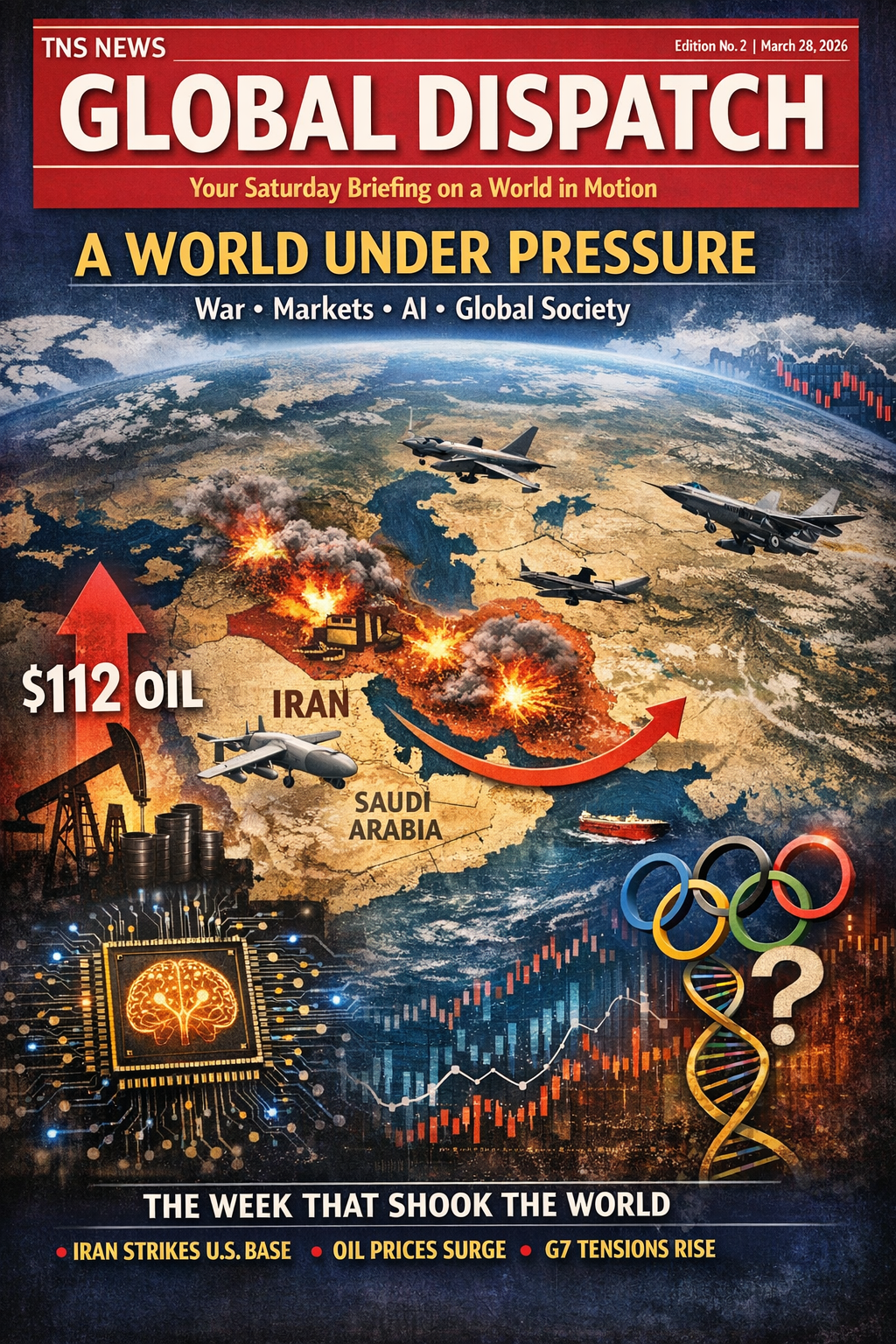
KUALA LUMPUR: The fourth week of the Iran–United States war delivered a cascade of geopolitical shocks, market turmoil and global policy debates, underscoring how a single regional conflict is now reverberating across diplomacy, financial markets, technology governance and international sport.
From a failed ceasefire proposal and a direct Iranian strike on a US-linked airbase in Saudi Arabia, to oil prices surging above US$110 and new global rules in artificial intelligence and Olympic competition, the week’s developments highlighted the widening scope of a crisis that now extends far beyond the battlefield.
Iran Rejects Washington’s Peace Plan as War Enters Day 29
Nearly four weeks after the conflict began on February 28 under what Washington termed Operation Epic Fury, diplomatic momentum stalled sharply this week.
The United States assembled a 15-point ceasefire proposal, transmitted to Tehran through intermediaries including Pakistan. Officials familiar with the proposal said it covered sanctions relief, limitations on Iran’s nuclear programme, restrictions on ballistic missiles, curbs on Tehran’s regional proxy networks and the reopening of the Strait of Hormuz, one of the world’s most critical energy transit routes.
Tehran rejected the proposal.
Iranian state broadcaster Press TV, citing a senior security official, reported that Iran would not accept a ceasefire under the current conditions. Foreign Minister Abbas Araghchi said Iran had not entered negotiations and had no immediate plans to do so.
Instead, Iran presented its own five-point counter-demand, including:
• An end to targeted killings of Iranian officials
• Guarantees against future US military action
• War reparations
• A halt to attacks on Hezbollah in Lebanon and allied militias in Iraq
• International recognition of Iranian sovereignty over the Strait of Hormuz
The final demand directly contradicts international maritime law, which treats the waterway as an international transit corridor open to all shipping.
“Iran will end the war when it decides to do so and when its own conditions are met,” the Iranian official said in remarks reported by Press TV.
Iran Strikes Prince Sultan Air Base in Saudi Arabia
The conflict escalated further late Friday when Iran launched a coordinated missile and drone attack on Prince Sultan Air Base, a major facility outside Riyadh used jointly by Saudi and US forces.
At least 10 American service members were wounded, two of them seriously, according to US officials speaking on condition of anonymity to discuss sensitive military matters.
Several aircraft were reportedly damaged, including aerial refuelling planes and an E-3 Sentry airborne early-warning aircraft, according to preliminary reporting by Air & Space Forces Magazine.
The strike was confirmed by satellite imagery analysed by open-source intelligence observers and reported by international media, including The Wall Street Journal.
US Central Command declined to comment on operational details.
The wider human toll continues to rise.
Thirteen American service members have been killed so far, according to US Central Command, with more than 300 wounded since the conflict began.
Iran’s Health Ministry reported 1,937 deaths and more than 24,800 injuries. Independent human-rights organisation Hengaw estimates the death toll may exceed 6,530 people, including at least 640 confirmed civilians.
In Lebanon, the Health Ministry reports 1,142 deaths and more than 3,300 injuries since hostilities expanded there earlier in March.
G7 Allies Confront Washington as War Widens
US Secretary of State Marco Rubio travelled to France this week for tense discussions with G7 foreign ministers, who gathered at the historic Abbaye des Vaux-de-Cernay near Paris.
Several European officials voiced frustration that Washington launched the campaign without prior consultation.
German Defence Minister Boris Pistorius described the conflict as an economic catastrophe.
“This war is a catastrophe for the world’s economies,” Pistorius said. “Nobody asked us before. It’s not our war.”
Rubio acknowledged that the conflict could continue two to four more weeks, exceeding initial estimates.
US officials also privately conceded that only about one-third of Iran’s missile capabilities had been destroyed so far.
European intelligence assessments presented at the meeting suggested Russia may be assisting Iran, including through satellite imagery and drone-technology upgrades.
The G7 issued a joint statement calling for an immediate cessation of attacks on civilians, but stopped short of criticising the United States directly.
Oil Surges Past US$110 as Markets Slide
Financial markets reacted sharply to the continuing conflict.
Brent crude oil closed Friday at US$112.57 per barrel, its highest level since mid-2022. US benchmark WTI crude settled at US$99.64.
The surge erased earlier hopes of a ceasefire that had briefly pushed prices below US$100 earlier in the week.
Wall Street endured its worst session since the conflict began.
The Dow Jones Industrial Average fell 793 points, closing at 45,166.64.
The S&P 500 declined 1.67 per cent to 6,368.85.
The Nasdaq Composite dropped 2.15 per cent to 20,948.36.
Energy supply fears are now spreading beyond oil.
Around one-third of global fertiliser trade normally passes through the Strait of Hormuz, and disruptions have already pushed fertiliser prices 30 to 40 per cent higher, raising concerns over global food production.
Several governments have begun emergency responses.
The Philippines declared a national energy emergency, while Japan temporarily lifted limits on coal-fired power generation. Vietnam removed environmental fuel taxes to ease domestic prices.
Finland’s president Alexander Stubb warned the crisis could trigger a global recession deeper than the Covid-19 downturn.
AI Breakthroughs Mark a Transformational Month
Beyond geopolitics and markets, March 2026 also marked a pivotal moment for artificial intelligence.
OpenAI released GPT-5.4 earlier this month with expanded capabilities, including a one-million-token context window and integrated computer-use functions that allow AI systems to operate software environments autonomously.
On benchmark testing designed to simulate real workplace tasks, the model reportedly achieved performance comparable to human professionals.
Google responded with Gemini 3.1, while Elon Musk’s xAI launched Grok 4.20, intensifying competition among the world’s leading AI developers.
At the same time, the United States passed the AI Accountability Act, requiring companies deploying artificial intelligence in areas such as hiring, lending, healthcare and criminal justice to conduct regular bias audits.
The legislation marks one of the first major regulatory frameworks governing advanced AI systems.
Olympic Gender Rules Ignite Global Debate
A separate controversy emerged in international sport.
The International Olympic Committee announced that eligibility for women’s events at Olympic Games and IOC-sanctioned competitions will be determined through a one-time screening for the SRY gene, beginning with the 2028 Los Angeles Olympics.
IOC President Kirsty Coventry said the measure is intended to protect the integrity of the female category.
But the decision has drawn sharp criticism from human-rights groups and some athletes.
South African runner Caster Semenya, who has long challenged gender-eligibility regulations, called the move “a step backward”.
Scientists have also cautioned that the presence of the gene does not automatically confer a competitive advantage, highlighting the complexity of biological sex variation.
Legal challenges are widely expected before the Los Angeles Games.
The Human Cost of War
Behind the geopolitical manoeuvring, the humanitarian toll continues to mount.
The UN Women agency estimates that at least 620,000 women and girls across Lebanon, Palestine and Syria have been displaced since the conflict began.
Aid agencies report worsening conditions in several areas.
In Lebanon, some families are skipping meals as food prices surge. In Iran, rescue workers responding to airstrikes have in some cases discovered relatives among the victims, according to the Iranian Red Crescent.
The humanitarian dimension of the conflict is now becoming one of its defining features.
A Rare Public Health Victory
Amid the week’s turmoil, global health officials marked a rare milestone.
The World Health Organisation verified that Chile has eliminated leprosy, making it the first country in the Americas to achieve that status.
The disease, documented for more than four thousand years, once carried deep social stigma worldwide.
WHO officials described Chile’s achievement as proof that long-term public-health investment and sustained political commitment can eradicate even ancient diseases.
What to Watch Next Week
Several developments could shape the coming week.
Washington has set April 6 as a new deadline linked to potential strikes on Iranian energy infrastructure, a move that analysts warn could push oil prices even higher.
Markets will also watch closely for signals from Tehran on possible negotiations, as well as any formal US response to allegations of Russian assistance to Iran.
The Federal Reserve’s next policy meeting on April 28-29 is now expected to be one of the most consequential in years as policymakers assess inflation risks from the conflict.
Meanwhile, legal challenges to the IOC’s new eligibility rules are already being prepared by athlete advocacy groups.
GLOBAL DISPATCH — TNS NEWS
Published March 28, 2026.
All figures verified against international reporting by AP, Reuters, Bloomberg, CNBC, NPR and other global news agencies.
All text produced by TNS News editorial team.