


YOUR SATURDAY BRIEFING ON A WORLD IN MOTION
By TNS NEWS TEAM| Edition No. 1 | Saturday, March 7, 2026
FROM THE EDITOR Welcome to the first edition of Global Dispatch — your curated Saturday guide to the stories that matter, wherever they happen. This week the world shifted on multiple axes simultaneously: a major Middle East war, an escalating conflict in South Asia, a stagflation scare on Wall Street, and a defining week for the future of artificial intelligence. We track it all, so you can start your weekend informed.
🌐 GEOPOLITICS
The Iran War: What Happened, and Why It Matters
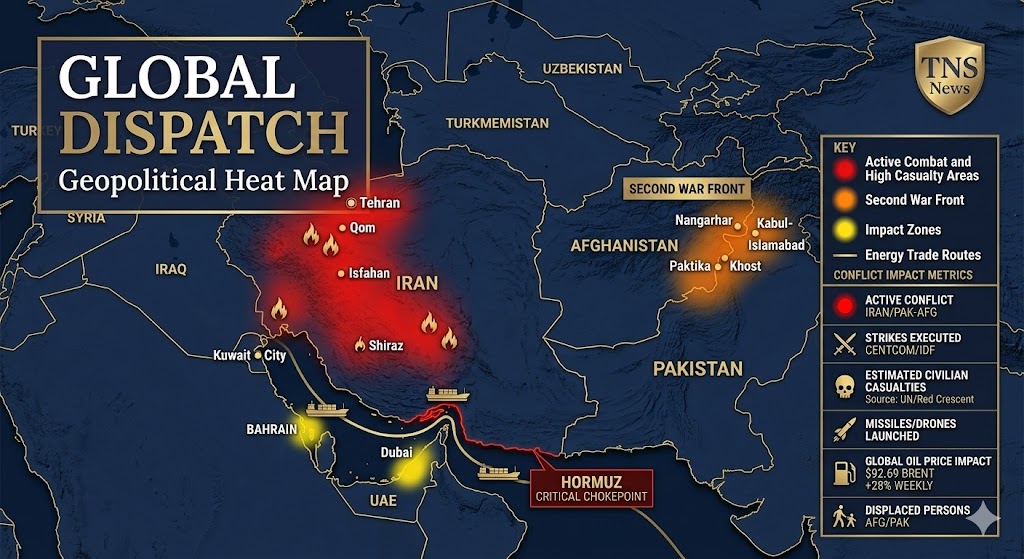
At 2:30 a.m. EST on February 28, President Donald Trump posted an eight-minute video on Truth Social announcing that the United States and Israel had begun joint airstrikes on Iran. Within hours, the world had a new war. The US operation, codenamed Operation Epic Fury, and its Israeli counterpart, Operation Roaring Lion, targeted Iran’s leadership, missile production infrastructure, nuclear sites, and military command networks across Tehran, Isfahan, Qom, Karaj, Shiraz, Tabriz, and Kermanshah.
The opening salvo was extraordinary in scale. In the first twelve hours alone, US forces executed over 900 strikes, while 200 Israeli fighter jets hit close to 500 targets. Among those killed in the initial strikes was Iran’s Supreme Leader, Ayatollah Ali Khamenei — a development that sent shockwaves through Tehran and left Iran’s political structure without its central figure for the first time since 1989. By March 5, the IDF confirmed that 40 senior Iranian military commanders had been eliminated, including the Chief of Staff of the Iranian Armed Forces.
Iran’s retaliation — designated Operation True Promise 4 — was equally sweeping. Tehran launched roughly 420 missiles and thousands of drones across nine countries, targeting US military bases, Gulf states, and Israel. Explosions were reported in the UAE (including near Dubai Airport), Bahrain, Qatar, and Saudi Arabia. An Iranian strike hit the US Embassy in Kuwait, prompting Secretary of State Marco Rubio to temporarily close it. A friendly-fire incident on March 2 saw a Kuwaiti F/A-18 accidentally shoot down three American F-15E jets; all six crew members survived. Three US Army soldiers stationed in Kuwait were confirmed killed in action.
By March 5, US Central Command reported that Iranian theatre ballistic missile launches had been reduced by 86 per cent from their early-war peak, and drone shoot-downs fell by 73 per cent — a sign that Iran’s offensive capacity is degrading, though not yet broken. The CSIS estimated that the war’s first 100 hours cost approximately US$3.7 billion, with most of that unbudgeted. Trump has said the conflict could last four to six weeks, and has demanded Iran’s unconditional surrender, a stance that has for now foreclosed any negotiated off-ramp.
“By attacking Iran without clear objectives or an exit strategy, the US and Israel turned what was the greatest strategic threat to regional security into an unpredictable set of imminent dangers.”
Brian Katulis, Middle East Institute
The diplomatic backdrop is worth remembering: just one day before strikes began, Oman’s Foreign Minister Badr Al-Busaidi announced that Iran had agreed in principle to never stockpile enriched uranium and to accept full IAEA verification, declaring peace to be ‘within reach.’ Washington went ahead regardless. Iran’s Foreign Minister Abbas Araghchi, interviewed by NBC News on March 5, made clear Tehran had not requested a ceasefire — and that Iran was ready to repel any ground offensive.
Pakistan vs Afghanistan: A Second War Breaks Out
While global attention was fixed on Iran, a separate and equally alarming military confrontation escalated along the Afghanistan-Pakistan border. On February 21, Pakistan launched airstrikes against alleged militant camps in Nangarhar, Paktika, and Khost provinces, triggering retaliatory attacks from the Afghan Taliban government. By March 6, Pakistan’s defence minister had declared a formal state of ‘open war.’
The figures from the United Nations are stark. As of March 6, UNHCR reported that at least 115,000 people had been displaced in Afghanistan and a further 3,000 in Pakistan. UNAMA recorded at least 56 Afghan civilian deaths — including 24 children and six women — with 129 more injured, figures that the UN itself described as preliminary and likely to rise. The World Food Programme was forced to suspend food distributions to approximately 160,000 people in the affected border provinces. Turkey’s President Erdogan has offered to mediate, and both Russia and China have called for de-escalation, but as of Saturday, the fighting continued unabated.
📊 GLOBAL ECONOMY
Oil Surges to US$92, Wall Street Posts Its Worst Week Since October
The Iran war delivered a direct economic shock to global markets this week, and by Friday afternoon the damage was significant. Brent crude — the international oil benchmark — surged 8.5 per cent on Friday alone to settle at US$92.69 a barrel, briefly touching US$94, its highest price since September 2023. WTI, the American benchmark, crossed US$90 for the first time in years. The spike was driven by the near-paralysis of the Strait of Hormuz — the narrow waterway through which approximately one-fifth of the world’s daily oil and LNG supply flows. According to energy intelligence firm Vortexa, crude tanker transits through the strait fell from a daily average of 24 vessels to just four on March 1, with roughly 200 internationally trading tankers stranded in the Gulf.
“You cannot sugarcoat this report. A negative payrolls number combined with a big jump in oil prices will have traders worrying about stagflation risks.”
Brian Jacobsen, Chief Economic Strategist, Annex Wealth Management
Markets had a brutal week. The S&P 500 fell 1.3 per cent on Friday and closed at 6,740, capping Wall Street’s worst weekly performance since October. The Dow Jones Industrial Average dropped
453 points and the Nasdaq fell 1.6 per cent. Airlines, shipping companies, and energy-intensive industries led the losses — Old Dominion Freight Line fell 7.9 per cent, Carnival Cruise Lines dropped 5 per cent, and Southwest Airlines shed 5.3 per cent.
Compounding the energy shock was a deeply worrying labour market reading. The US Labor Department reported on Friday that the economy shed 92,000 jobs in February — when economists had expected a gain of 59,000. The unemployment rate rose to 4.4 per cent. December’s previously reported data was also revised down by 65,000 jobs, meaning payrolls have now contracted in two of the last three months. Federal government employment has fallen by 330,000 positions, or 11 per cent, from its October 2024 peak, partly reflecting the Trump administration’s workforce reduction drive.
The combination of a stalling labour market and surging energy-driven inflation has revived a word that central bankers had hoped to leave behind: stagflation. The Federal Reserve, which had signalled rate cuts for 2026, now faces the worst-case scenario of its dual mandate — a weakening economy it cannot easily stimulate because of inflation risk. San Francisco Fed President Mary Daly put it plainly: ‘Both of our goals are at risk now and we have to keep our eyes on both.’ Goldman Sachs raised its Q2 Brent forecast to US$76 a barrel on Wednesday, warning that five weeks of sustained Hormuz disruption could push prices above US$100 — a threshold that analysts say risks tipping the global economy into recession.
For Malaysia and ASEAN, the implications are direct. As a region heavily dependent on Gulf shipping lanes for energy and petrochemical imports, any sustained Hormuz blockade will feed directly into import costs, consumer price pressure, and exchange rate stress on the ringgit. Analysts will be watching Bank Negara’s March Monetary Policy Committee statement closely.
💡 TECHNOLOGY
The Anthropic-Pentagon Rupture — and OpenAI’s Controversial Deal
The biggest AI governance story of the week was not a new model release — it was a corporate and political rupture over the military use of artificial intelligence. Anthropic, maker of the Claude AI system, refused to remove safeguards that would have allowed the US Department of Defense to use its technology for domestic mass surveillance of American citizens or for fully autonomous weapons capable of acting without human control. The Pentagon responded by designating Anthropic a ‘supply chain risk,’ and President Trump ordered all federal agencies to cease using Anthropic products within six months.
Within hours, OpenAI’s CEO Sam Altman announced that his company had struck its own deal with the Pentagon, allowing its AI models to be deployed in classified military networks. The deal, which Altman himself admitted was ‘definitely rushed’ and ‘looked opportunistic and sloppy,’ drew immediate backlash from within OpenAI and from the broader technology community. OpenAI later revised the contract’s language to more explicitly bar domestic surveillance, including the use of commercially acquired personal data.
“Anthropic pushed for moral boundaries. OpenAI settled for softer legal ones.”
MIT Technology Review, March 2, 2026
The episode exposed a structural fault line in the AI industry: how companies with stated safety commitments navigate demands from national security clients operating under wartime urgency.
Anthropic’s Claude app surged to the number-one position on Apple’s App Store over the weekend as users rallied behind the company. Former NSA Director Paul Nakasone, now an OpenAI board member, publicly urged the Pentagon to withdraw the supply chain risk designation, saying: ‘This is not a supply chain risk.’ The FOMC meeting on March 17-18 will be closely watched for how policymakers weigh these dynamics.
Netflix and Ben Affleck’s AI Deal — Hollywood’s New Frontier
In a separate story that illustrates how AI is reshaping the creative industries, Netflix announced a deal this week with Ben Affleck’s AI company InterPositive. The technology enables filmmakers to build proprietary AI models trained on their own footage, allowing them to digitally remove stunt wires, reframe shots, fix lighting, and reconstruct scenes that were never captured on camera — all at a fraction of traditional post-production costs. Affleck, who also joined Netflix as a senior adviser, said the goal is to keep human creativity at the centre while using AI to resolve the most labour-intensive technical challenges in filmmaking.
🤝 SOCIETY & HUMAN INTEREST
The Human Cost of Two Wars
Behind the satellite images and munitions counts are the people whose lives have been shattered this week. In Iran, the Red Crescent reported on March 3 that over 600 civilians had been killed in the conflict’s opening days, with independent human rights groups estimating 742 deaths — including children killed when an elementary school in Minab was struck in the early hours of the operation. Iran’s foreign ministry called the attack a war crime. Israel denied responsibility. The figures could not be independently verified. In Tehran’s Niloofar Square, 20 more civilians were confirmed dead on March 2 in what Iranian state media described as a strike on a civilian district.
In Afghanistan and Pakistan, the toll falls most heavily on children and the internally displaced. The UN Human Rights Chief Volker Türk, in an unusually direct appeal on March 6, called on both governments to stop fighting immediately, citing 56 Afghan civilian deaths — among them 24 children and six women — alongside 129 further injuries. For the 22 million Afghans already dependent on humanitarian aid before this conflict began, the suspension of food distributions and the destruction of border health facilities has worsened a situation that was already among the worst humanitarian crises on earth.
The Good News: Science, Conservation, and Human Resilience
Not all this week’s stories told of destruction. Researchers at the University of California, Davis announced a promising clinical result for a stem-cell treatment that addresses spina bifida in the womb. The procedure applies stem cells from the mother’s placenta to the baby’s spine during surgical repair — and a phase one trial showed meaningful improvements in mobility and quality of life for children born with the condition. The team described it as opening a pathway toward new treatment options for birth defects more broadly.
In Ukraine, where war has disrupted nearly every aspect of daily life, Rewilding Europe this week celebrated a rare environmental success: the restoration of Lake Kartal in the Danube Delta. A
multi-year project that reconnected the River Danube with the lake has triggered a rapid ecological comeback that conservationists described as a ‘beacon of hope.’ Birdlife, fish populations, and wetland vegetation have all returned at speed that surprised even the scientists involved.
Finally, NASA’s Artemis II mission — the first crewed lunar mission since Apollo 17 in 1972 — remains on track for an April launch after a series of technical setbacks through February and early March. The four-astronaut crew of Reid Wiseman, Victor Glover, Christina Koch, and Canadian astronaut Jeremy Hansen will attempt a ten-day free-return trajectory around the Moon. Glover will become the first person of colour, Koch the first woman, and Hansen the first non-American, to travel beyond low Earth orbit. The rocket was rolled back to the Vehicle Assembly Building in late February to resolve a helium flow issue, but NASA Administrator Jared Isaacman confirmed an April launch window remains the target.
🔭 WHAT TO WATCH NEXT WEEK
⚔️ Iran War: Week Two: Watch for any movement on ceasefire talks after Iranian officials reportedly reached out to Washington mid-week. Trump’s ‘unconditional surrender’ stance has so far blocked any formal channel, but the diplomatic pressure from China, the EU, and Gulf states will intensify.
⛽ Oil and Hormuz: The US$100 per barrel threshold is the market’s key risk signal. The Strait of Hormuz remains the chokepoint. Any expansion of strikes to Gulf energy infrastructure — particularly in Qatar or Saudi Arabia — would trigger a supply shock with global recession implications. Watch Goldman Sachs and IEA updates closely.
🤖 AI Governance: The Legal Battle Begins: Trump’s executive order pre-empting state AI regulation is heading for constitutional challenge. Watch also for Congressional responses to the Anthropic-Pentagon dispute — several senators have signalled concern about the designation of a private company as a ‘supply chain risk’ for holding to published safety principles.
🌏 Pakistan-Afghanistan: Mediation or Escalation?: Turkey, Russia, and China have all offered to mediate. Islamabad and Kabul have not yet engaged in any formal dialogue. If fighting continues into a second week at its current tempo, the UN Security Council will face pressure to convene. The humanitarian pipeline — food, medicine, shelter — is already broken.
📊 Fed and Markets: The March 17-18 FOMC Meeting: With the February jobs report printing a loss of 92,000 jobs and oil at US$90-plus, the Federal Reserve faces an unprecedented policy dilemma. Markets are pricing rate cuts, but oil-driven inflation argues against them. The March CPI report, due next week, will be decisive in framing the Fed’s choices.
🚀 Artemis II: Will April Hold?: NASA is targeting an April 1 launch window for the first crewed Moon mission in over 50 years. Post-rollback technical reviews are underway at the Vehicle Assembly Building. Any further delays will put the programme’s already-stretched schedule under renewed political scrutiny.
- TNS NEWS
© 2026 TNS News. All rights reserved. Original reporting. All facts independently sourced from primary newswires, official statements, and verified agency reports.