


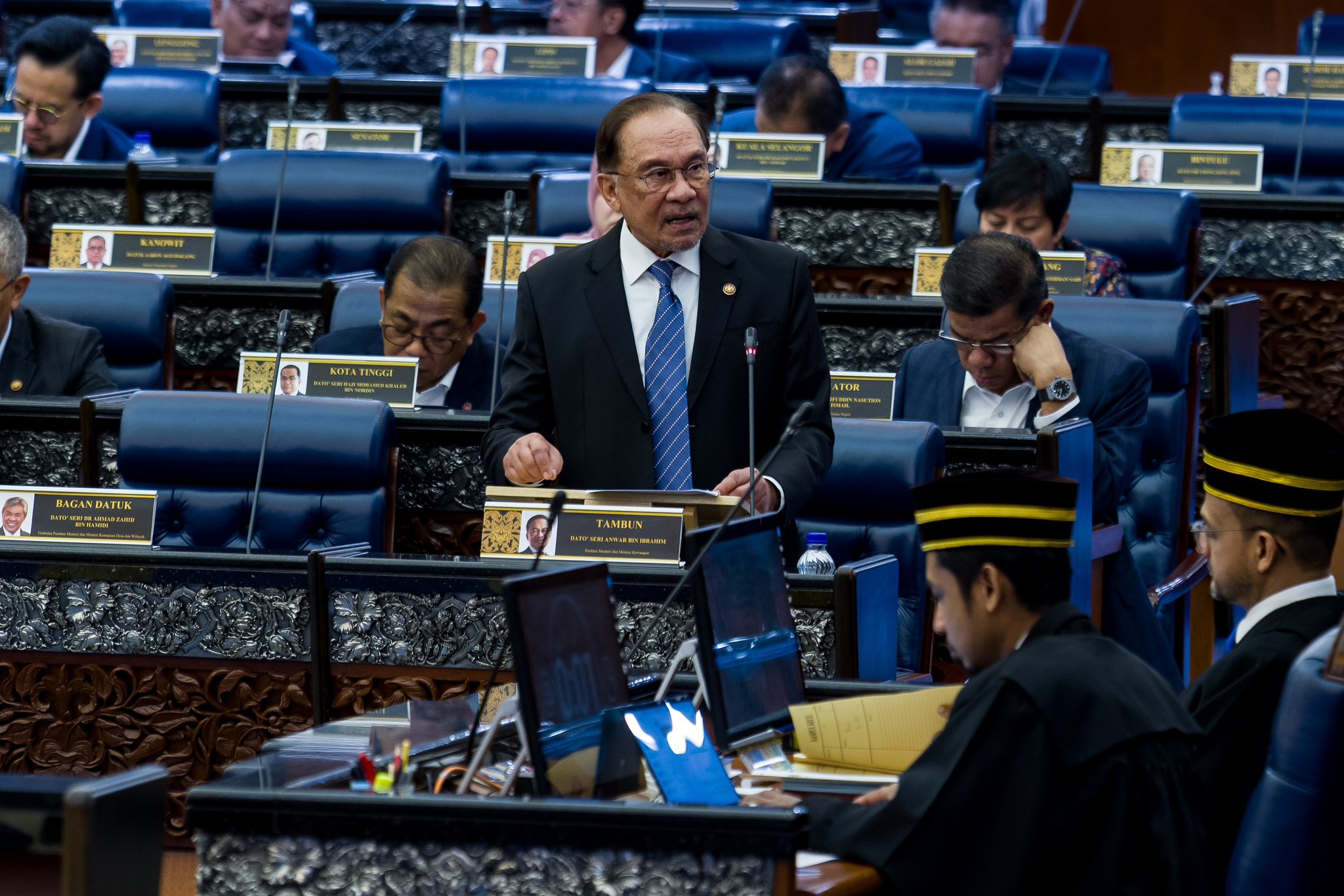

Prime Minister Datuk Seri Anwar Ibrahim outlines six-pronged response, asserts no compromise on national sovereignty. Image credit to Anwar Ibrahim Official Facebook
By TENGKU NOOR SHAMSIAH TENGKU ABDULLAH
KUALA LUMPUR, May 5 – Prime Minister Datuk Seri Anwar Ibrahim today laid out Malaysia’s strategic and measured response to the United States’ imposition of reciprocal tariffs, affirming that Malaysia will negotiate from a position of strength — not subservience — backed by solid economic fundamentals, ASEAN solidarity, and long-term reform.
Addressing a Special Parliamentary Session attended by lawmakers, Senators, and State Assembly Speakers, Anwar stressed that Malaysia’s response will be “principled, data-driven, and diplomatically mature,” rejecting populist retaliation or alarmist rhetoric.
“We will not bow to undue pressure, nor will we respond with retaliation. Instead, we act with strategy and dignity — safeguarding our national interests through engagement and resolve,” he said.
Talks Underway, But No Commitments Yet
Following President Donald Trump’s re-election, the U.S. announced reciprocal tariffs on dozens of trading partners, with Malaysia facing a suspended 24% tariff and a provisional 10% base rate.
Anwar confirmed early-stage negotiations have begun, led by the Ministry of Investment, Trade and Industry (MITI), and that Malaysia has received “positive feedback” from U.S. counterparts.
“No final agreement has been reached, and all discussions remain under a Non-Disclosure Agreement,” Anwar said. “But there is a real possibility that, with mutual goodwill, these tariffs may be reduced.”

Image credit to Anwar Ibrahim Official Facebook
Refuting U.S. Claims, Reaffirming Mutual Economic Ties
Anwar firmly dismissed Washington’s claim that Malaysia imposes a 47% effective tariff on U.S. goods — a figure based on Malaysia’s trade surplus with the U.S. rather than actual duty rates.
“The real average tariff Malaysia imposes on U.S. goods is only 5.6%, as verified by the U.S. Trade Representative itself,” he said.
He added that Malaysia is not merely an exporter to the U.S., but also a substantial investor — with RM34.4 billion in approved investments and RM182.7 billion in U.S. capital market holdings, including strategic procurement like the Malaysia Aviation Group’s recent Boeing aircraft deal.
ASEAN Consensus: No Retaliation, Yes to Dialogue
As ASEAN Chair for 2025, Malaysia has secured regional support for a united response. A Special ASEAN Economic Ministers’ Meeting concluded with a five-point consensus:
- No retaliatory tariffs
- Support for WTO rules-based trade
- Formation of an ASEAN Geo-Economic Task Force
- Focus on SME protection and supply chain stability
- Reinforced engagement with the U.S. and other key partners
Malaysia will also raise the issue at the ASEAN-GCC-China Leaders Summit later this month.
“ASEAN is not a passive bloc. With a GDP of USD4 trillion and 640 million people, our voice carries weight in global trade negotiations,” said Anwar.
Malaysia’s Economic Position: Sound and Strengthening
Anwar reaffirmed that Malaysia is not responding from a position of weakness. Instead, reforms under the Ekonomi MADANI agenda have strengthened resilience:
- GDP growth (2024): 5.1%
- Inflation: 1.8%
- Unemployment: 3.1% (10-year low)
- Trade surplus: RM137 billion
- Record investments: RM378.5 billion in 2024 (+14.9% YoY)
“These are not the indicators of an economy in retreat — but one that is reforming, realigning, and resilient,” he said.
Malaysia’s Six-Pillar Strategic Response
Anwar unveiled a coordinated national plan to safeguard economic stability:
1. High-Level Monitoring (NGCC):
The National Geo-Economic Coordination Centre, chaired by Anwar, monitors trade disruptions and formulates data-driven responses across sectors.
2. SME Relief & Resilience:
RM1 billion in loan guarantees under SJPP and RM500 million in soft loans via DFIs have been allocated to support affected exporters.
3. Market Diversification:
Malaysia is expanding trade with BRICS, the GCC, and non-traditional partners. In 2024, exports surged to Egypt (+53.6%), Pakistan (+29%), and Cambodia (+30.1%).
4. Accelerated Domestic Development:
Infrastructure and SEZ projects in Johor, Perlis, and the northern border regions are being fast-tracked, with procurement thresholds raised to empower small contractors.
5. Reform Continuity – NIMP 2030 & NETR:
RM25 billion in domestic investment will be deployed this year by GLICs, supporting semiconductor projects, renewable energy (2,000MW under LSS5), and AI/quantum research.
6. Trade Diplomacy & New FTAs:
Malaysia has concluded its EFTA agreement (to be signed next month) and is restarting FTA negotiations with the EU and South Korea. First CPTPP-linked palm oil shipment to the UK was completed last week.
No Compromise on National Interests
Anwar stressed that Malaysia will not concede core principles — including Bumiputera rights, strategic industry protections, or domestic vendor support.
“Any review of non-tariff barriers will focus only on outdated regulations — and all decisions will follow transparent, inclusive processes,” he assured.
Outlook: Reform, Not Retreat
While a downward revision of Malaysia’s 2025 GDP forecast is likely — currently projected at 4.5–5.5% — Anwar said the Ministry of Finance and Bank Negara will issue updates once policy clarity emerges.
“We cannot control external storms — but we can control how we navigate them,” he said. “Let us not yield to fear or politics. Let us lead with strategy and unity.”
- TNS NEWS