


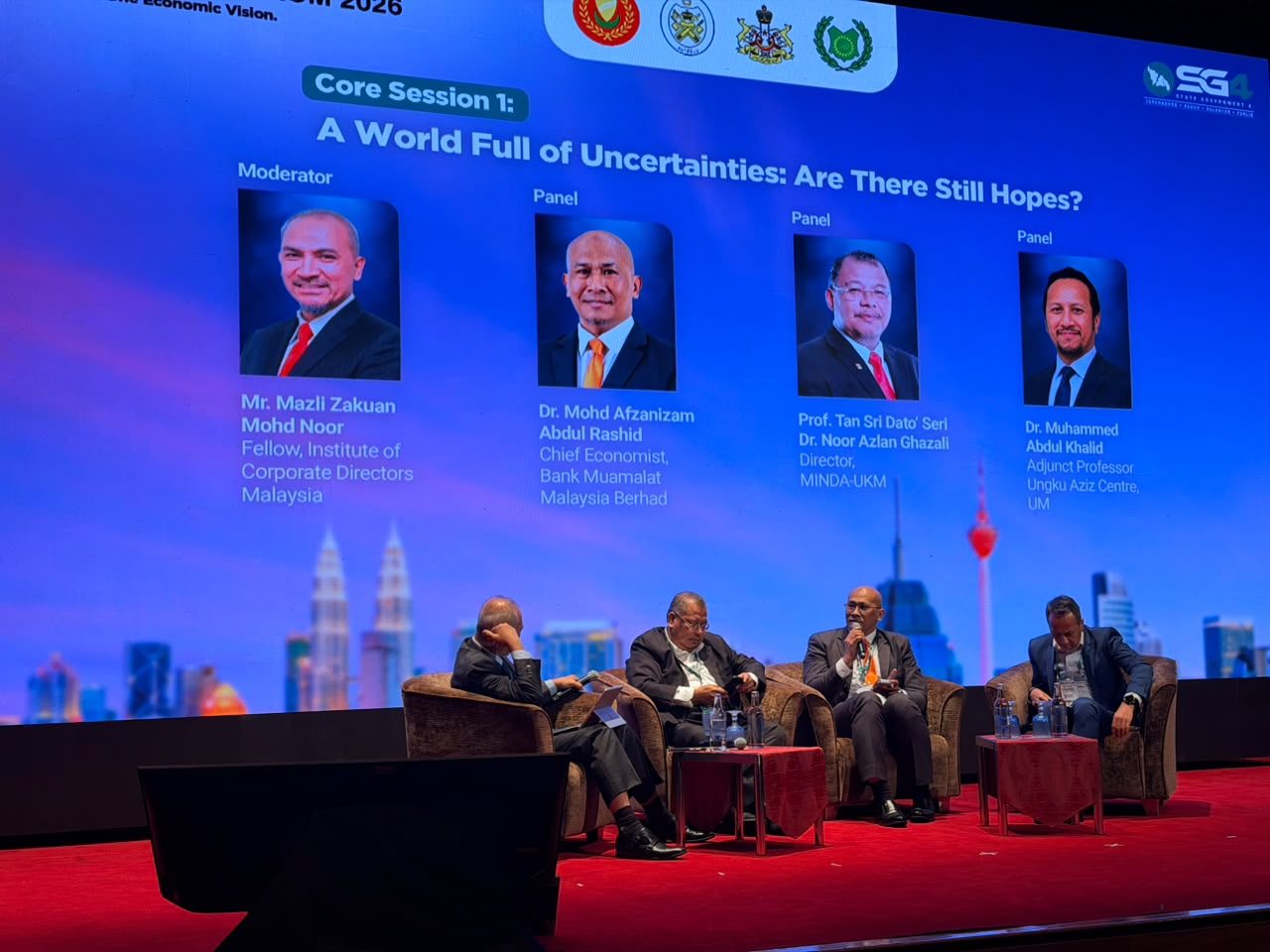
At the recently held SG4 Business Economic Forum, three economists called for structural reforms, credible fiscal policies and better-targeted public spending to ensure economic growth improves household welfare.
By TENGKU NOOR SHAMSIAH TENGKU ABDULLAH
KUALA LUMPUR, Nov 4 – Malaysia’s pursuit of economic growth risks masking longstanding structural weaknesses unless policymakers address stagnant wages, graduate unemployment, income inequality and the uneven distribution of economic benefits, three prominent economists have warned.
They cautioned that stronger gross domestic product (GDP) figures and expanding government budgets offered little assurance of meaningful progress if ordinary households continued to struggle with living costs and limited economic opportunities.
The concerns were raised by Prof Tan Sri Dato’ Seri Dr Noor Azlan Ghazali, Dr Muhammed Abdul Khalid and Dr Mohd Afzanizam Abdul Rashid during a panel discussion titled “A World Full of Uncertainties: Are There Still Hopes?” at the recently held SG4 Business Economic Forum 2026 at the Kuala Lumpur Convention Centre.
The Oct 26 forum, organised by SG4 Group Sdn Bhd under the theme “Four States, One Economic Vision”, brought together policymakers, economists, investors and industry leaders to explore economic opportunities across Kedah, Kelantan, Terengganu and Perlis.
SG4 is a strategic economic cooperation initiative involving the four state governments, aimed at pooling resources, attracting investment and strengthening regional competitiveness.
The forum was opened by Terengganu Menteri Besar Dato’ Seri Ir. Dr Ahmad Samsuri Mokhtar, while former prime minister Tun Dr Mahathir Mohamad delivered a special address through his son, Tan Sri Mokhzani Mahathir.
Describing SG4 as a “sleeping giant”, Dr Mahathir urged the states to combine their resources, develop local capabilities and unlock greater economic value from their natural wealth.
The programme also featured addresses by Kedah Menteri Besar Dato’ Seri Muhammad Sanusi Md Nor, Kelantan Deputy Menteri Besar Dato’ Dr Muhammad Fadzli Hassan, speaking on behalf of the Kelantan Menteri Besar, and Perlis Menteri Besar Abu Bakar Hamzah.
Growth Is Not A Cure For Everything
Dr Muhammed, Adjunct Professor at Universiti Malaya’s Ungku Aziz Centre, questioned Malaysia’s longstanding dependence on GDP growth as the principal measure of economic success.
“We are a nation that is addicted to growth. We think growth solves all problems,” he said.
He argued that economic expansion did not necessarily resolve structural problems that had persisted for decades.
Citing graduate unemployment, food security and dependence on foreign workers, he questioned why problems identified in earlier national development plans remained unresolved despite repeated government commitments.
He also criticised the tendency to announce ambitious development plans without sufficient attention to implementation, continuity and measurable outcomes.
Dr Muhammed warned that the disconnect between economic expansion and household welfare could fuel public dissatisfaction.
Referring to protests internationally, he argued that citizens who felt excluded from the benefits of growth could increasingly question the effectiveness of government policies.
He also raised concerns about subsidy distribution, arguing that higher-income households continued to receive substantial benefits from government support intended to ease economic pressures.
Public Spending Must Deliver Lasting Benefits
Prof Noor Azlan, Director of MINDA-UKM, similarly questioned whether Malaysia had struck the right balance between recurring subsidies and long-term development expenditure.
He argued that investment in schools, hospitals and infrastructure could deliver economic and social benefits for decades, while broad-based subsidies required substantial recurring financial commitments.
However, he stressed that subsidy reform should not come at the expense of vulnerable households.
“We do help. We must help. But help rightly,” he said.
Prof Noor Azlan urged policymakers to use reliable economic data to ensure financial assistance reached those genuinely in need.
He also emphasised that economic policymaking required ethical responsibility and concern for society, not merely technical expertise.
Global Debt Puts Fiscal Credibility Under Scrutiny
Bank Muamalat Malaysia Berhad Chief Economist Dr Mohd Afzanizam Abdul Rashid broadened the discussion to the risks posed by rising government debt and weakening fiscal credibility.
He said elevated bond yields in major economies reflected growing investor concerns over public finances, particularly in advanced economies where government debt had exceeded annual economic output.
Without credible plans to manage debt, governments risked facing higher borrowing costs, potentially restricting their ability to finance development and essential public services.
Dr Afzanizam cited the experience of former British Prime Minister Liz Truss, whose administration lasted less than two months amid financial market turmoil following tax-cut proposals that lacked a sufficiently credible funding framework.
The resulting pressure on sterling and British government bonds illustrated how quickly financial markets could react when confidence in fiscal management deteriorated.
He cautioned that economic programmes must be supported by realistic financing strategies and credible fiscal commitments.
Third Sector Has A Bigger Role To Play
Dr Afzanizam also highlighted the importance of strengthening the third sector to support more inclusive economic development.
He identified cooperatives, non-governmental organisations, social enterprises, waqf institutions and zakat organisations as important contributors to economic and social welfare.
These institutions, he said, could complement government programmes by supporting communities and addressing needs that conventional market mechanisms might not adequately serve.
He urged the government to promote and expand the third sector as part of Malaysia’s broader economic development agenda.
Dr Afzanizam also observed that younger generations were increasingly pragmatic in their expectations of political leadership.
He said younger people had little tolerance for corruption and expected practical solutions rather than political rhetoric.
In his assessment, political leaders would need to demonstrate the credibility and effectiveness of their policies to secure the confidence of younger voters.
Global Economic Power Shifting East
Turning to the international economy, Prof Noor Azlan said heightened global uncertainty should increasingly be viewed as part of a broader structural transformation rather than merely a temporary disruption.
Despite geopolitical tensions, trade uncertainty and economic volatility, businesses and consumers had continued to adapt.
He pointed to the COVID-19 pandemic as an example of how crises could permanently reshape economic behaviour, accelerating digitalisation, electronic commerce and online communication.
Prof Noor Azlan also urged Malaysia to pay closer attention to China’s expanding economic influence and emerging economic groupings, including BRICS.
“The world economy is shifting to the East, and we Malaysia is in the East. So point is, are we ready for that?” he asked.
For the SG4 states, the changing economic landscape could open opportunities in tourism, trade, investment and regional cooperation.
He highlighted Terengganu’s potential to attract more Chinese tourists, provided the state strengthened its tourism infrastructure and international-standard accommodation.
Beyond GDP: The Real Test Of Economic Progress
Although approaching the challenges from different perspectives, the three economists converged on a central concern: economic growth alone cannot guarantee better living standards or stronger economic resilience.
Dr Muhammed questioned the persistence of structural problems and the unequal distribution of economic benefits.
Prof Noor Azlan emphasised better-targeted public spending, ethical responsibility and Malaysia’s readiness for global economic transformation.
Dr Afzanizam highlighted fiscal credibility, stronger community-based institutions and the growing demand for effective and accountable policymaking.
Their arguments also carried implications for SG4, where closer economic cooperation must ultimately translate into productive investment, better employment opportunities and higher household incomes.
For Malaysia, the challenge is not simply to sustain GDP growth, but to ensure that economic expansion delivers lasting improvements in wages, productivity, public services and the quality of life.
The question confronting policymakers is therefore increasingly clear: not merely how fast Malaysia can grow, but who benefits from that growth.
- TNS NEWS