


Samsuri says economic growth must reach households as four states seek investment in industry, infrastructure and downstream rare earth activities
IN BRIEF
- Terengganu Menteri Besar Dato’ Seri Ir. Dr Ahmad Samsuri Mokhtar says growth must be judged by what reaches households, not headline figures.
- He floats a renewed Malaysia Economic Model, an SG4 Islamic financial hub and an interstate fiscal equalisation formula.
- The four SG4 states recorded a combined GDP of about RM133.4 billion in 2025 and RM220.43 billion in approved investments between 2020 and 2025.
- Proposed infrastructure includes a Kulim to Tok Bali east-west dual carriageway, the KXP Cargo Airport and three seaport projects.
By PHUBIEYAS AHMAD
KUALA LUMPUR, Oct 26 – Terengganu Menteri Besar Dato’ Seri Ir. Dr Ahmad Samsuri Mokhtar today proposed a fairer formula for federal development funding and an SG4 Islamic financial hub, saying economic growth must translate into better jobs, wages and living standards.
Opening the SG4 Business & Economic Forum 2026 at the Kuala Lumpur Convention Centre (KLCC), he said headline figures on gross domestic product (GDP), investment and exports meant little to households struggling with everyday expenses.
Ahmad Samsuri said that “people do not live in GDP”, but in rent, food prices, transport costs and school fees. “A young graduate without work does not feel a growth rate,” he told the gathering.
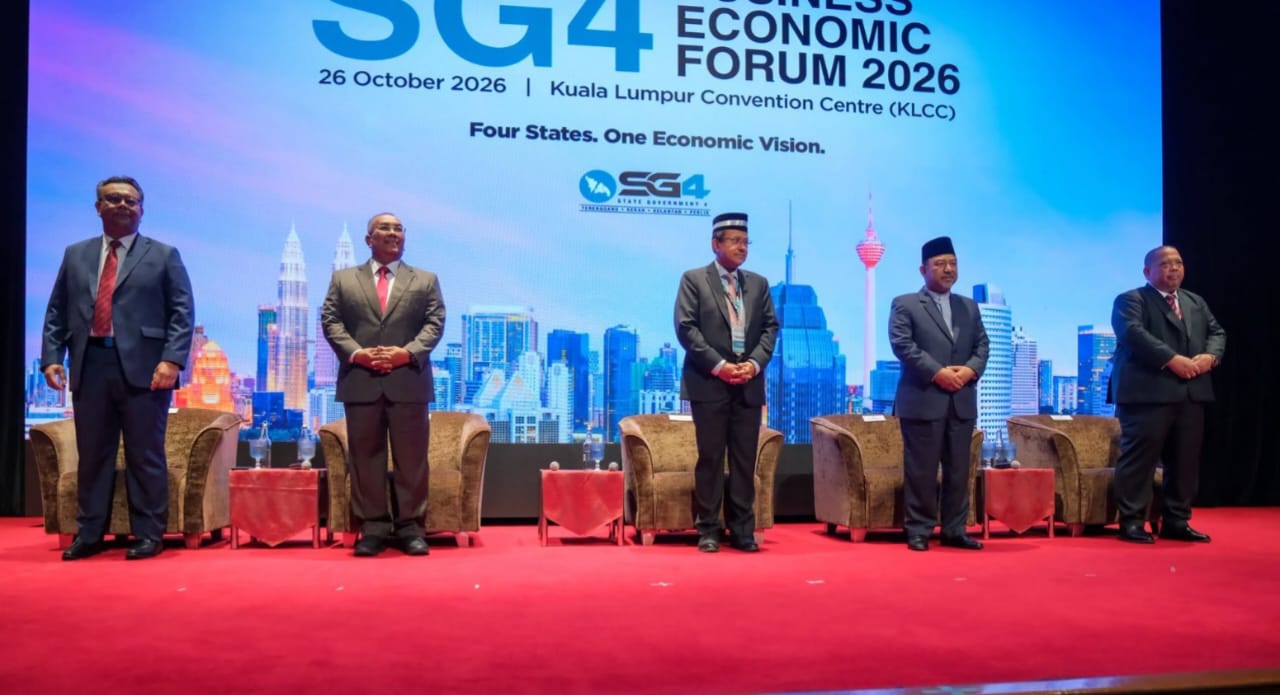
The forum, themed “Powering SG4’s Potential”, was organised by SG4 Group Sdn Bhd, the company jointly owned by Kedah, Kelantan, Terengganu and Perlis. It brought together state leaders, diplomats, industry representatives and academics.
Tan Sri Mokhzani Mahathir delivered the keynote address on behalf of his father, former prime minister and SG4 adviser Tun Dr Mahathir Mohamad.
Also present were Kedah Menteri Besar Dato’ Seri Muhammad Sanusi Md Nor; Kelantan Menteri Besar Dato’ Mohd Nassuruddin Daud; Perlis Menteri Besar Abu Bakar Hamzah and Deputy Kelantan Menteri Dato’ Dr Mohamed Fadzli Dato’ Hassan.

Terengganu Menteri Besar Dato’ Seri Ir Dr Ahmad Samsuri Mokhtar
That Reaches Households
Ahmad Samsuri argued that national growth figures could mask inequality between households and regions.
He returned to two principles he raised in the parliamentary debate on the Supply Bill 2027: fairness and capacity. “We need fairness and we need capacity,” he said.
Fairness, he explained, applies to every community, every region and every generation. “Fairness does not mean taking from one to give to another,” he said, adding: “Where you are born must not decide how far you can go.”
On that basis, he proposed that Malaysia consider a renewed Malaysia Economic Model (MEM), built on existing national policies but with the well-being of the people as its central purpose, and consistent with the principles of Maqasid Syariah.
He also posed a pointed question to policymakers: “Are we building an economy of the country or somebody else’s economy?”
Investment Approvals And Project Quality
Ahmad Samsuri acknowledged investor frustration with approval delays and bureaucracy at both state and federal levels, while stressing the need to scrutinise proposals.
He said some proposals involved poor documentation, questionable intermediaries or attempts to obtain approval letters solely to secure bank financing. He also highlighted stalled projects and overlapping responsibilities between state and federal agencies.
Reforming Federal And State Finances
Ahmad Samsuri called for an interstate fiscal and development equalisation formula to address differences in states’ resources and development needs. He cited Australia, Germany and Canada as examples of countries with equalisation mechanisms.
The aim, he said, was to make development allocations more transparent, consistent and responsive to need, while reducing political influence over funding decisions. He expressed hope that the arrangements could change after the 16th General Election.
He stressed that the proposal was not meant for states to go it alone. “A Malaysia that is fair to every region is a stronger Malaysia,” he said.
Islamic Finance And New Industries
He suggested exploring an SG4 Islamic financial hub to channel Sharia-compliant capital into productive activities across the four states. Potential areas included renewable energy, infrastructure, manufacturing and technology, alongside trade and supply chain financing for smaller businesses.
He also proposed an SG4 green and clean energy industrial hub, with green hydrogen and green ammonia as longer-term possibilities where viable.
On rare earth elements, Ahmad Samsuri said the four states held approximately 70 per cent of Malaysia’s resources. He called for downstream activities that would generate greater value locally, supported by scientific evidence, clear regulation and strict environmental safeguards, including protection of water resources.
He described each state’s role: Terengganu in petroleum and gas, petrochemicals, maritime industries and tourism; Kelantan in agro-industry, halal industries, heritage tourism and cross-border trade; Kedah in high-tech manufacturing, semiconductors, agriculture and logistics; and Perlis in border trade, renewable energy and links with Southern Thailand.
Referring to his recent meeting with European Union diplomats on the ongoing Malaysia-EU trade negotiations, he said any agreement must deliver mutual benefit, including for local enterprises and businesses.
Investment Approvals And Infrastructure Proposals
Earlier, SG4 Group Sdn Bhd chairman Prof Dr Haim Hilman Abdullah outlined the four states’ economic profile and investment priorities.
Haim Hilman said the four states recorded a combined GDP of approximately RM133.4 billion in 2025 and RM220.43 billion in approved investments between 2020 and 2025. Manufacturing accounted for RM198.37 billion of those approvals. The approved investments carried the potential to generate 76,306 employment opportunities. He also said the states produced 131,600 graduates between 2021 and 2024.
“Our priority is to translate that interest into successful operations, productive businesses and rewarding careers,” Haim Hilman said.
Haim Hilman presented an illustrative scenario in which sustained annual growth of 7 per cent would lift combined GDP from RM133.35 billion in 2025 to about RM723.75 billion by 2050, measured in constant 2015 prices. The scenario would depend on sustained investment, higher productivity and effective implementation; it was not a guaranteed outcome.
The infrastructure agenda seeks to improve links between industrial centres, ports and air freight facilities.
He outlined a proposed east-west dual carriageway linking Kulim Hi-Tech Park with Tok Bali Port via Baling, Gerik, Jeli and Pasir Puteh, alongside the proposed KXP Cargo Airport in Kedah for high-value exports such as semiconductors and electrical and electronics products.
Other initiatives he outlined included the Kemaman Port expansion, Tok Bali Seaport and a proposed seaport at Sanglang, Jerlun. He said their benefits would depend on planning, commercial viability and delivery.
SG4 Background
SG4, short for “State Government 4”, was formed in 2023 as an economic cooperation platform for Kedah, Kelantan, Terengganu and Perlis. SG4 Group Sdn Bhd was formally launched in September 2024, with each state holding a 25 per cent stake.
The grouping seeks to coordinate investment and development across the four states, with Dr Mahathir serving as adviser.
Closing his address, Ahmad Samsuri said SG4 was not seeking to compete with other states. “We are not going to compete with anybody or any state,” he said, adding that stronger enterprises, skilled workers and more productive industries in the four states would benefit the nation as a whole.
- TNS NEWS