


By PHUBIEYAS AHMAD
KUALA LUMPUR, Oct 26 – Malaysia sits alongside one of the world’s busiest shipping corridors, possesses substantial petroleum infrastructure and has established ports serving international maritime trade. Yet an important economic question remains: is the country capturing enough value from the ships and energy cargo passing through the region?
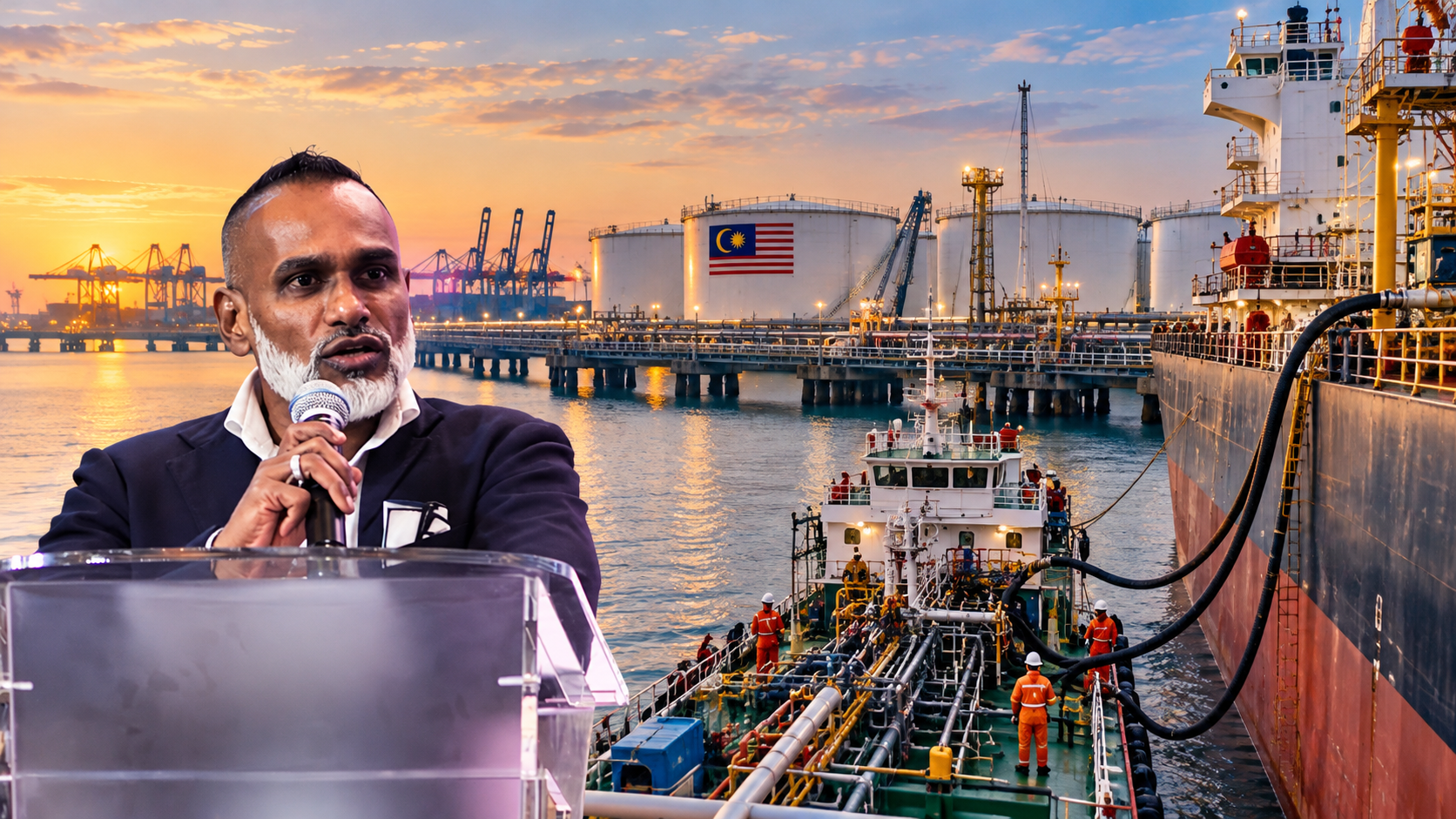
Maritime industry expert Datuk Seri R. Jeyenderan believes Malaysia could unlock new commercial opportunities by expanding its marine-fuel industry, particularly in fuel blending, storage, trading and bunkering – the business of supplying fuel to ships.
With more than 30 years of experience in the maritime and shipping industry, he said Malaysia should move beyond conventional petroleum cargo handling towards higher-value activities that could support local businesses, attract investment and strengthen the maritime economy.
“We could make more money from oil cargo by doing more of the work locally, including mixing the fuel, storing it and selling it to ships, instead of simply receiving and moving the cargo,” he said in a statement issued last week.
His proposal raises a broader question about Malaysia’s economic diversification strategy: how can the country turn its existing resources, infrastructure and geographical advantages into new sources of business activity and government revenue?
A Revenue Opportunity Beyond Oil Exports
The issue has gained significance amid growing pressure on Malaysia to broaden its revenue base while managing substantial fiscal commitments.
During the second-reading debate on the Supply Bill 2027 in the Dewan Rakyat on October 21, Selangor Menteri Besar and Gombak MP Datuk Seri Amirudin Shari urged the government to identify new strategic industries capable of generating sustainable returns.
He highlighted that subsidies, civil service emoluments, debt servicing and retirement commitments accounted for 76.9 per cent of federal operating expenditure, leaving limited fiscal space for development and economic transformation.
Amirudin also questioned whether economic growth, rising investment and expanding trade were translating into sufficient government revenue.
Against this backdrop, Jeyenderan’s proposal presents one possible avenue for Malaysia to capture greater economic value from its existing petroleum and maritime industries.
Rather than concentrating mainly on transporting and handling petroleum cargo, Malaysian companies could participate in fuel blending, storage, trading and direct supply to international shipping operators.
These activities could generate additional business income, support employment and potentially contribute to government revenue through taxation, licensing and other applicable charges.
However, the actual financial benefits would depend on market demand, commercial viability, investment and the regulatory environment.
Why Marine Fuel Matters
One area identified by Jeyenderan is Very Low Sulphur Fuel Oil (VLSFO), a marine fuel commonly used by vessels to comply with international environmental regulations.
Since January 2020, the International Maritime Organization (IMO) has generally restricted the sulphur content of fuel oil used by ships outside designated emission control areas to 0.50 per cent by mass.
The regulation has sustained demand for compliant marine fuels, creating opportunities for petroleum suppliers, fuel blenders, storage operators and bunkering service providers.
Jeyenderan said Malaysia could explore producing VLSFO by blending suitable petroleum components, conducting quality testing and supplying the finished product to vessels operating along regional shipping routes.
“For example, a company could obtain suitable fuel components from refineries or petroleum suppliers, blend them in controlled proportions and test the resulting product to ensure it meets the required sulphur limit and other fuel specifications.
“The finished VLSFO could then be stored in dedicated tanks before being delivered to ships at ports or through bunker vessels,” he said.
Such operations would enable Malaysian companies to participate in more stages of the marine-fuel supply chain rather than concentrating primarily on petroleum cargo transportation.
Singapore Demonstrates The Scale Of The Market
The commercial potential becomes clearer when viewed against neighbouring Singapore’s position as the world’s leading marine-fuel bunkering hub.
According to the Maritime and Port Authority of Singapore (MPA), marine-fuel sales reached a record 56.77 million tonnes in 2025, an increase of 3.4 per cent from the previous year.
Alternative marine-fuel sales also rose to 1.95 million tonnes, compared with 1.35 million tonnes in 2024, reflecting growing demand for a broader range of shipping fuels.
The figures demonstrate the scale of the regional marine-fuel business, although they do not establish how much of that market Malaysia could realistically capture.
Malaysia’s proximity to the Strait of Malacca offers a geographical advantage, but location alone will not guarantee commercial success.
Competitive pricing, reliable fuel quality, sufficient storage capacity, efficient port operations and regulatory certainty would be essential to attracting international shipping customers.
Rather than attempting to replicate Singapore’s entire bunkering ecosystem, Malaysia could identify specialised opportunities where its existing petroleum infrastructure and supply chains provide a competitive advantage.
Regulation And Investment Will Determine Success
Jeyenderan stressed that developing a marine-fuel hub would require clear regulatory and operational guidelines governing the handling, storage, transfer and blending of petroleum products.
“Such operations would require appropriate equipment, quality testing and documentation to ensure the fuel meets specifications and remains suitable for use,” he said.
He added that transparent procedures and proper documentation would help protect government revenue, provide businesses with greater certainty and encourage investment in higher-value maritime activities.
“These activities could support local businesses and generate additional demand for port services, logistics and petroleum trading,” he said.
However, several questions would need to be addressed before the proposal could become a commercially sustainable industry.
Could Malaysia attract sufficient shipping demand to justify additional investment? Would domestic operators be able to compete effectively with established regional suppliers? And how much additional tax revenue and economic activity could the industry realistically generate?
Answering these questions would require detailed market assessments, investment planning and coordination among government agencies, port authorities and industry participants.
There is also a longer-term challenge. As international shipping gradually adopts alternative and lower-emission fuels, Malaysia would need to ensure that new investments remain competitive as fuel demand and environmental requirements evolve.
Turning Existing Strengths Into Economic Value
For Malaysia, Jeyenderan’s proposal highlights a broader challenge facing the country’s economic transformation agenda: converting existing resources and infrastructure into more sophisticated, higher-value industries.
The country already possesses important elements of a maritime and energy ecosystem. The next step would be determining how those strengths could support commercially viable projects, private investment and sustainable economic returns.
Jeyenderan believes developing Malaysia’s marine-fuel capabilities could create additional economic activity while strengthening the country’s position in the regional maritime and energy supply chain.
Ultimately, the measure of success would not simply be how much petroleum cargo or marine fuel Malaysia handles, but how much lasting economic value the country can retain from the business.
- TNS NEWS