


BY TNS NEWS TEAM
March 7, 2026
KUALA LUMPUR — The confrontation between Iran and the United States is entering a more complex and potentially dangerous phase, as reports from international media suggest Russia may be quietly assisting Tehran while publicly calling for an immediate halt to hostilities.
The development has raised concerns among analysts that the crisis could evolve beyond a bilateral military confrontation into a wider geopolitical contest involving major global powers.
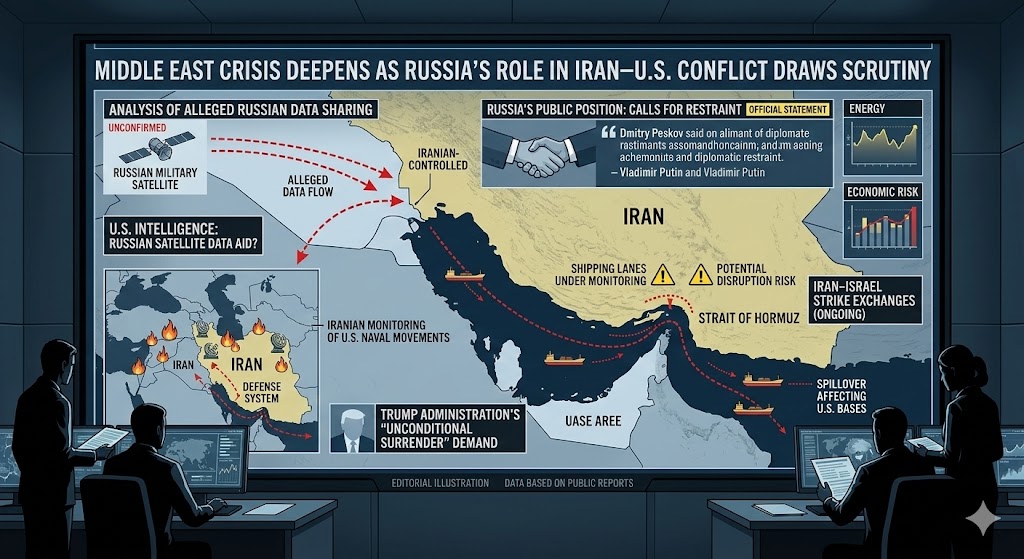
According to reports by foreign media including Reuters and the Associated Press, U.S. intelligence officials believe Russia has provided Iran with information that could help Tehran track American military movements in the region, including the locations of U.S. naval vessels and aircraft operating in the Gulf.
Officials cited in those reports said there is no clear indication that Russia is directly participating in combat operations. However, analysts note that intelligence-sharing if confirmed could enhance Iran’s ability to monitor or respond to U.S. deployments, complicating Washington’s military posture in the region.
Moscow has not confirmed the allegations.
Instead, Russian officials have maintained a diplomatic tone in public statements. Kremlin spokesman Dmitry Peskov said Iran had not formally requested Russian arms supplies, while President Vladimir Putin called for an immediate cessation of hostilities during a recent phone conversation with Iranian President Masoud Pezeshkian.
According to the Kremlin’s readout of the call, Putin condemned what he described as Western military aggression against Iran and reaffirmed Russia’s support for Iran’s sovereignty and territorial integrity. Moscow also said it is engaging with regional leaders in an effort to prevent the conflict from expanding further across the Middle East.
War Enters a Wider Phase
On the ground, the conflict has broadened in scope.
Iran and Israel have continued exchanging strikes as military operations spill across several theatres in the region. Some attacks have also affected areas linked to U.S. military presence in Gulf countries that host American bases.
Iranian President Masoud Pezeshkian later issued an apology to neighbouring states affected by the strikes, signalling Tehran’s concern that the conflict could strain relations with regional partners.
At the same time, Iranian leaders have rejected calls from Washington to surrender or halt their military posture under pressure.
U.S. President Donald Trump has taken a hardline stance, declaring that Washington would accept nothing short of “unconditional surrender” from Tehran — a position that significantly reduces the likelihood of immediate diplomatic negotiations.
Rising Humanitarian and Economic Risks
The war is already producing a mounting humanitarian toll.
Iran’s ambassador to the United Nations said more than 1,300 civilians have been killed since the conflict began, accusing U.S. and Israeli forces of striking civilian infrastructure. Washington and Israel deny intentionally targeting civilian sites and maintain that Iran’s actions triggered the confrontation.
Beyond the battlefield, the crisis is raising concerns across global markets and policymaking circles.
Particular attention is focused on the Strait of Hormuz — a strategic maritime corridor through which roughly one-fifth of the world’s oil supply passes. Any prolonged disruption to shipping in the area could trigger significant energy price volatility and reignite inflationary pressures worldwide.
Air routes, maritime shipping and insurance costs across the region are also being closely monitored by international businesses.
A Growing Geopolitical Test
For global strategists, the most consequential development may be the potential involvement of outside powers.
Russia’s diplomatic backing for Iran — combined with reports of possible intelligence cooperation — suggests the conflict may increasingly intersect with the broader rivalry between Washington and Moscow.
If Moscow’s role deepens, the crisis could gradually transform from a regional military confrontation into a more complex geopolitical contest with wider implications for global security and economic stability.
For now, the situation remains fluid. But with hardened political positions, ongoing military exchanges and the emergence of external powers in the diplomatic arena, the Middle East crisis appears to be entering a far more volatile stage.
- TNS News