


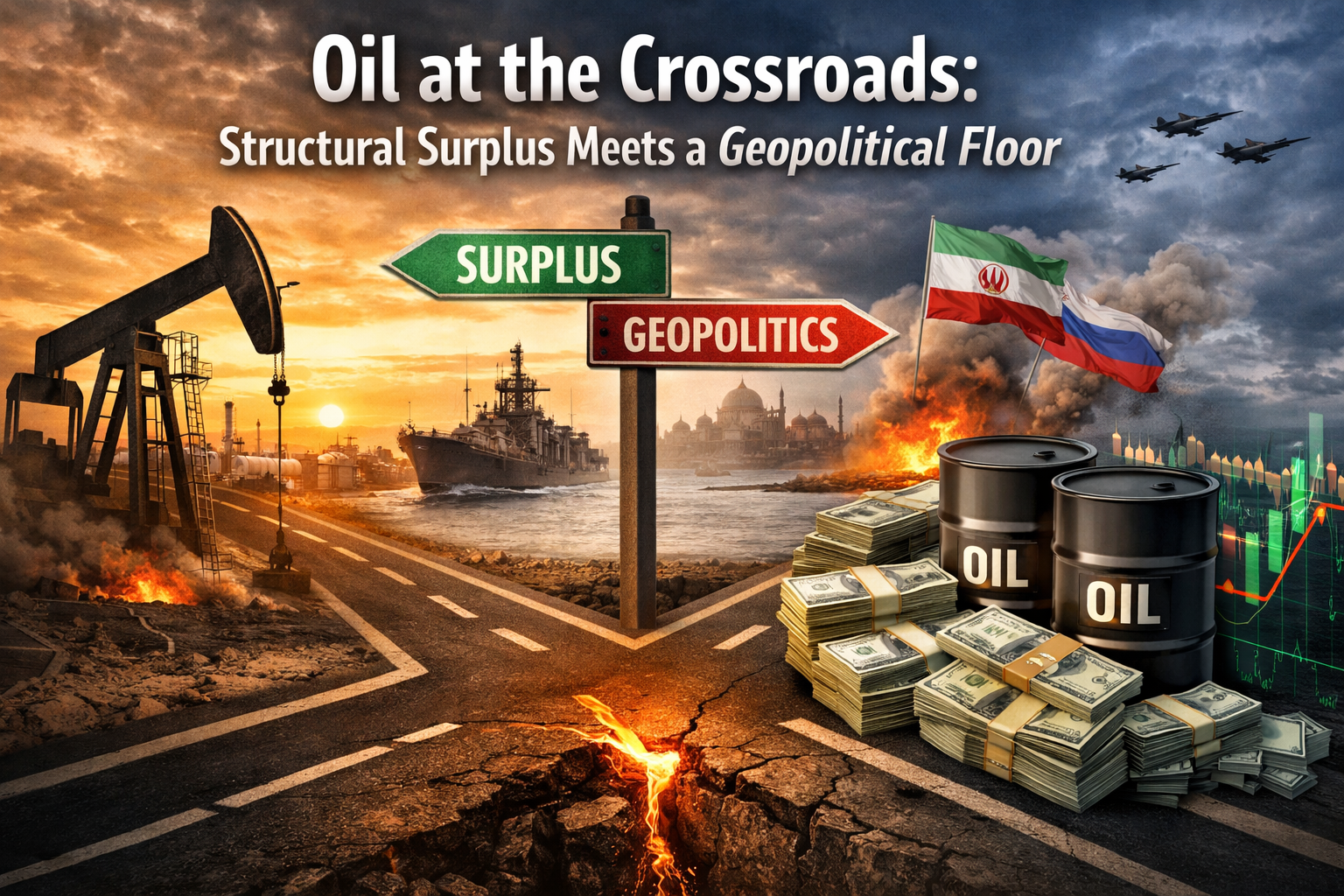
Shan Saeed tells TNS News why Brent crude remains anchored within a disciplined $65–$87 corridor as comfortable inventories and steady non-OPEC supply growth collide with embedded geopolitical risk and macro-financial repricing pressures.
By TENGKU NOOR SHAMSIAH TENGKU ABDULLAH
KUALA LUMPUR, Feb 28 – The global oil market has entered 2026 in a state that defies traditional commodity cycles. Rather than being driven purely by shifts in physical supply and demand, it now sits at the intersection of structural surplus, embedded geopolitical premia, and macro-financial recalibration. Oil no longer behaves as a simple barrel-based trade; it functions as a policy-sensitive macro instrument shaped by fiscal signals, currency dynamics, and geopolitical realignment.
As Shan Saeed, Global Chief Economist at Juwai IQI, told TNS News: “In 2026, the global oil market occupies a position of strategic equilibrium, defined by structural surplus, measured demand expansion, and embedded geopolitical risk premia — anchoring Brent crude within a disciplined $65–$87 per barrel corridor. Oil this year trades less as a cyclical commodity and more as a policy-sensitive macro instrument, responsive to fiscal signals, currency dynamics, and geopolitical recalibration.”
This framing defines what may be described as the operating doctrine of the oil market this year: equilibrium, but risk-infused.
On fundamentals, supply modestly exceeds demand.
According to Shan: “On fundamentals, supply modestly outpaces demand. IEA estimates point to a surplus in the range of 2.0–3.7 million barrels per day, with global production rising from approximately 105.6 mbpd in mid-2025 to 106.6 mbpd in early 2026. Non-OPEC growth, led by North American output, provides a stabilizing buffer, while OPEC+ retains calibrated flexibility to prevent disorderly downside and defend fiscal equilibrium among producers.”
Recent agency assessments broadly align with this view. Production growth has edged ahead of incremental demand gains, inventories remain comfortable relative to prior tightening cycles, and institutional price forecasts from major banks generally cluster below the upper bound of Shan’s corridor.
Yet price weakness has proven difficult to sustain.
OPEC+ refers to the expanded production alliance that includes the 13 members of the Organization of the Petroleum Exporting Countries together with major non-OPEC exporters such as Russia and several Central Asian producers. Formed in 2016, the coalition coordinates output across countries representing roughly 40 percent of global oil supply. Its objective is market stabilization aligned with fiscal sustainability among producer states.
In 2026, OPEC+ retains what Shan describes as calibrated flexibility. It can adjust supply to defend a fiscal floor if required. However, in a market increasingly buffered by diversified non-OPEC growth — particularly from the United States, Canada, Brazil, and Guyana — its ability to engineer sustained upside acceleration has moderated. The alliance can prevent collapse, but it cannot fully command breakout momentum.

Shan Saeed is Global Chief Economist at Juwai IQI
On the demand side, moderation prevails.
“Demand growth, projected at 0.8–1.4 mbpd, remains constructive but not exuberant. Transportation normalization, aviation recovery, petrochemical resilience, and emerging-market consumption underpin incremental gains. Yet renewable penetration, electrification trends, and structural efficiency gains temper acceleration.”
Demand is present, but it is no longer explosive. Non-OECD economies account for the majority of incremental growth, while electrification, efficiency gains, and energy transition policies impose a structural ceiling on elasticity.
If fundamentals argue for stability, geopolitics argues for caution.
“Inventories remain comfortable. OECD stocks are elevated relative to prior tightening cycles. On fundamentals alone, sustained upside momentum lacks conviction. Yet geopolitics refuses complacency.”
Middle East tensions — particularly surrounding Iran and the Strait of Hormuz — embed what Shan estimates to be a latent premium of $6–$8 per barrel. Roughly one-fifth of globally traded oil passes through the Strait of Hormuz, making it one of the world’s most consequential maritime chokepoints.
“Sanctions architecture affecting Russian and Iranian exports remains the decisive wildcard, capable of tightening effective supply with minimal notice.”
This is the defining tension of 2026. Structural surplus coexists with strategic fragility. The geopolitical floor limits sustained breakdown even when inventories appear comfortable.
Macro variables add another layer of complexity.
“Macro variables add further complexity. A softer U.S. dollar offers cyclical support to commodities, though structural surplus constrains breakout enthusiasm. However, should expansionary U.S. fiscal dynamics accelerate structural dollar erosion — or should OPEC+ enforce tighter supply discipline than markets presently discount — the upper bound of the corridor would cease to function as resistance and instead become a platform for repricing.”
In such a scenario, the $87 ceiling would no longer behave as resistance. It would mark a macro repricing threshold.
For Asia-Pacific — the world’s largest oil-importing region — this framework carries significant policy implications. A disciplined price band provides relative predictability for inflation management, trade balances, and fiscal calibration. Yet the geopolitical premium remains structurally unhedgeable.
For Malaysia, where petroleum-linked revenues continue to influence fiscal buffers and currency sensitivity, the corridor framework becomes a practical reference point for budget planning and macro risk assessment in 2026.
Shan’s conclusion is unequivocal: “2026 is not a year of scarcity shock or systemic collapse. It is a year of volatile equilibrium — rewarding strategic positioning over speculative excess.”
In 2026, fundamentals argue for moderation. Geopolitics argues for a floor. Both forces operate simultaneously.
This is not a year for momentum trading. It is a year for disciplined allocation, macro awareness, and strategic patience.
The oil market is balanced — but risk-infused.
About Shan Saeed
Shan Saeed is Global Chief Economist at Juwai IQI, one of Asia’s largest international real estate and investment platforms. A widely cited macroeconomic strategist, commodity analyst, and former sovereign wealth adviser, he advises institutional investors, corporate clients, and sovereign bodies across emerging and developed markets on economic outlook, cross-asset strategy, and commodity
- TNS NEWS