


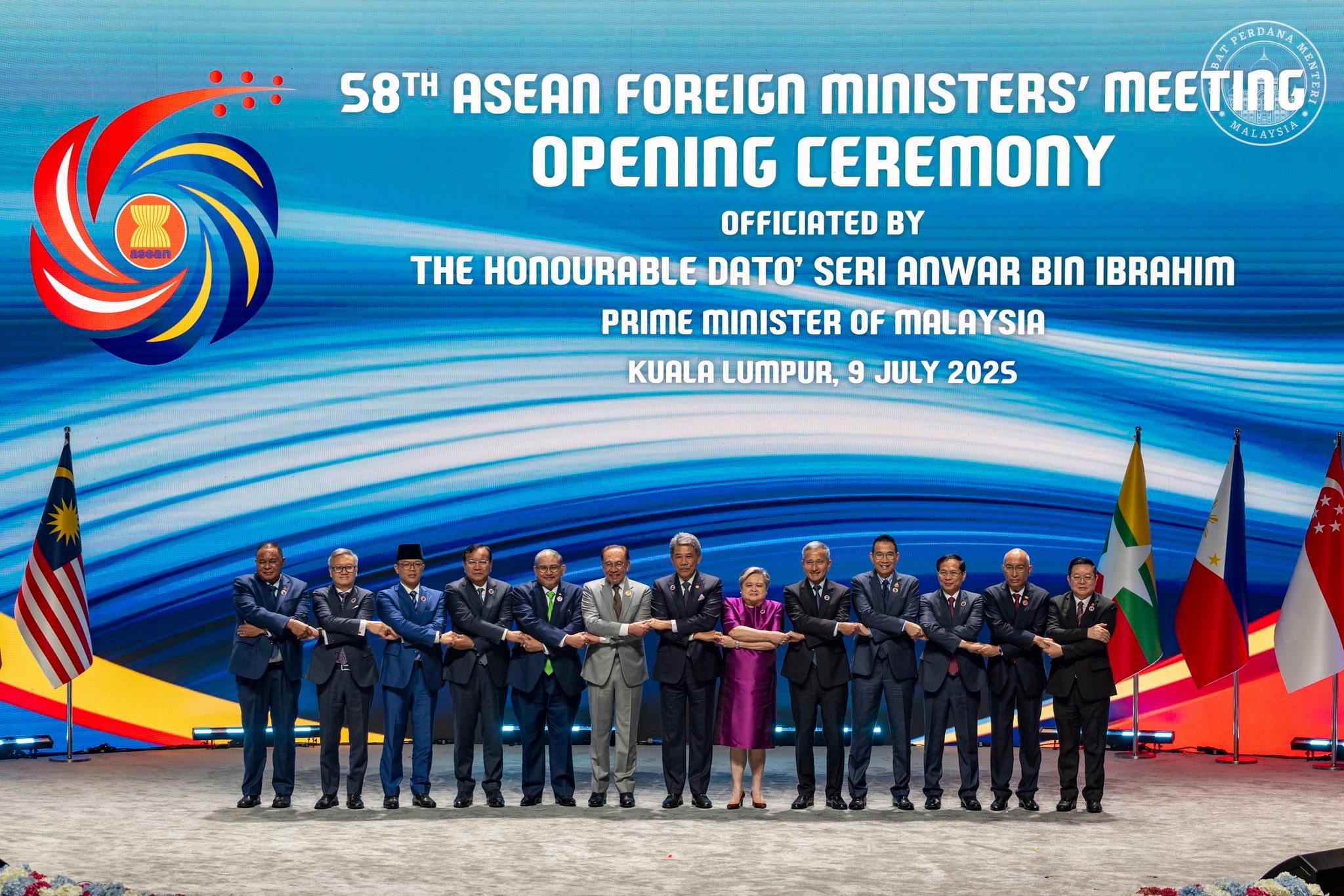

Malaysia’s Prime Minister calls on ASEAN to reclaim regional agency, align policy with principle, and resist external pressures in a shifting global order.
By TENGKU NOOR SHAMSIAH TENGKU ABDULLAH
KUALA LUMPUR, July 9 – In a speech marked by intellectual clarity and moral urgency, Prime Minister Datuk Seri Anwar Ibrahim today opened the 58th ASEAN Foreign Ministers’ Meeting (AMM) in Kuala Lumpur, challenging Southeast Asian nations to defend their sovereignty, deepen internal integration, and craft a shared regional future on their own terms.
Speaking before Foreign Ministers of ASEAN and Timor-Leste, ASEAN Secretary-General Dr. Kao Kim Hourn, and senior representatives from major powers including the United States, China, Russia, Japan, and the European Union, Anwar placed ASEAN at the fulcrum of a fast-changing international order.
“ASEAN will not be spoken for in absentia,” Anwar declared, drawing applause. “We are a region that charts its own course—deliberately, coherently, and with purpose.”

A Framework for the Future: ASEAN Vision 2045
Framing Malaysia’s 2025 Chairmanship as a moment of consequence, Anwar stated the bloc must make “deliberate choices” about its direction through 2045. He urged ASEAN to embrace strategic clarity, institutional cohesion, and people-focused outcomes — values inherently embedded in the ASEAN Vision 2045.
His speech skillfully wove together current global challenges with long-standing regional aspirations, calling for ASEAN to “remain the region’s primary anchor for dialogue” while simultaneously deepening its internal resolve.
“Our region’s strength lies not in the absence of tension,” he said, “but in our commitment to manage it through mutual respect, continuous dialogue, and the search for consensus. That is the ASEAN way—and it must remain our guide.”

A World in Disarray: Erosion of the Rules-Based Order
In a sombre appraisal of global affairs, Anwar explicitly named the ongoing violence in Gaza and Ukraine, instability in Africa, and the crisis in Myanmar as emblematic of a broader erosion of the rules-based international order.
“The global order is fraying. Conflict, coercion, and mistrust now define too many relationships,” he warned. “The multilateral system cannot endure if its principles are upheld only when convenient.”
He added that recent tensions in the Middle East carry “profound” risks for energy security and international law — cautioning that selective engagement with global norms ultimately undermines long-term peace and stability.

PM Datuk Seri Anwar Ibrahim speaks with Indonesian Foreign Minister H.E. Sugiono at the opening of the 58th ASEAN Foreign Ministers’ Meeting in Kuala Lumpur. Deputy Prime Minister Fadillah Yusof looks on.
Economic Sovereignty and Policy Coherence
In a key policy signal, Anwar emphasised the growing entanglement of economics and geopolitics, noting how tools such as tariffs and investment restrictions are increasingly used as instruments of control.
“This is no passing storm. It is the new weather of our time,” he said, underlining the need for a robust and unified ASEAN response.
He called for ASEAN to respond with clarity, conviction, and institutional alignment. “Our Foreign and Economic Ministers must move in concert,” he urged, advocating for more robust linkages and synergy between the region’s economic and diplomatic strategies.
Crucially, Anwar pushed for ASEAN to invest more within itself and expand intra-regional trade to fortify internal resilience against external shocks and reduce reliance on external dependencies.
Centrality, Continuity, and Timor-Leste’s Path
Reaffirming ASEAN Centrality as the cornerstone of regional diplomacy, Anwar reiterated Malaysia’s full support for Timor-Leste’s accession as the bloc’s 11th member.
“We are heartened by the progress made. I urge all Member States to continue supporting Timor-Leste’s path—not only into our institutions, but into our shared vision for the region’s future,” he said, highlighting the importance of inclusivity for ASEAN’s continued strength.

Malaysian Foreign Minister Datuk Seri Mohamad Hasan greets Timor-Leste’s Foreign Minister, H.E. Bendito dos Santos Freitas, at the opening of the 58th ASEAN Foreign Ministers’ Meeting (AMM) in Kuala Lumpur on July 9, 2025
People as the Anchor of Policy
Striking a deeply humanistic tone, Anwar reminded delegates that ASEAN’s ultimate relevance lies in outcomes that directly affect ordinary lives. He painted vivid portraits of daily resilience across Southeast Asia — a food vendor in Batambang, a farmer in Central Luzon, and a child in Chiang Rai.
“Our region can become more peaceful and more prosperous—if we have the courage to see ASEAN not as nations moving in parallel, but as one community moving with purpose.”
With those compelling words, Anwar declared the meeting open — not just as a ritual of diplomacy, but as a launchpad for ASEAN to reclaim its future, speak with a unified voice, and act with strategic foresight.
ASEAN Foreign Ministers Deliberate Key Issues Amidst Geopolitical Shifts
Following Prime Minister Anwar Ibrahim’s opening address, the 58th ASEAN Foreign Ministers’ Meeting (AMM) transitioned into its core working sessions, including the Plenary Session and the crucial AMM Retreat.
Both sessions are being chaired by Malaysian Foreign Minister Datuk Seri Mohamad Hasan. The Retreat, a follow-up to an earlier gathering in Langkawi this year, is expected to delve deeper into pressing regional challenges.
Discussions are anticipated to cover developments in Myanmar, progress on the long-negotiated Code of Conduct in the South China Sea, and strategies to bolster ASEAN’s collective resilience and unity amidst escalating geopolitical tensions.
All ten ASEAN Member States are represented at the meeting. Notably, Myanmar has sent a senior foreign ministry official in lieu of its foreign minister, while Timor-Leste, on track for full membership in October, is participating as an observer, represented by its Foreign Minister.
A key ceremonial highlight of the AMM agenda will be the signing ceremony for the Instrument of Accession to the Treaty of Amity and Cooperation in Southeast Asia (TAC). This significant event will be witnessed by all ASEAN foreign ministers and ASEAN Secretary-General Dr. Kao Kim Hourn, underscoring the region’s commitment to peace and cooperation.
Hosted under Malaysia’s 2025 ASEAN Chairmanship, which carries the theme “Inclusivity and Sustainability,” the 58th AMM and its related events are a comprehensive series of engagements. The programme comprises 24 ministerial-level meetings, including important sessions with ASEAN’s Dialogue and Sectoral Dialogue Partners.
These high-level discussions, taking place at the Kuala Lumpur Convention Centre from July 8 to 11, are expected to draw approximately 1,500 delegates from across the region and beyond, reflecting the broad interest in ASEAN’s role in shaping the Indo-Pacific.
- TNS News