


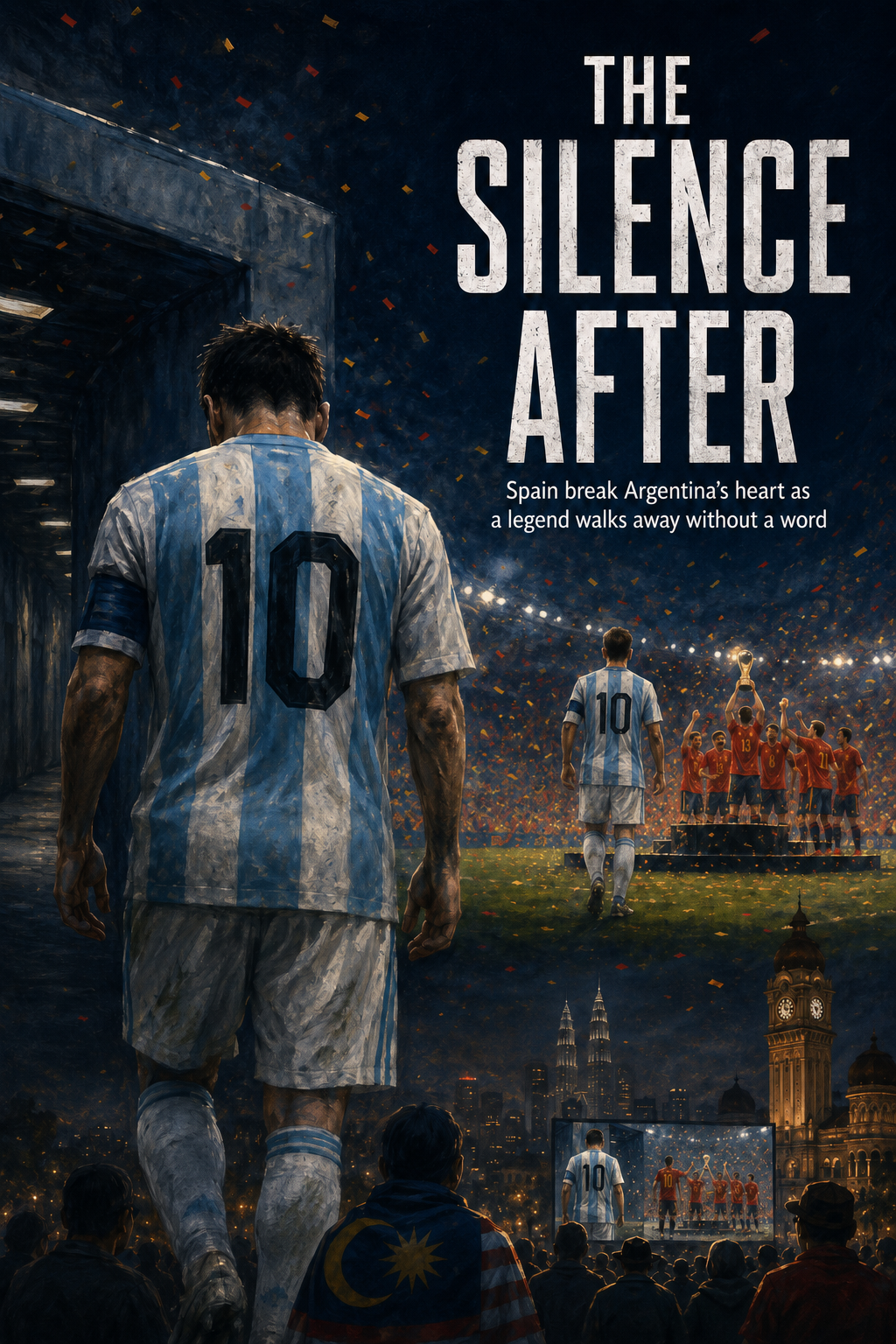
EAST RUTHERFORD, New Jersey — Monday, July 20, 2026 (in the early hours, Malaysia time)
When the whistle finally blew, after more than two hours of football, Lionel Messi did not speak.
He stood still. He stared into the distance, past the scoreboard, past the confetti already gathering in the corners of New York New Jersey Stadium (MetLife Stadium), as if looking for something that wasn’t there anymore. He rubbed his face once. Then he made his way through Spain’s celebrating players, offering embraces to those closest to him — Lamine Yamal among them — saying nothing, because by then there was nothing left to say.
Spain 1, Argentina 0. A second star for La Roja. And, quite possibly, the last World Cup night of the greatest career the game has known — ending not in a roar, but in a silence that an estimated 300,000 people in Kuala Lumpur’s Dataran Merdeka, and countless more across Malaysia who never went to bed, felt from 15,000 kilometres away.
A Baby Photo, and a Generation Later
To understand why this match mattered the way it did, you have to go back further than the final whistle — back to a photograph almost nobody remembered until this week.
Long before either of them was famous, Messi once posed for a UNICEF charity calendar holding a baby. That baby was Lamine Yamal. Told about the picture again at a fan event in New York on Friday, Messi laughed. “Una locura,” he called it – a madness. “That’s life. I took a photo when he was a baby, and now the two of us are facing each other in a World Cup final.”
He meant it warmly. He also meant to win. “He’s a tremendous player,” Messi said of the teenager who now wears Barcelona’s No. 10 – Messi’s old number. “He has his entire career ahead of him, and he has a great opportunity to achieve something historic on Sunday. We’ll do everything we can to make sure it doesn’t happen this time.”
Sunday came. And for once, the kindness and the rivalry both turned out to be true at once: Yamal got his history. Messi did not get to stop him.
The Match That Refused to Break
It shouldn’t have taken this long to decide.
Spain, as they had all tournament, controlled the ball and starved Argentina of oxygen — the tournament’s stingiest defence, just one goal conceded across all eight of their matches, doing what it had always done. Argentina, as they had all tournament, absorbed and waited, trusting that their moment would come the way it always seemed to: late, dramatic, improbable. Argentina had needed extra time or late drama in every knockout victory on the road to the final, repeatedly surviving when elimination seemed inevitable — a run that had already asked more of this squad than most champions are ever asked to give.
This time, survival had a name: Emiliano Martínez.
Argentina’s goalkeeper produced the finest performance of his life on the sport’s biggest stage — 11 saves by full time, according to Opta’s official match data, breaking the previous World Cup final record of eight. He turned away a Nico Williams screamer from the edge of the box. Deep into stoppage time, with the match still goalless and the whole of Argentina holding its breath, he threw himself low to save a Lamine Yamal free kick and drag the final into extra time. Even then he wasn’t finished: early in the first period of extra time, he was beaten by a Spain effort that looked to have finally broken the deadlock — only for it to be chalked off after a video review found a foul in the build-up. For well over a hundred minutes, Emiliano Martínez was the only thing standing between Spain and the trophy.
Then, three minutes into second-half stoppage time, with regulation time almost gone, the ground shifted under Argentina’s feet. Enzo Fernández, already booked for dissent, lunged into a reckless, over-the-ball challenge on 18-year-old Pau Cubarsí. Referee Slavko Vinčić reached for a second yellow without hesitation. Red card. Ten men, for the whole of extra time, against a Spain side that had barely needed an invitation to keep pressing.
The invitation came anyway, in the 106th minute. Ferran Torres on as a substitute since the 62nd minute met a knockdown header from Nico Williams, who had risen to meet Pedro Porro’s cross, and buried it from close range. One shot. One goal. One World Cup, decided.
Argentina finished the match having managed a single attempt on goal in more than 125 minutes of football. It wasn’t for lack of heart. It was, in the end, a team that had used up every last drop of the resilience that had carried it this far and found, for the first time in the tournament, that nothing remained to rescue them.
A Quiet Night for the King
Spain’s game plan, more than anything else, was built around one man: keep Messi quiet, and the rest would follow.
It worked with ruthless efficiency. The 39-year-old rarely touched the ball in dangerous areas all night, hemmed in by a defensive structure that had shut down better attacks than his all tournament. It was among the quietest performances of Messi’s World Cup career — and if this truly was his final World Cup match, it will not be remembered for a moment of magic, but for its absence. On the other side of the pitch, Argentina’s Nicolas Tagliafico was doing the same to Yamal, reducing Spain’s teenage superstar to a near non-factor of his own. Two great attacking talents, both quietly cancelled out by two contests decided, in the end, elsewhere.
Messi stayed mostly stoic through the immediate aftermath – the silence, the stare, the wordless embrace with Yamal. It was only later, during the medal ceremony, standing with his teammates as Spain’s players climbed the podium ahead of them, that something gave way. He received his runner-up medal. He walked back onto the pitch to take in the enormity of the scene one last time. And the tears began to fall.
Spain’s Second Star, and a New Generation Crowned
The result gives Spain their second World Cup title, following their breakthrough win in 2010, and ends Argentina’s bid to become the first nation to repeat as champions since Brazil’s back-to-back titles in 1958 and 1962.
The individual honours told their own story of a changing guard. Rodri was awarded the Golden Ball as player of the tournament, a decision that surprised some given Messi’s eight goals and four assists, but one that reflected Spain’s captain marshalling a team that rarely looked troubled. Kylian Mbappé claimed a second consecutive Golden Boot with ten goals, edging Messi by two. Unai Simón won the Golden Glove. And Pau Cubarsí, the same 18-year-old fouled in the incident that turned the match was named Best Young Player, on a night when Spain’s youth quietly inherited the football world.
Ferran Torres, fittingly, was named Man of the Match. Emiliano Martínez, on the losing side, may have given the single greatest goalkeeping performance the World Cup final has ever seen and it still wasn’t enough.
History’s First Halftime Show, and a Ceremony to Match
Around the heartbreak and the history, FIFA staged a spectacle worthy of the occasion. After days of wildfire smoke and a Saturday flash-flood warning over New York, Sunday broke clear and sunny, 80 degrees at kickoff, as if the weather itself had decided to cooperate for the biggest night of the tournament.
The 11-minute halftime show the first in World Cup history, curated by Coldplay’s Chris Martin and produced by Global Citizen opened with Madonna leading a nightclub-themed medley alongside Brazilian legends Ronaldinho and Ronaldo, before conductor Gustavo Dudamel led the New York Philharmonic and Venezuela’s Simón Bolívar Symphony Orchestra, with an assist from the Muppets’ Dr. Teeth and the Electric Mayhem, into a symphonic cover of “Seven Nation Army” that gave way to BTS performing “Dynamite.” Justin Bieber slowed the pace with an acoustic “Everything Hallelujah,” before Shakira and Burna Boy closed with “Dai Dai,” the tournament’s official song.
The show supports FIFA’s Global Citizen Education Fund, which has now raised more than US$50 million toward its US$100 million goal, boosted by US$1 from every ticket sold across the tournament.
Post Malone had earlier headlined the pre-match closing ceremony. Roughly 80,000 fans filled the stadium, some paying nearly US$10,000 for the cheapest available tickets, in a tournament that had already shattered World Cup attendance records: more than 3.6 million fans passed through turnstiles across the first 56 matches alone of the expanded, 48-team format.
In a break from recent tradition, US President Donald Trump joined FIFA president Gianni Infantino to jointly present the trophy to Spain’s captain. FIFA also introduced bespoke, Super Bowl-style championship rings for the first time in the tournament’s history set with a miniature trophy, diamonds and sapphires. Rodri and coach Luis de la Fuente received temporary rings on the night, with 30 fully customised rings for the winning squad to follow once personalised.
What Was Being Defended Wasn’t Just a Trophy
Before kickoff, Argentina coach Lionel Scaloni had tried to explain what his team was really playing for — something bigger than a second consecutive star.
“We have reclaimed something that I think is very valuable: that people stand in front of the television in their Argentina shirt and give each other a hug, a Newell’s fan with a Rosario Central fan, and a Boca Juniors fan with a River Plate fan,” he said on Friday, naming some of the country’s fiercest domestic rivalries. “We see it. We feel it. We keep it in mind. How could it not move you?”
That unity didn’t disappear with the final whistle. It simply changed shape — into the silence of a stadium half-draped in sky blue and white, into a locker room absorbing a loss nobody had quite prepared for, into a legend who cried not because Argentina lost, but because of everything the losing meant.
Malaysia’s 3 AM Vigil
None of it happened anywhere near Malaysia, and all of it was felt there just the same.
At Dataran Merdeka’s record-breaking screening part of the “Uniti Merdeka” finale that police had estimated could draw as many as 300,000 people and across KL Festival Park, LaLaport BBCC, Unifi Arena, and rooftop watch parties from Melawati Mall to Setiawangsa, a country that had refused to sleep watched the drama stretch from 90 minutes into extra time, from hope into heartbreak into history, all before most of Kuala Lumpur’s alarms were due to go off.
For Argentina’s supporters in Malaysia, it was a painfully familiar shape: so close, so long, undone in extra time by a team that simply had more left to give. For Spain’s fans including the tightly-knit Spanish community that had rallied support for La Roja through the tournament it was pure delirium deep into the early hours, as Ferran Torres wrote his name into World Cup history nearly 15,000 kilometres from home.
By the time Kuala Lumpur’s morning traffic began to move, the trophy had a new home, and a new generation – Yamal, Cubarsí, Rodri stood at the top of the football world. Messi’s search for one final crowning moment goes on, unfinished, the way the very best stories sometimes are. But for one long night that stretched from New Jersey to the Klang Valley, nobody watching needed telling that they’d witnessed something they would remember for a long time to come.
Full-Time: Spain 1-0 Argentina (a.e.t.) Goal: Ferran Torres 106′ | Man of the Match: Ferran Torres Sent off: Enzo Fernández (Argentina) 90+3′ Venue: New York New Jersey Stadium (MetLife Stadium), East Rutherford — Attendance: ~80,000 Referee: Slavko Vinčić
Sources:
NBC News — FIFA World Cup final 2026 live updates: Spain outlasts Argentina 1-0
ESPN — Spain edge Argentina after extra time to win 2nd World Cup title
Olympics.com — Spain reign supreme in FIFA World Cup 2026
Yahoo Sports (USA TODAY) — Messi looks dazed after Argentina loses World Cup final to Spain
Yahoo Sports — Enzo Fernández sent off with late red card
Yahoo Sports — Emiliano Martínez breaks saves record in extra-time loss to Spain
Goal.com — Argentina player ratings vs Spain
theScore — Rodri takes Golden Ball over Messi; Mbappé claims Golden Boot
NBC Sports — 2026 World Cup award winners
ESPN — Donald Trump to present World Cup trophy at final
NPR — Argentina, Spain and their stars Lionel Messi and Lamine Yamal meet in World Cup final
NPR — The World Cup’s first-ever halftime final show
amNewYork — 2026 World Cup sets all-time attendance record
The Star — Football fever grips Dataran Merdeka
BERNAMA — Komuniti Sepanyol di Malaysia berikan sokongan padu kepada La Roja
CBS Sports — 2026 World Cup final: Trump to attend, FIFA to present championship rings
Yahoo Sports — Ronaldo and Ronaldinho join Madonna in World Cup final halftime show
Athlon Sports — FIFA World Cup 2026 award winners: Golden Boot, Golden Ball, Golden Glove, Best Young Player
Opta Analyst — Spain 1-0 Argentina stats (a.e.t.): Torres decides World Cup final
- TNS NEWS