


No Ceasefire. One Champion.
By TNS News Team
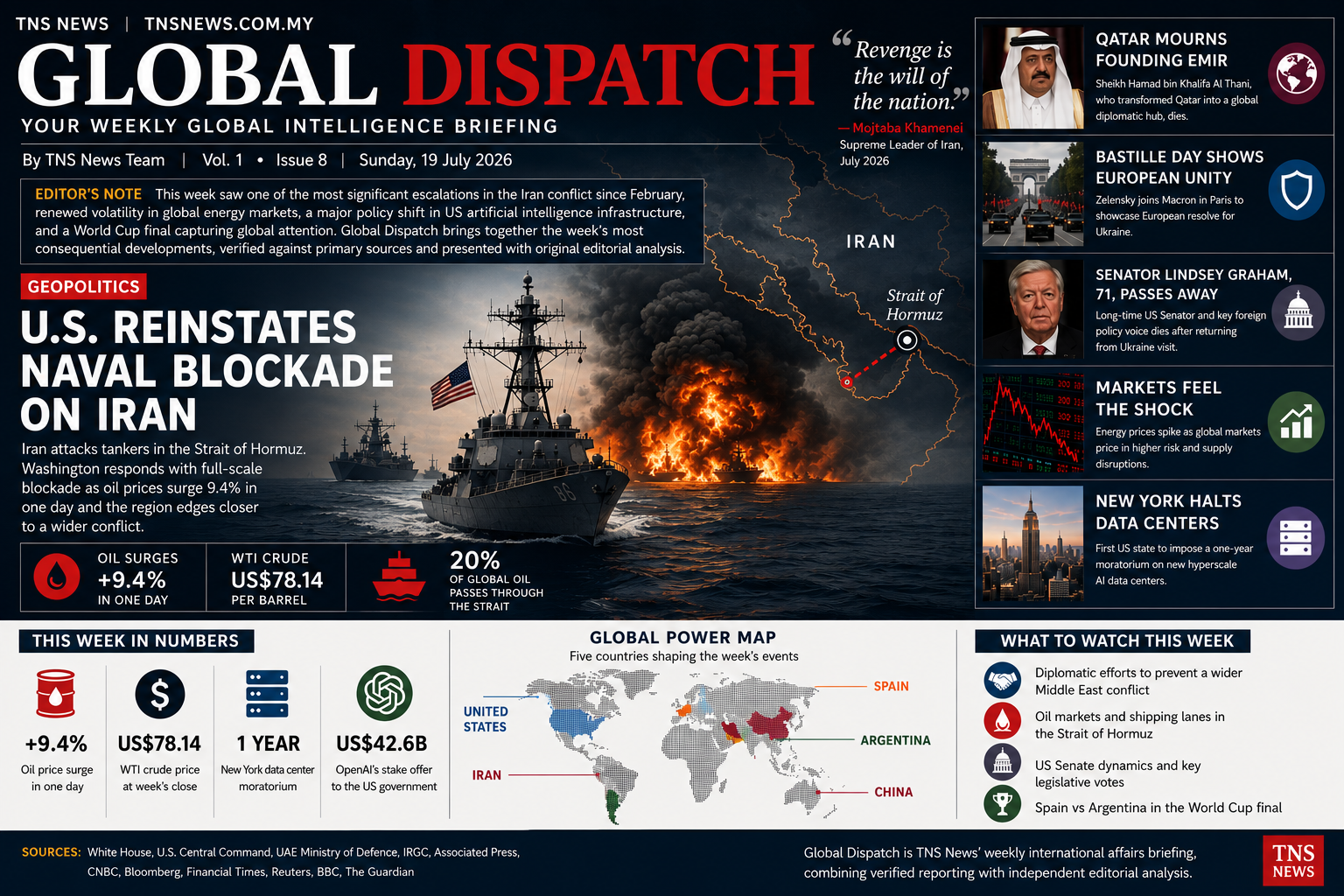
EDITOR’S NOTE This week saw one of the most significant escalations in the Iran conflict since February, renewed volatility in global energy markets, a major policy shift in US artificial intelligence infrastructure, and a World Cup final capturing the attention of the world. Global Dispatch brings together the week’s most consequential developments, verified against primary sources and presented with original editorial analysis.
GEOPOLITICS
The Naval Blockade: America’s Most Significant Escalation Since February
This week delivered the most consequential military escalation of the Iran conflict since its opening night. On Monday, 13 July, Iran struck two UAE-flagged very large crude carriers, the Mombasa and the Al Bahiyah, in the southern lane of the Strait of Hormuz within Omani territorial waters, killing one Indian crew member and wounding eight others, four of them seriously.
The UAE Ministry of Defence confirmed the attacks, condemning them as a blatant attack and a serious breach of international law, and said the UAE retained its full right to respond. Iran’s IRGC said the vessels were targeted for transporting cargo in violation of Tehran’s self-declared maritime authority over the strait.
US Central Command announced the same day that it was reinstating the naval blockade of all ships travelling to and from Iranian ports, effective 4 p.m. ET on 14 July.
The blockade had been paused during the ceasefire period and now resumed with full force. Trump formally notified Congress that limited military action was resuming in Iran.
The blockade announcement triggered an immediate 9.4 per cent surge in WTI crude, which settled at US$78.14 a barrel, its largest single-session gain since April. Jordan’s military intercepted four Iranian ballistic missiles on Tuesday morning.
On Tuesday, US projectiles struck four points in the port city of Bushehr, site of Iran’s only nuclear power plant. The US said it struck only military infrastructure in the surrounding area; Iran said the strikes targeted civilian nuclear energy infrastructure.
“Revenge is the will of the nation.”
Mojtaba Khamenei, Supreme Leader of Iran, July 2026
Mojtaba Khamenei’s first public statement as Iran’s new Supreme Leader was not a call for negotiation. He pledged revenge on behalf of the Iranian nation, a declaration that aligned with Iran’s parliament simultaneously submitting a bill asserting Tehran’s permanent legal sovereignty over the Strait of Hormuz, a claim Washington and international maritime bodies rejected as having no basis in the law of the sea. Yet a thread of diplomacy remains.
The Associated Press reported on 16 July that hopes for US-Iran diplomacy remain alive even as fighting intensifies over the strait. Both sides, analysts note, are striking at lower intensity than the opening weeks of the war, a pattern some read as deliberate: maintaining enough pressure to keep leverage while leaving back-channel contacts through Pakistan, Qatar, and Oman intact.
Qatar Mourns a Founding Emir. Bastille Day Becomes a Show of Unity.
Two significant secondary stories framed the week’s geopolitics. Sheikh Hamad bin Khalifa Al Thani, who served as Qatar’s emir from 1995 until 2013 and transformed the country into a global diplomatic and media hub, died this week.
Leaders from Europe, Africa, and Asia travelled to Doha to offer condolences to the ruling family, underscoring Qatar’s central role as a mediator in the Iran conflict and across multiple regional crises over the past three decades.
In Paris, President Emmanuel Macron used France’s Bastille Day on 14 July to stage a display of European resolve. Ukrainian President Volodymyr Zelensky joined Macron and European heads of state at a parade specifically curated to showcase military unity around Ukraine. Zelensky’s presence in Paris carried its own symbolism: it was the same day President Trump was granting Iraq’s Prime Minister Ali al-Zaidi an Oval Office meeting at the White House, with Washington attempting to use Baghdad as a potential back-channel to Tehran.
Senator Lindsey Graham, 71, Dies After Ukraine Visit
A figure closely associated with US foreign policy died at the start of this week. Senator Lindsey Graham, Republican of South Carolina and chairman of the Senate Budget Committee, passed away on Saturday night, 11 July, from a rupture of the aorta caused by hardening of the arteries, the Washington DC medical examiner confirmed on Sunday.
He was 71. Graham died hours after returning from a visit to Ukraine, where he had met President Zelensky on Friday. President Trump described him as one of the greatest people and Senators he had ever known and told NBC News that a phone call they shared on Saturday evening could have been his last.
Senate Majority Leader John Thune of South Dakota called Graham a strong advocate for the United States and a strong ally to freedom-loving countries across the globe.
Graham had served in the Senate since 2002 and was seeking a fifth term in November. His death narrows the Republican Senate majority at a time when the leadership is already managing tight vote margins.
Governor Henry McMaster of South Carolina will appoint a replacement. Graham spent his final weeks in Congress as a vocal advocate for US military resolve in the Iran conflict and had visited Kyiv multiple times in support of Ukraine.
GLOBAL ECONOMY
One Day, 9.4 Per Cent: The Blockade Shock Hits Markets
The US reinstatement of the naval blockade was not just a military announcement: it was an immediate commodity market event. WTI crude’s 9.4 per cent single-session surge on 13 July, settling at US$78.14 per barrel, was its largest daily gain since April 2026.
Brent followed proportionally. Airline fares, already elevated by months of conflict-driven fuel costs, have risen 26.7 per cent year-on-year according to Deloitte global economic data.
The blockade effectively removes Iranian oil from global supply entirely, tightening an already depleted market: OECD government inventories had already fallen to their lowest levels since December 1990 before this week’s escalation.
The broader economic picture reflects how deeply the Iran conflict has embedded itself into the global cost structure. China’s fixed-asset investment contracted 4.1 per cent in the first five months of 2026 against the same period a year earlier, the sharpest pullback since May 2020. Property investment fell 16.2 per cent over the same period.
Meanwhile, TSMC, the Taiwanese chipmaker at the centre of the global artificial intelligence infrastructure build-out, posted record quarterly revenue this week, driven by relentless demand.
The divergence between AI infrastructure expansion and broader economic strain reflects a growing tension at the heart of global capital flows in 2026.
TECHNOLOGY
New York Halts Hyperscale Data Centres. OpenAI Offers Washington a US$42.6bn Stake.
New York Governor Kathy Hochul this week signed an executive order imposing a one-year moratorium on the construction of large new data centres in the state, making New York the first US state to halt hyperscale development.
The order applies to proposed facilities requiring at least 50 megawatts of electricity and prevents the state’s Department of Environmental Conservation from issuing discretionary permits for projects not yet complete.
New York’s grid was already carrying approximately 12 gigawatts in pending connection requests from proposed data centres and other large electricity consumers as of May, a backlog the state cited as justification for the pause.
Hochul said officials needed time to develop consistent environmental standards, citing concerns over electricity prices, water consumption, and pressure on local infrastructure. Her administration also plans to seek the repeal of sales-tax exemptions granted to large data-centre projects.
Separately, OpenAI this week offered the United States government a stake in the company valued at US$42.6 billion, in what would be an unprecedented direct commercial partnership between a frontier artificial intelligence laboratory and the federal government. The offer, confirmed by two people familiar with the discussions, is part of OpenAI’s ongoing effort to deepen its relationship with the US national security establishment following the Pentagon deal controversy earlier this year.
On Thursday, 17 July, two events converged: Google launched Gemini 3.5 Pro, and the World Artificial Intelligence Conference opened in Shanghai with Chinese President Xi Jinping attending in person for the first time since the conference was established. Xi’s attendance underscored Beijing’s framing of artificial intelligence development as a matter of national strategic priority.
The same day, NPR reported that American-led technology restrictions had failed to slow China’s AI development and were instead accelerating Beijing’s push to build domestic alternatives, intensifying the technology competition between the world’s two largest economies.
GLOBAL POWER INDEX
Top five countries shaping this week’s events
1 UNITED STATES Naval blockade, World Cup host nation
2 IRAN Hormuz crisis, Mojtaba Khamenei’s first move
3 SPAIN World Cup final, reigning European champions
4 ARGENTINA Defending world champions in today’s final
5 CHINA WAIC, TSMC record revenue, US tech rivalry
SOCIETY & HUMAN INTEREST
The Final: Spain vs Argentina, MetLife Stadium, 3pm ET
The 2026 FIFA World Cup final is played today. Spain and Argentina meet at MetLife Stadium in East Rutherford, New Jersey, the venue FIFA calls New York New Jersey Stadium for the tournament, in a match that pits the reigning European champions against the defending world champions. Kickoff is at 3pm ET on FOX and Telemundo.
It is the biggest sporting event of the year, and it arrives on the final day of the first World Cup contested by 48 nations, the largest field in the tournament’s 96-year history.
Spain reached the final by beating France 2-0 in the semifinal at AT&T Stadium near Dallas on 14 July, a dominant performance that extended La Roja’s record of conceding just one goal in seven tournament matches, that single concession coming against Belgium in the quarterfinal.
Argentina reached the final in a more characteristically dramatic fashion, beating England 2-1 after extra time at Mercedes-Benz Stadium in Atlanta on 15 July. Anthony Gordon gave England the lead but Argentina came from behind with two goals in a seven-minute span: Enzo Fernandez equalised before Lautaro Martinez sealed the win two minutes into extra time, ending England’s best World Cup run since 1966.
In Saturday’s third-place playoff at Hard Rock Stadium in Miami, England defeated France in a dramatic contest that Didier Deschamps, managing his final match after 14 years in charge of the French national team, was unable to turn in his favour.
Zinedine Zidane is expected to take over as France manager. Kylian Mbappe entered today’s final day of the tournament level with Lionel Messi at eight goals each in the Golden Boot race, with Messi holding the tiebreaker through assists. Argentina are seeking to become the first side to win back-to-back World Cups since Brazil in 1958 and 1962.
“Argentina’s World Cup run has been defined by jaw-dropping, late-game heroics.”
Yahoo Sports, July 2026
THIS WEEK IN NUMBERS
9.4% Single-session surge in WTI crude on 13 July
US$78.14 WTI crude barrel price at 13 July close
8 UAE crew members wounded in tanker attacks
1 year New York data centre construction moratorium
US$42.6bn OpenAI stake offered to US government
8 World Cup goals each for Messi and Mbappe
96 Years of World Cup history: biggest ever field
71 Senator Lindsey Graham, age at death
WHAT TO WATCH THIS WEEK
1. Spain vs Argentina: Kickoff 3pm ET today at MetLife Stadium. Spain’s defensive solidity against Argentina’s capacity for late drama. Messi’s last chance to defend the title he won in Qatar in 2022. One of them becomes world champion tonight.
2. Iran Naval Blockade: The blockade was announced 13 July and took effect on 14 July. Watch whether Iran allows any vessels to transit the strait this week or maintains a complete chokehold. Every day the blockade holds, global supply chains absorb another shock.
3. Iran Diplomacy: Pakistan, Qatar, and Oman maintain back-channel contacts despite the blockade and fresh strikes. Watch whether any of the three mediators can produce a formal proposal both sides will accept, or whether the conflict enters a more sustained phase.
4. New York Data Centre Legal Challenges: Governor Hochul’s order will face immediate legal challenge from hyperscalers with projects in the permitting pipeline. Watch for the first injunction filings this week.
5. OpenAI Government Stake: The US$42.6 billion offer is without precedent. Watch for Congressional and White House responses, and for rival AI laboratories to respond with their own positioning on government partnerships.
6. US Senate Vacancy: Governor McMaster of South Carolina will appoint a replacement for Senator Graham. With the Republican majority already thin and Senator McConnell absent during hospitalisation, watch whether the appointment carries implications for upcoming Senate votes.
GLOBAL DISPATCH | TNS NEWS | tnsnews.com.my
Global Dispatch is TNS News’ weekly international affairs briefing, combining verified reporting with independent editorial analysis. Sources: CNN, AP, Reuters, Al Jazeera, NBC News, NPR, Washington Post, Roll Call, Yahoo Sports, Fox Sports, England Football, Deloitte, CENTCOM, MarineTraffic. Published Sunday, 19 July