


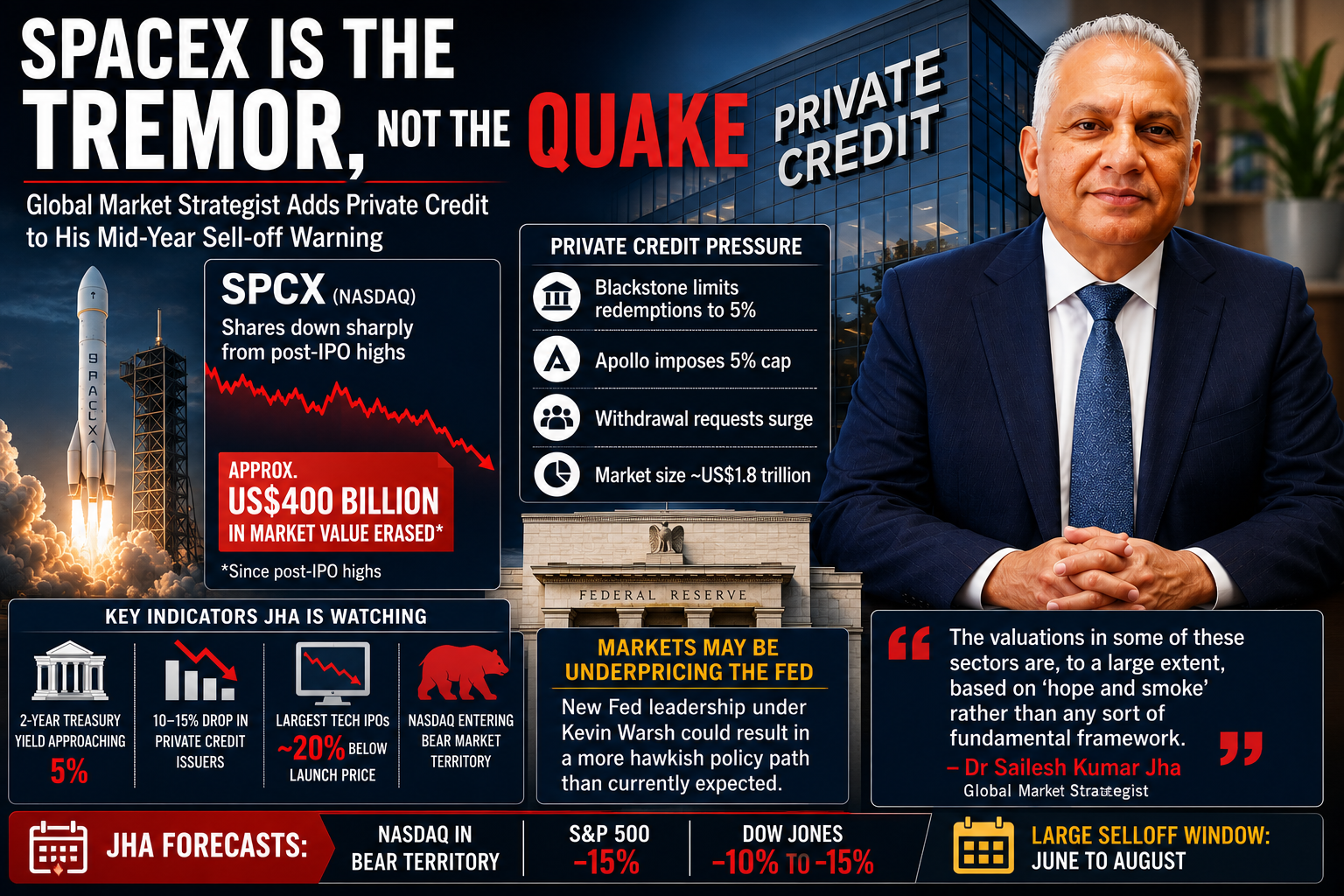
Days after warning that markets were mispricing the Federal Reserve, the strategist points to SpaceX’s slide and mounting stress in private credit as the next triggers for the correction he expects between June and August.
By TENGKU NOOR SHAMSIAH TENGKU ABDULLAH
KUALA LUMPUR, June 24 – The sell-off Dr Sailesh Kumar Jha outlined in a TNS News interview on June 22 is, in his view, drawing closer, and he now points to two fresh triggers: the stumble in newly listed SpaceX and mounting stress in private credit.
The global market strategist and former chief Asia economist at Credit Suisse AG in Singapore views both developments as early signs of the broader repricing he expects between June and August. His bullish outlook on Malaysia, detailed in that earlier interview, remains unchanged.
SpaceX (SPCX), the most closely watched market debut of the year, slipped below the US$150 level at which it first traded on June 12 during Tuesday’s session before recovering to close about 1 per cent higher near US$156. The rebound ended a three-session slide that had erased almost 24 per cent of its value.
Monday’s 16 per cent fall alone wiped about US$400 billion from its market capitalisation.
Jha had warned days earlier that the stock was likely to “fall by another 10 per cent in the near term” and could drop below its US$135 IPO price.
For him, the decline is a signal rather than an isolated event.
“This is another trigger for the large sell-off I’m calling for between June and August,” he said. “Not time to buy yet. Let the heavy positioning clear up first.”
The area that concerns him most, however, is private credit.
Recent developments in the market have reinforced that concern. Several large fund managers have capped investor withdrawals in recent weeks.
Blackstone’s flagship private credit fund, with assets of roughly US$79 billion, limited redemptions to 5 per cent in early June after investors sought to withdraw 10 per cent. Apollo imposed a similar 5 per cent cap on its main retail fund on Monday after withdrawal requests reached almost 17 per cent.
Cliffwater and several other firms have adopted similar measures across a private credit market estimated to be worth about US$1.8 trillion.
Jha expects the share prices of firms heavily exposed to these products to fall by at least 10 to 15 per cent over the next three months.
His reasoning rests on market mechanics.
Most private credit loans carry floating rates tied to the Secured Overnight Financing Rate (SOFR), meaning their yields move almost one-for-one with short-term US interest rates. At the same time, many borrowers are highly leveraged mid-market companies.
With funds yielding around 9 per cent while risk-free rates remain near 4.5 to 5 per cent, investors are, in his assessment, receiving insufficient compensation for the risks involved.
“Investors are only getting a 4.0-4.5 per cent illiquidity premium, which is very low to compensate for the large risks ahead,” he said.
Not everyone shares that view. Some institutional managers, including Oaktree, argue that large investors remain committed to the asset class even as retail investors become more cautious.
“The valuations in some of these sectors are, to a large extent, based on hope and smoke rather than any sort of fundamental framework.”
— Dr Sailesh Kumar Jha
On technology and artificial intelligence, Jha is equally blunt.
“The valuations in some of these sectors are, to a large extent, based on ‘hope and smoke’ rather than any sort of fundamental framework,” he said, adding that the same criticism largely applies to private credit.
“When US interest rates are low, these sectors give the aura that life is good, don’t worry, be happy. When US interest rates start to rise in a significant manner, the story changes completely.”
A fall below its IPO price for a marquee company such as SpaceX would, in his view, signal a broader reassessment of growth valuations rather than a one-off setback.
To determine whether the correction has fully played out, Jha is watching several indicators: a US two-year Treasury yield approaching 5 per cent, a 10 to 15 per cent decline in the shares of major private credit issuers, the largest recent technology IPOs trading around 20 per cent below their launch prices, and the Nasdaq entering bear market territory.
Those levels remain some distance away.
The two-year Treasury note yielded about 4.2 per cent this week, although it has been climbing since Kevin Warsh chaired his first Federal Reserve meeting on June 17.
Following that meeting, the Federal Reserve dropped its easing bias, and the two-year yield recorded its largest one-day increase on a Fed decision day since March 2008.
That hawkish shift, which formed the basis of Jha’s June 22 warning that markets were underestimating the Fed’s policy path, helped trigger the technology sell-off to which SpaceX’s decline has added momentum.
His view remains far from the consensus.
Most analysts covering SpaceX continue to rate the stock a buy, with average 12-month price targets well above current levels. Supporters argue that the post-listing decline reflects stretched valuations and a limited public float rather than any deterioration in the company’s Starlink or launch businesses.
How severe does Jha expect the correction to be?
He forecasts the Nasdaq will enter bear market territory, while the S&P 500 could fall around 15 per cent and the Dow Jones Industrial Average decline between 10 and 15 per cent.
Even so, he characterises the move as a reset rather than a crisis.
“This is not the start of a prolonged bear market in US equities,” he said.
According to Jha, extended bear markets typically require a solvency crisis or a severe liquidity shock combined with policymakers who are slow to respond. He argues that US authorities today are far better positioned to act decisively than they were in 2008.
He recalls that period vividly.
In the autumn of 2007, then-Federal Reserve Chairman Ben Bernanke characterised economic weakness as temporary and cyclical, while policymakers were slow to ease financial conditions.
“I remember that time vividly because I was sitting on a trading floor at a global investment bank,” Jha said.
“In the summer of 2007, I had recommended moving to cash for many investors, which was a counter-consensus call at the time.”
— Dr Sailesh Kumar Jha
On Malaysia, Jha’s view remains unchanged.
The bullish case he outlined on June 22 still stands. He remains overweight Malaysian equities, maintains an end-2026 target of 1,900 for the FBM KLCI, and expects the ringgit to outperform most Asian currencies even as the US dollar strengthens.
The benchmark index traded around 1,712 in mid-June, implying potential upside of roughly 11 per cent to his target.
In Jha’s framework, Malaysia is the harbour, not the storm.
For now, his message to investors hoping to catch a technology rebound remains straightforward:
The positioning, in his view, has yet to clear.
- TNS NEWS