


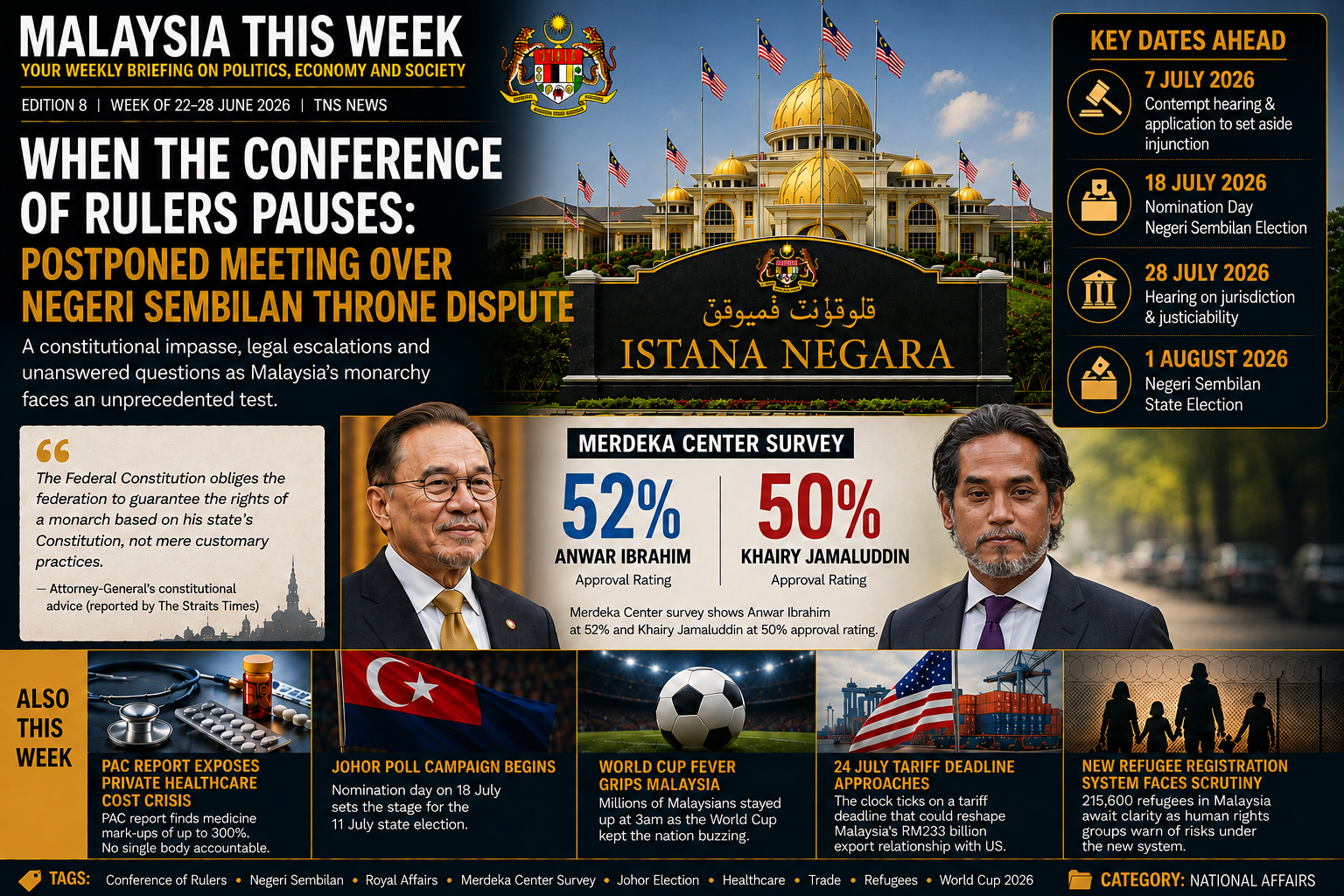
Your weekly briefing on politics, economy and society
Edition 8 | Week of 22-28 June 2026 | TNS NEWS Team
The week of 22 to 28 June 2026 may prove to be one of the most consequential of the year. Conference of Rulers postponed its June meeting because of the Negeri Sembilan throne dispute. A 1,999-page PAC report exposed the full extent of Malaysia’s private healthcare cost crisis with medicines marked up 300 per cent and no single body accountable for fixing it. Johor held nomination day for a multi-party election on 11 July.
A Merdeka Center survey showed Anwar at 52 per cent and Khairy at 50. The World Cup kept millions awake at 3am. The US trade clock ticks toward a 24 July tariff deadline that could reshape Malaysia’s RM233 billion export relationship with Washington. And 215,600 refugees living in Malaysia find their futures resting on a new government registration system that human rights groups say puts them at risk. This is the week that was.
ROYAL AFFAIRS
WHEN THE CONFERENCE OF RULERS PAUSES: CONFERENCE OF RULERS POSTPONES JUNE MEETING OVER NEGERI SEMBILAN THRONE DISPUTE
In a development described by constitutional observers as highly unusual, the Conference of Rulers postponed its scheduled June 23 to 25 meeting at short notice, with the Negeri Sembilan throne dispute cited as the reason. The Singapore Straits Times, citing sources with knowledge of the deliberations, reported that the postponement was directly linked to the unresolved question of who represents Negeri Sembilan at the conference table. The nine hereditary Malay rulers and four state governors who constitute the Conference meet three times yearly; the last comparable postponement occurred in 2021 during the Covid-19 pandemic. No new date for the June meeting has been announced. The next scheduled sitting is in October 2026.
The dilemma at the heart of the postponement is straightforward but constitutionally unprecedented: Tuanku Muhriz Tuanku Munawir continues to be recognised as Yang di-Pertuan Besar by the federal government, the Negeri Sembilan state government, and Prime Minister Datuk Seri Anwar Ibrahim. However, the four Undang, the traditional territorial chieftains of Negeri Sembilan, proclaimed Tunku Nadzaruddin Tuanku Ja’afar as the 12th Yang di-Pertuan Besar at a hotel in Melaka on 5 June, despite a High Court injunction that the parties have interpreted differently. Under Malaysia’s constitutional monarchy, rulers participate formally in the Conference of Rulers; allowing Tuanku Muhriz to attend could be read by the Undang’s camp as conferring federal endorsement; excluding him would be constitutionally untenable given the federal government’s stated position. The Conference, exercising collective prudence, chose to pause rather than allow a rushed proceeding to deepen the institutional fracture.
This week brought the most significant legal escalation yet in the dispute. DKU secretary Raja Norazli Raja Nordin confirmed he is initiating committal proceedings for contempt of court against six individuals, including three Undangs: Datuk Mubarak Thahak, Datuk Maarof Mat Rashad (Undang Jelebu), Datuk Muhammed Abdullah (Undang Johol), Datuk Abdul Rahim Yasin (Undang Rembau), Tunku Besar Tampin Tunku Syed Razman Tunku Syed Idrus Al-Qadri, and Datuk Seri Badarudin Abdul Khalid (Shahbandar Sungai Ujong). The basis is that all six allegedly defied the ad interim injunction granted by High Court judge Roz Mawar Rozain on 5 June, which explicitly restrained them from convening any DKU meeting or altering the status quo of the DKU, yet the hotel proclamation proceeded the same day. Committal proceedings for contempt of court are serious: if a prima facie case is established, the respondents could face imprisonment or a fine. The contempt hearing has been fixed for 7 July 2026. Separately, the four Undang filed an application on 12 June to set aside the injunction entirely, also listed before the Seremban High Court on 7 July. A substantive hearing on the court’s jurisdiction and justiciability over the dispute has been fixed for 28 July 2026. The Negeri Sembilan state election is set for 1 August, with nomination day on 18 July, meaning all three legal proceedings will run in parallel with an active election campaign.
The most consequential new revelations this week came from The Straits Times of Singapore in a report published on 26 June by correspondent Shannon Teoh. According to official sources cited in that report, the Attorney-General had formally advised Prime Minister Anwar Ibrahim that Tuanku Muhriz’s removal and replacement by the four Undang did not comply with the Negeri Sembilan Constitution, and that the Federal Constitution obliges the federation to guarantee the rights of a monarch based on his state’s Constitution, not mere customary practices. Critically, the AG’s advice concluded that there was no constitutional reason for Tuanku Muhriz not to chair the Conference of Rulers. This advice was tendered not only to the Prime Minister but also to the other rulers ahead of the cancelled June 23 meeting. The question this raises, which the ST report and veteran journalist Kalimullah Hassan’s subsequent commentary put squarely on the table, is why the AG’s advice was set aside. The other rulers chose to postpone the Conference rather than have Tuanku Muhriz chair it as usual, which implies a collective decision not to act on the AG’s position. That is not a neutral institutional outcome. It is a choice, and it demands an explanation that has yet to be publicly offered.
Against this backdrop, Tuanku Muhriz moved decisively to strengthen his position through the adat process itself. On Thursday 25 June, Tunku Besar Seri Menanti Tunku Ali Redhauddin Tuanku Muhriz received the Dato’-Dato’ Adat of Luak Rembau in a formal audience at Istana Besar Seri Menanti, and announced that Tuanku Muhriz had consented to hold the Istiadat Menghadap Menjunjung Duli bagi Menyempurnakan Kejadian Undang Luak Rembau ke-22 at Istana Besar Seri Menanti on Saturday 27 June at 2pm. The candidate chosen by the Kerapatan Buapak and Ibu Soko of Luak Rembau, unanimously and through the prescribed adat process, is Hassan Ab Hamid, 67, a retired teacher. Today’s ceremony, if it proceeds as scheduled, would install Hassan as the 22nd Undang of Luak Rembau, directly replacing Datuk Abdul Rahim Yasin, who is among the six named in the contempt proceedings. Tunku Ali made clear that this is not Tuanku Muhriz appointing an Undang, which would be constitutionally incorrect; under Adat Perpatih, the selection comes from within the luak, and the Yang di-Pertuan Besar’s role is to receive and formally recognise what the luak has decided. The process was initiated from within Rembau, not from the palace. The Dato’-Dato’ Lembaga of Luak Rembau issued a separate statement confirming Abdul Rahim Yasin as the legitimate Undang, signalling that the Rembau succession is itself contested, with at least two groups claiming to represent the legitimate adat leadership of the luak.
ANALYSIS: The Conference of Rulers postponement is the most institutionally significant development in the Negeri Sembilan crisis to date but the ST report’s disclosure of the AG’s advice sharpens the picture considerably. If accurate, the AG concluded that Tuanku Muhriz remains the constitutionally legitimate Yang di-Pertuan Besar, that his removal was not constitutionally effected, and that there was no reason he should not chair the Conference of Rulers. That advice was before the other rulers. They postponed anyway. That gap between the country’s top legal officer’s position and the collective institutional response is the question that veteran journalist Kalimullah Hassan, writing on 26 June, placed most pointedly before the public: why was the AG’s advice set aside, and what does that signal about the relative weight of constitutional law versus royal institutional solidarity in Malaysia? It is a legitimate question, and the absence of any public rebuttal to the report’s central claims has inevitably invited further questions. Tuanku Muhriz’s move to recognise a new Undang of Rembau through the correct adat process is simultaneously constitutionally sound and strategically astute: it demonstrates the Yang di-Pertuan Besar acting within the system, not against it, and begins to rebuild the adat structure around his recognised authority rather than waiting for the courts to do it for him. The contempt hearing on 7 July, the injunction set-aside application on the same day, and the jurisdiction hearing on 28 July collectively represent the most consequential judicial calendar for Malaysian constitutional law in a generation. And all of it runs alongside an active election campaign in a state where the ruler’s identity remains formally unresolved.
Sources: The Straits Times (Shannon Teoh), 26 June 2026; Kalimullah Hassan commentary, 26 June 2026; Sinar Harian (Syamilah Zulkifli), 25 June 2026; The Straits Times, 23 June 2026; SCMP, 23 June 2026; The Vibes, 16-23 June 2026; The Edge Malaysia, 15 June 2026; The Star, 5 June 2026; Malay Mail, 5-6 June 2026; FMT, 5 June 2026; gkg.legal constitutional analysis, June 2026
ELECTIONS
NOMINATION DAY TODAY: JOHOR’S 56-SEAT MULTI-PARTY BATTLE IS UNDER WAY
The 16th Johor state election enters its formal campaign phase today, Saturday 27 June, with nomination day under way simultaneously at 56 nomination centres across the state from 9am. The campaign period of 14 days commences once candidates are officially declared, running until 11.59pm on 10 July. A total of 2,727,926 registered voters will decide the contest on polling day 11 July 2026, with early voting on 7 July. Five MACC 24-hour operations rooms have been activated across Tampoi, Batu Pahat, Kluang, Segamat, and Mersing to monitor compliance with the MACC Act 2009 and the Election Offences Act 1954.
The candidate landscape confirmed ahead of nomination day reveals a genuinely multi-cornered contest across most seats. Barisan Nasional and Pakatan Harapan are each fielding candidates in all 56 seats. Perikatan Nasional, whose Johor branch maintained cooperation between Bersatu and PAS despite the national split, is distributing 32 seats between its components: Bersatu contesting 16, PAS 11, and the Malaysian Indian People’s Party five. This means 32 of 56 seats will see at least a three-cornered fight between BN, PH, and PN. Parti Bersama Malaysia, contesting its first election since its May formation, will field candidates in 15 seats in the Johor Bahru urban corridor, including Bukit Naning, Mahkota, Tiram, Puteri Wangsa, Johor Jaya, Permas, Larkin, Stulang, Perling, Kempas, Skudai, Kota Iskandar, Bukit Permai, Bukit Batu, and Senai. In many of these seats, four or more parties will compete. Parti Sosialis Malaysia contests one seat in Skudai. The Malaysian United Democratic Alliance contests four seats including Puteri Wangsa.
BN chairman Onn Hafiz said the BN candidate list prioritises service record over age, race, or gender, with a mix of incumbents, fresh faces, and selected returnees. PKR’s Johor chief Aminolhuda Hassan said PH will present a unity government track record as its central message, arguing that the Madani government’s infrastructure investments in Johor, including the Johor-Singapore Special Economic Zone and the LRT extension, represent tangible results. Rafizi and Nik Nazmi, in a joint statement, described the Johor state election as Bersama’s debut and an opportunity to pioneer a political culture focused on problem-solving rather than political accommodation.
ANALYSIS: The Johor state election is not primarily a contest about who governs Johor. BN enters the election as the clear favourite to retain power in the state that has been their strongest ground since 2022. The more consequential story is what the results say about the new multi-party landscape taking shape ahead of GE16. Three dynamics are worth watching. First, Bersama’s 15-seat debut in urban Johor Bahru will provide the first empirical data point on whether Rafizi and Nik Nazmi can translate their social media and media profile into actual votes. If Bersama’s candidates secure deposits and credible vote shares even without winning, the third force narrative survives and grows. If they lose their deposits in most seats, the experiment faces a serious credibility test. Second, PH’s performance without a BN alliance will show whether the progressive urban vote holds, fragments, or migrates to Bersama. Third, PN’s showing, particularly in Malay-majority seats outside the Johor Bahru corridor, will indicate whether Perikatan has recovered any momentum in its traditional strongholds after the political turbulence of 2026.
Sources: The Star, 22-26 June 2026; Malay Mail, 21-26 June 2026; FMT, 21-26 June 2026; Bernama via multiple outlets; EC press statement, 12 June 2026; Bersama statement via The Star, 22 June 2026
ECONOMY AND PUBLIC POLICY
Why Your Hospital Bill Keeps Rising: PAC TABLES DAMNING REPORT ON PRIVATE HEALTHCARE COSTS
A 1,999-page Parliamentary Accounts Committee report tabled in the Dewan Rakyat on Tuesday 24 June has given official parliamentary standing to what Malaysians have been saying for years: the private healthcare system is charging patients excessively, insurance premiums have spiralled out of reach, and no single regulatory body has been mandated to fix it. PAC chairwoman Mas Ermieyati Samsudin said the committee’s inquiry was prompted by widespread public concern over steep insurance premium increases of between 40 and 70 per cent in recent cycles, which have forced policyholders to drop coverage and turn to already-stretched public hospitals. The report, which drew on 21 witnesses across 19 formal proceedings between February and August 2025, made 17 recommendations directed at five separate government bodies.
The findings are stark. Private hospitals are marking up medicines by as much as 300 per cent to cross-subsidise operational expenses. A practice known as unbundling sees hospitals imposing separate charges for basic items such as pillowcases, alcohol swabs, and clinical waste disposal that are ordinarily included in standard room fees. Ninety-four per cent of medicines used in the private sector are imported, and more than 1,500 types of drugs have only a single registered manufacturer in Malaysia, creating effective monopolies in pricing. There is no regulatory mechanism governing how private hospitals adjust their charges over time, an asymmetry that Prudential chief health officer Manisha Keyal described as structurally unfair: Bank Negara Malaysia regulates insurance premiums, but nothing equivalent governs the hospital costs that drive those premiums. The AIA chief executive raised the additional problem of overutilisation: hospitals ordering unnecessary MRI scans and endoscopic procedures to recover capital costs. AIA chief executive Heng Zee Wang put it bluntly, asking why the same MRI costs RM5,000 at one hospital, RM3,000 at another, and RM1,500 at a third.
The PAC’s 17 recommendations span five agencies: the Ministry of Finance, Bank Negara Malaysia, the Ministry of Health, the Ministry of Domestic Trade and Cost of Living, and the Malaysia Competition Commission. Key recommendations include establishing an independent governance mechanism for private healthcare consumer protection, amending the Private Healthcare Facilities and Services Act 1998 to extend the Health Ministry’s regulatory reach to hospital charges beyond doctors’ fees, expediting the rollout of a Diagnosis Related Group billing system in the private sector, and requiring Bank Negara Malaysia to encourage insurers to adopt smaller, more predictable premium increases instead of sharp adjustments over longer periods.
ANALYSIS: The PAC report is the most substantive parliamentary intervention in Malaysian healthcare cost governance in a generation, and its implications touch every household in the country with private medical insurance. The critical weakness, as Insurance Business Malaysia noted, is that the 17 recommendations are distributed across five separate bodies with no single authority designated to lead implementation. This is precisely the structural fragmentation that has allowed the current crisis to develop: responsibility has always been shared, which in practice has meant it belongs to nobody. The Galen Centre for Health and Social Policy has called for an independent statutory Private Healthcare Commission with a clear consumer-protection mandate. That is the logical next step. Without a single accountable body, the recommendations risk the fate of previous healthcare reform proposals: widely agreed in principle, slowly diluted in implementation, and still unresolved at the next PAC inquiry. The government’s response in the coming weeks will determine whether this report is a turning point or another filed document.
Sources: Malay Mail, 25 June 2026; FMT, 24 June 2026; CodeBlue, 25 June 2026; Insurance Business Malaysia, 25 June 2026; PAC press release, 24 June 2026; PAC chairwoman Mas Ermieyati statement via Bernama
SPORT AND SOCIETY
THE WORLD CUP THAT NEVER SLEEPS: MALAYSIA GOES FOOTBALL MAD AT 3AM
The 2026 FIFA World Cup, which kicked off in North America on 12 June in a 48-team expanded format, has gripped Malaysia with a fervour that defies the graveyard-shift scheduling imposed by the 12 to 15-hour time difference between Malaysia and the host cities of the United States, Canada, and Mexico. Most group stage matches kick off between 3am and 10am Malaysian time, yet mamak stalls have been packed, office productivity on Monday mornings has visibly suffered, and social media has been dominated for two weeks by match highlights, memes, and real-time commentary in Bahasa Malaysia and English. The Round of 32, which begins today Saturday 28 June, marks the knockout phase, after which every match is eliminate or go home.
The group stage has delivered drama in abundance. Among the standout results resonating in Malaysia: South Korea knocked out Group H with a memorable run before falling in the group stage, reigniting the perennial conversation about when a Southeast Asian nation will next reach this stage. Japan reached the Round of 32 from Group C. Saudi Arabia drew attention with their performance. The African contingent, led by Morocco, performed strongly, extending the continent’s growing World Cup presence.
“For Malaysian football fans, however, the tournament carries a bittersweet dimension: Harimau Malaya has never qualified for the FIFA World Cup finals, and the question remains when Malaysia might finally reach football’s biggest stage.”
Football Association of Malaysia officials have pointed to Malaysia’s improved FIFA rankings and the expanded 2030 format as grounds for optimism, but concrete results on the qualification pathway remain the benchmark.
Malaysia’s broadcast landscape has shifted substantially for this edition. Astro holds exclusive broadcast rights, with matches available across Astro SuperSport and the Astro Go streaming platform. Free-to-air access has been a point of public debate, with consumer groups arguing that a 48-team World Cup should be accessible to all Malaysians regardless of subscription status. The Communications Ministry has not mandated free-to-air access. Social media platforms have partly filled the gap, with clips and highlights widely shared, though rights enforcement by FIFA has been active. Prime Minister Anwar Ibrahim has weighed in, saying on social media that Malaysia’s World Cup ambition must be backed by structural investment in grassroots football, youth academies, and coaching standards.
ANALYSIS: The FIFA World Cup’s grip on Malaysia is both a cultural phenomenon and an economic one. The mamak economy runs on football; the advertising industry reconfigures around it; media consumption patterns shift for six weeks. But the World Cup also holds up a mirror to Malaysian football’s ongoing underperformance on the global stage. Malaysia last qualified in 1974. The 2026 expanded format with 48 teams was widely cited as Malaysia’s best opportunity to qualify, and the country did not make it. The FAM’s optimism about 2030 must be grounded in a credible player development and coaching infrastructure, not aspirational statements. The countries that have closed the gap to World Cup qualification in recent decades, Iceland, Morocco, Japan, South Korea, share a common thread: patient, well-funded, long-term investment in youth development that preceded results by a decade. Malaysia’s football administrators have the World Cup fever of the nation behind them. The question is whether they have the institutional capacity to convert that energy into a qualification cycle that produces a different outcome in 2030 or 2034.
Sources: Wego Travel Blog, June 2026; FIFA official website; FMT, 25 June 2026; NST, 22-26 June 2026; The Star, 22-26 June 2026; Astro Media
POLITICS
ANWAR AT 52 PER CENT, KHAIRY AT 50: THE MERDEKA CENTER SURVEY THAT HAS EVERYONE TALKING
A Merdeka Center public opinion survey released on Thursday 25 June has provided the most comprehensive snapshot of Malaysia’s political landscape since the twin state elections were announced, and it contains numbers that will be studied carefully by every political strategist in the country. Prime Minister Datuk Seri Anwar Ibrahim records the highest approval rating among all political leaders tested, at 52 per cent, placing him first in a field of seven leaders. The headline figure that has drawn the most attention is second place: recently returned Umno leader Khairy Jamaluddin is at 50 per cent, just two percentage points behind the Prime Minister, in his first appearance in a major national survey since his readmission to Umno in April 2026.
The survey, conducted between 12 March and 9 April 2026 among 1,209 registered voters via telephone interview using stratified random sampling to reflect Malaysia’s national electoral profile, presents the full leadership rankings as follows: Anwar Ibrahim at 52 per cent, Khairy Jamaluddin at 50 per cent, Muhyiddin Yassin at 36 per cent, Rafizi Ramli at 32 per cent, Ahmad Samsuri Mokhtar at 28 per cent, Abdul Hadi Awang at 25 per cent, and Deputy Prime Minister Ahmad Zahid Hamidi at 24 per cent, with 61 per cent expressing dissatisfaction with Zahid’s performance, the highest dissatisfaction figure of any leader tested. However, a deeper reading reveals a politically significant ethnic breakdown: among Malay respondents, Anwar places third behind both Khairy and Muhyiddin with his overall first-place position driven by strong non-Malay support. On the economy, satisfaction with the government’s handling stood at 46 per cent against 51 per cent dissatisfied, though Merdeka Center noted that economic dissatisfaction had declined significantly compared to the overall trend throughout 2025. A steady 42 per cent of voters believe the country is moving in the right direction, unchanged from December 2025 and February 2026. Among Malay respondents, 39 per cent said the country is moving in the right direction, compared to 50 per cent among Chinese respondents and 33 per cent among Indian respondents. Voters aged 21 to 30 were the most optimistic at 57 per cent positive; those aged 51 to 60 were the least at 32 per cent.
The survey also reveals significant public appetite for institutional reform that cuts across ethnic lines with unusual consistency: 73 per cent of respondents supported limiting the Prime Minister’s tenure to a maximum of two terms or 10 years; 84 per cent backed separating the roles of Attorney-General and Public Prosecutor; and 58 per cent supported direct elections for the Kuala Lumpur mayor’s post. Merdeka Center noted that these findings showed only minor differences between Malay and non-Malay respondents, indicating broad cross-ethnic consensus on structural governance reform.
ANALYSIS: The Merdeka Center survey lands in the middle of election season with findings that cut in several directions. Anwar’s 52 per cent overall approval is a solid number for a government approaching its fourth year in office — but the ethnic breakdown tells a more complicated story. Among Malay voters, Anwar places third, behind Khairy and Muhyiddin. That structural deficit in Malay support is the Madani government’s most persistent political vulnerability, and it is directly relevant to both the Johor and Negeri Sembilan state elections, where Malay-majority seats will determine the outcome more than any other variable. The more striking finding remains Khairy at 50 per cent, two points behind the Prime Minister, without holding any elected position. Khairy’s support is strongest among Malays, where his rebranding through podcasts and media appearances has clearly registered, while his non-Malay numbers are modest. That split profile is itself revealing: Khairy’s strongest support remains among Malay respondents, suggesting his current appeal is concentrated within that demographic.Zahid’s 24 per cent approval with 61 per cent dissatisfied is the survey’s most exposed finding for the government. As DPM and Umno president, he is simultaneously the second most powerful figure in the country and the least popular leader tested. That gap cannot persist indefinitely as election season intensifies.
Sources: Merdeka Center survey press release, 25 June 2026; The Star, 25 June 2026; FMT, 25 June 2026; Borneo Post, 25 June 2026; Newswav, 25 June 2026; Bernama, 25 June 2026; Malaysiakini, 25 June 2026
ECONOMY AND TRADE
THE 24 JULY DEADLINE: MALAYSIA DOUBLES DOWN ON US TRADE TALKS AS TARIFF CLOCK TICKS
In a parliamentary session on Monday 23 June, Minister of Investment, Trade and Industry Datuk Seri Johari Abdul Ghani reaffirmed in the Dewan Rakyat that Malaysia will continue its trade engagement with the United States, warning that stepping away from the negotiating table would expose the country to the risk of unilateral tariff actions with severe consequences for its most critical export sector. Responding to a supplementary question from Datuk Seri Hamzah Zainuddin of Perikatan Nasional, Johari outlined the stakes in precise terms: Malaysia’s total exports amount to RM1.6 trillion, of which RM711 billion is generated by the electrical and electronics and semiconductor sectors alone. Of that, RM233 billion in goods were exported to the United States last year. These are the numbers that define why Malaysia cannot afford to disengage, whatever the domestic political cost of being seen to accommodate Washington.
The reaffirmation comes at a moment of acute trade policy uncertainty. The Agreement on Reciprocal Trade signed between Malaysia and the United States at the ASEAN Summit in October 2025, which locked in a 19 per cent tariff rate in exchange for substantial market access concessions, was declared null and void by MITI in March 2026 following a US Supreme Court ruling that struck down the IEEPA authority underpinning the tariff regime. Washington subsequently imposed a uniform 10 per cent tariff on all trading partners under Section 122 of the Trade Act of 1974, a provision whose authority is time-limited to 150 days and expires around 24 July 2026, unless extended by the US Congress. Simultaneously, the US Trade Representative has been running two Section 301 investigations covering Malaysia: one into excess manufacturing capacity in electronics, machinery, and steel; and a second into alleged failure to take effective action on forced labour. Both carry the potential for new, punitive tariff instruments that could be in place before the Section 122 authority expires. A MITI delegation visited Washington in May for talks related to these investigations, emphasising that Malaysia’s manufacturing sector operates on market principles.
ANALYSIS: The Malaysian government finds itself in a structurally difficult position. The original ART gave Malaysia a degree of tariff certainty, at the price of significant concessions on market access, bumiputera preferential policies, 5G supplier restrictions, and forced labour compliance. The Supreme Court ruling invalidated the tariff instrument but not Malaysia’s concessions, which remain on the table. Now, with Section 122 authority expiring on 24 July and Section 301 investigations running in parallel, Malaysia faces the real possibility of new tariffs at a higher rate than the original 19 per cent, with none of the negotiating leverage it had in October 2025. Johari’s message to Parliament, that disengagement carries greater risk than engagement, is strategically sound. But it also acknowledges a fundamental asymmetry: Malaysia needs the US market far more than the US needs Malaysia’s. In that context, the remaining weeks before 24 July are among the most consequential in Malaysia’s trade policy calendar for years. The outcome will land during an election campaign, making the political management of any negative development doubly challenging.
Sources: The Vibes, 23 June 2026; FMT, 23 June 2026; Fulcrum/ISEAS, 20 April 2026; StratNews Global, 16 March 2026; MITI official website; Cassidy Levy Kent analysis, October 2025
SOCIETY AND HUMAN RIGHTS
215,600 REFUGEES, ONE NEW SYSTEM: MALAYSIA’S DPP RAISES RIGHTS CONCERNS AS CABINET REVIEW LOOMS
Malaysia is home to 215,600 refugees and asylum seekers registered with the United Nations High Commissioner for Refugees as of February 2026, the vast majority from Myanmar including 126,144 Rohingyas, 15,774 Chins, and 33,002 from other conflict-affected ethnic groups in that country. Since January 2026, the government has been rolling out a new national refugee registration system, the Dokumen Pendaftaran Pelarian or DPP, which aims to replace the existing UNHCR-led registration framework with a Malaysian government-managed database. Phase one of the DPP launched formally on 1 June 2026, beginning with Rohingya and other detainees in immigration detention centres. The Home Affairs Ministry was due to present a comprehensive refugee management plan to Cabinet in mid-June for discussion. Yahoo News Malaysia reported on 23 June that Malaysia is home to over 215,000 refugees and asylum seekers, citing the latest figures.
The DPP has generated significant international concern. Human Rights Watch, in a report published on 4 May, said the new system raises protection, rights, and privacy concerns, pointing to the absence of a publicly available legal framework, the exclusion of UNHCR from refugee status determination under the new system, and the collection of biometric data including voice recordings and facial recognition without clear data protection safeguards. Fortify Rights, in a statement on 1 June, called on the government to ensure the DPP protects refugees from arrest, detention, forced returns, and government misuse of data. The Home Minister has stated that the DPP will be the sole document verifying refugee status, and that UNHCR’s role will be limited to resettlement. The government has also been clear that the end outcome for refugees remains repatriation, third-country resettlement, or deportation, and not permanent residency in Malaysia. The government projects it will take until 2029 to review the cases of all nearly 220,000 refugees currently registered with UNHCR.
At the same time, the government has allocated RM10 million in its 2026 budget to implement the DPP, a commitment that UNHCR has described as reflecting growing national ownership of refugee registration. The Legal Aid and Public Defence Bill 2025 has strengthened legal protections by guaranteeing inclusive access to legal aid for all children regardless of nationality, including refugee children. The Refugee Medical Insurance programme, launched in August 2025, has registered over 4,200 refugees toward a target of 10,000 by December 2026. And around 32,000 refugees have been registered for the Touch ‘n Go digital e-wallet. The picture is therefore mixed: genuine steps toward a structured national framework, alongside concerns about whether that framework will meet international protection standards.
ANALYSIS: Malaysia’s DPP is simultaneously the most ambitious refugee governance reform the country has ever attempted and the most contested. The previous system, under which UNHCR effectively ran all aspects of refugee registration and status determination, was always a temporary arrangement in a country that has never ratified the 1951 Refugee Convention and has no domestic asylum law. The DPP at least acknowledges that the status quo was structurally unsustainable. But the concerns raised by HRW and Fortify Rights are not procedural quibbles: they go to the heart of whether a country with no refugee law, a history of indefinite detention, and active immigration raids can credibly run a fair status determination process. The government’s framing of the DPP primarily as a security and data-management tool, rather than a protection framework, reinforces those concerns. The Cabinet review of the refugee management plan in mid-June will be the next opportunity to see whether the government moves toward a rights-compliant system or entrenches the security-first approach. For 215,600 people, and for Malaysia’s international standing, the answer matters.
Sources: UNHCR Malaysia figures at a glance, February 2026; Yahoo News Malaysia, 23 June 2026; Human Rights Watch, 4 May 2026; Fortify Rights, 1 June 2026; UNHCR Malaysia website; DVB, December 2025
NUMBERS TO NOTE
RM4.10 per litre: RON97 retail price for 25-30 June 2026, down 25 sen from RM4.35 previously; unsubsidised RON95 also reduced 25 sen to RM3.47 per litre; Peninsular diesel down 30 sen to RM4.07 per litre; BUDI95 subsidised RON95 remains unchanged at RM1.99 per litre for eligible Malaysians; the Finance Ministry attributed the cuts to moderating global crude oil prices and progress in the West Asian conflict (Ministry of Finance announcement, 24 June 2026)
215,600: Refugees and asylum seekers registered with UNHCR in Malaysia as of February 2026, with 193,824 from Myanmar; the government’s new DPP registration system launched Phase 1 on 1 June 2026 (UNHCR Malaysia / Yahoo News Malaysia, 23 June 2026)
300 per cent: Maximum mark-up of medicines by private hospitals to cross-subsidise operational expenses, as found by the PAC inquiry (PAC report, June 2026)
40 to 70 per cent: Range of insurance premium increases in recent cycles that triggered the PAC inquiry and prompted many Malaysians to drop private medical coverage (Malay Mail / FMT, 25 June 2026)
104: Total matches in the 2026 FIFA World Cup, the largest edition ever with 48 teams across the United States, Canada, and Mexico; Round of 32 begins 28 June (FIFA / Wego Travel Blog)
October 2026: Next scheduled Conference of Rulers sitting, now the earliest opportunity for the nine rulers to convene since the June postponement (Malay Mail / The Vibes)
56: Seats contested in the 16th Johor state election, with nomination day on 27 June and polling on 11 July 2026; at least four-cornered fights expected across most urban Johor Bahru seats (EC / The Star, 26 June 2026)
15: Seats Bersama will contest in Johor, targeting urban constituencies in the Johor Bahru corridor as the party’s electoral debut under Rafizi Ramli and Nik Nazmi (The Star, 22 June 2026)
52 per cent: Anwar Ibrahim’s approval rating in the Merdeka Center June 2026 survey, highest among seven leaders tested; Khairy Jamaluddin second at 50 per cent (Merdeka Center, 25 June 2026)
24 per cent: Ahmad Zahid Hamidi’s approval rating in the same survey, lowest among all leaders tested, with 61 per cent expressing dissatisfaction with his performance (Merdeka Center, 25 June 2026)
84 per cent: Share of survey respondents who backed separating the roles of Attorney-General and Public Prosecutor, among the highest institutional reform sentiments recorded in any Merdeka Center poll (Merdeka Center, 25 June 2026)
WHAT TO WATCH NEXT WEEK
1. Johor nomination day results: who filed, how many corners?
Nomination day on 27 June will confirm the full candidate list for all 56 seats. Watch for the total number of candidates, how many seats see four-cornered or more fights, whether any surprises emerge in candidate selections, and whether Bersama files all 15 of its intended seats. The shape of the contests will determine whether BN’s dominant position is secure or whether vote-splitting opens unexpected vulnerabilities.
2. Negeri Sembilan courts: July 7 contempt hearing and July 28 jurisdiction hearing
Two dates will define the legal trajectory of the Negeri Sembilan crisis. On 7 July, the Seremban High Court hears both the DKU’s contempt of court application against the six individuals including three Undangs, and the Undang’s counter-application to set aside the injunction. If the injunction is set aside, the contempt proceedings lose their foundation. If it stands, the respondents face the real possibility of imprisonment or fines. On 28 July, the court determines the fundamental jurisdiction and justiciability questions. Both hearings will occur in the heat of the Negeri Sembilan election campaign, which begins on nomination day 18 July.
3. Khairy’s next move: will Umno deploy him in Johor or Negeri Sembilan?
Khairy’s 50 per cent approval rating, two points behind the PM, makes him the most electorally valuable figure in Umno who is not currently a sitting MP or state assemblyman. Watch for whether Umno deploys him prominently in the Johor campaign, whether he is given a formal role in candidate selection or public campaigning, and whether his return begins to translate political capital into organisational momentum.
4. PAC healthcare report: will the government commit to a single regulatory body?
The PAC tabled 17 recommendations across five agencies with no lead authority designated. The Galen Centre has called for an independent statutory Private Healthcare Commission. Watch for the government’s formal response to the report, whether the Health Ministry tables any legislative amendment to the Private Healthcare Facilities and Services Act 1998, and whether Bank Negara Malaysia moves to restructure insurance premium governance in line with the PAC’s recommendations.
5. World Cup Round of 32: which Asian teams survive?
The knockout stage begins today. Japan and South Korea have qualified from the group stage. Watch for how the Asian representatives perform in the Round of 32, and for any statement from the Football Association of Malaysia on how the 2026 World Cup informs Malaysia’s qualification strategy for 2030. Malaysia’s last World Cup appearance was in 1974.
6. 24 July US tariff deadline: will Congress extend Section 122 authority?
The 10 per cent tariff on Malaysian goods rests on Section 122 authority expiring around 24 July. If Congress does not extend it and the USTR cannot conclude a new instrument in time, Malaysia faces a tariff vacuum that the Section 301 investigations could fill with punitive rates. Watch for any Congressional action, any USTR announcement, and any signal from MITI on the state of bilateral negotiations.
7. DPP Cabinet review: will Malaysia move toward a rights-compliant refugee framework?
The Home Affairs Ministry was due to present its comprehensive refugee management plan to Cabinet in mid-June. Watch for whether the plan has been tabled, what it contains on UNHCR’s future role, and whether the government responds to the HRW and Fortify Rights concerns about protection standards. For 215,600 registered refugees, the next policy decision could determine whether the DPP becomes a genuine protection framework or a surveillance and deportation tool.
8. Conference of Rulers: will a new June date be set before October?
The postponement announcement was made without naming a replacement date. Watch for any official communication from the Keeper of the Rulers’ Seal or the Prime Minister’s Department on whether a special session will be convened before October, or whether the nine rulers will formally wait until the scheduled October meeting to reconvene.
9. Zahid’s position: will the DPM’s 24 per cent rating generate internal Umno pressure?
Ahmad Zahid Hamidi’s 24 per cent approval, with 61 per cent dissatisfaction, is the survey’s most politically exposed finding for the government. Watch for whether Umno’s internal reaction to the number produces any public commentary from party figures, whether the statistic surfaces in the Johor campaign, and whether Anwar makes any moves to recalibrate the government’s public face heading into the election season.
UNTIL NEXT WEEK
Malaysia enters the week ahead carrying more than any single column can fully contain. An election is formally under way in Johor, a throne dispute remains unresolved in Seremban, a trade deadline ticks toward 24 July in Washington, 215,600 refugees await a Cabinet decision that will shape their futures, a healthcare system awaits a government response that 17 recommendations and five agencies cannot yet deliver, a survey tells the political class uncomfortable truths about who the public trusts, and the World Cup moves into its knockout phase at hours when only the most dedicated fans are still awake. Malaysia seldom offers a quiet week. This one will be no exception.
EDITORIAL NOTE
All facts in this edition are attributed to named, published sources as indicated. Allegations and ongoing legal proceedings are identified as such. No copyrighted text has been reproduced verbatim. Analysis sections represent the editorial assessment of TNS News.
— TNS NEWS