


Energy Diplomacy, Growth Optimism and Anti-Corruption Drive Shape National Agenda
Your Weekly Briefing on Politics, Economy & Society
Edition: Week of April 13–19, 2026
KUALA LUMPUR – Malaysia’s diplomatic and economic agenda this week was shaped largely by concerns over global energy security, with Prime Minister Datuk Seri Anwar Ibrahim engaging in multiple initiatives aimed at safeguarding the country’s fuel supply amid tensions in West Asia.
The developments ranged from high-level bilateral talks with Australia to renewed oil negotiations with Russia, reflecting a broader strategy to diversify supply channels while maintaining domestic stability.
AUSTRALIAN PM VISIT FOCUSES ON ENERGY SECURITY
Australian Prime Minister Anthony Albanese concluded a two-day official visit to Malaysia on April 16, marking another step in strengthening bilateral cooperation between the two countries.
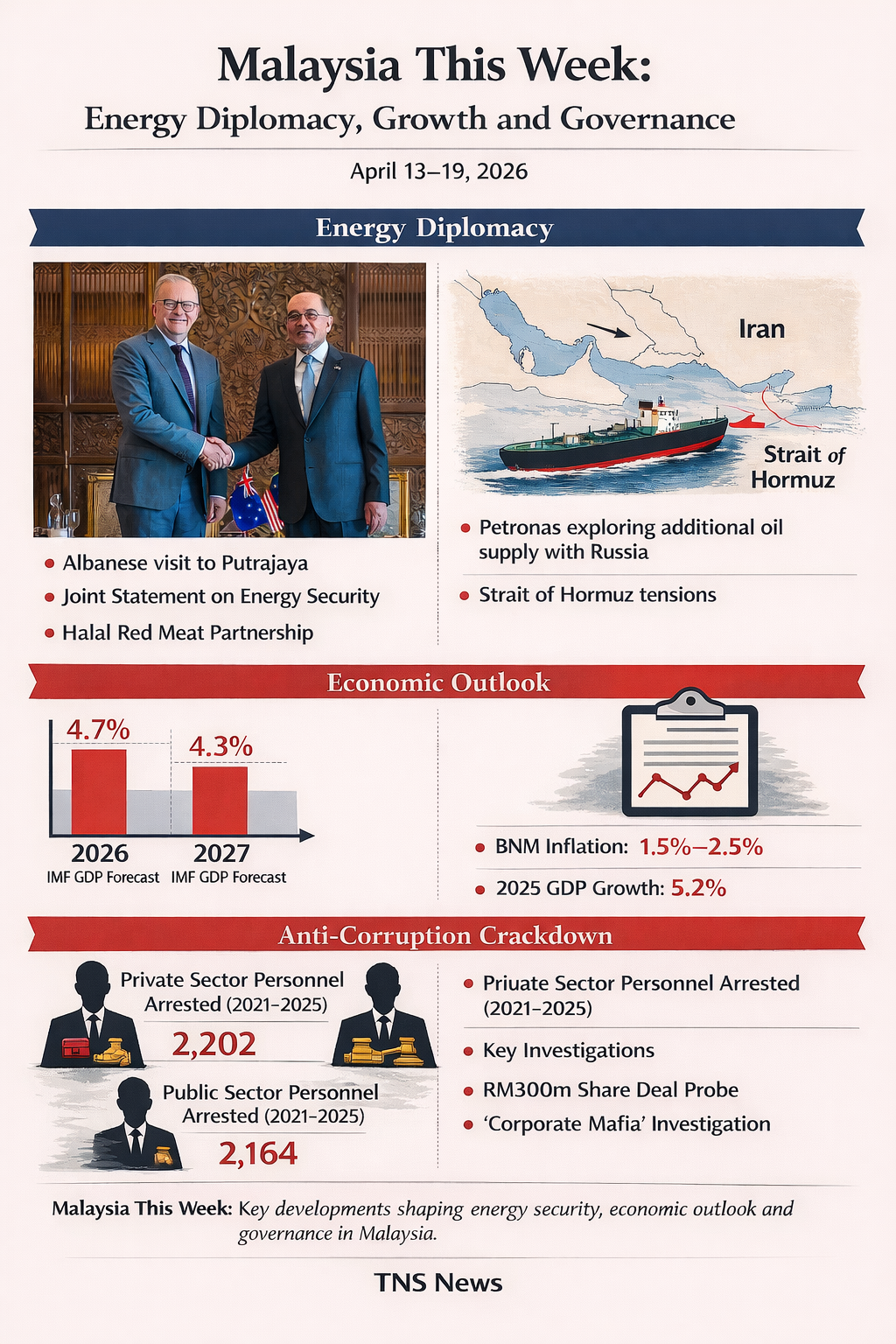
Albanese arrived on April 15 and was accorded an official welcome at the Perdana Putra Complex in Putrajaya before holding talks with Malaysia Prime Minister Datuk Seri Anwar Ibrahim.
Discussions centred on energy security, fuel supplies, fertiliser trade and broader economic cooperation amid global supply uncertainties linked to the West Asia conflict.
Both leaders issued a Joint Statement on Energy Security, highlighting the growing importance of Malaysia–Australia cooperation in ensuring stable supply chains.
Malaysia currently ranks as Australia’s third-largest supplier of refined fuel, accounting for about 10 percent of its imports, while Australia remains an important energy partner for Malaysia.
The two leaders also witnessed the signing of a Memorandum of Understanding on the Strategic Halal Red Meat Partnership between Malaysia’s JAKIM and Australia’s Department of Agriculture, Fisheries and Forestry.
Albanese’s visit included meetings with Natural Resources and Environmental Sustainability Minister Arthur Joseph Kurup and Petronas Chief Operating Officer Mohd Jukris Abdul Wahab, as well as a visit to the Petronas Twin Towers.
Australia is Malaysia’s 12th largest trading partner, with total bilateral trade reaching RM78.63 billion in 2025. Both countries have maintained a Comprehensive Strategic Partnership since 2021.
MALAYSIA EXPLORES RUSSIA OIL SUPPLY OPTIONS
Shortly after Albanese’s departure, Anwar revealed that Petronas would pursue negotiations with Russia to secure additional oil supplies for domestic consumption.
Speaking during the opening of the new Sultan Ismail Petra Airport terminal in Kota Bharu, Kelantan, Anwar said Malaysia’s constructive diplomatic relations with Russia may offer opportunities as global energy competition intensifies.
The move comes amid heightened concern over the Strait of Hormuz, one of the world’s most critical oil transit chokepoints.
Malaysian oil tankers were among the first to successfully navigate the strait in recent weeks following diplomatic engagement with Iranian authorities.
A Petronas tanker safely reached the Pengerang Integrated Complex in Johor, reinforcing government assurances that Malaysia’s supply chain remains stable.
Anwar stressed that domestic energy security remains the government’s primary priority.
While Australia had requested cooperation on fuel supplies, the prime minister said assistance to other countries would only be considered after ensuring adequate reserves for Malaysians.
Petronas has assured that fuel supply nationwide will remain stable through at least June 2026.
IMF RAISES MALAYSIA GROWTH OUTLOOK
Malaysia received positive macroeconomic news this week after the International Monetary Fund upgraded the country’s growth forecast.
In its April 2026 World Economic Outlook, the IMF projected Malaysia’s real GDP growth at 4.7 percent for 2026 and 4.3 percent for 2027, representing an upward revision from earlier estimates.
The revision reflects strong domestic demand and continued resilience in Malaysia’s export sectors.
Malaysia recorded 5.2 percent economic growth in 2025, while Bank Negara Malaysia currently expects the economy to expand between four and five percent in 2026.
BNM Governor Datuk Seri Abdul Rasheed Ghaffour, speaking from Washington during the IMF–World Bank Spring Meetings, said Malaysia’s relatively low inflation environment positions the country well to manage external shocks.
Headline inflation is projected to average between 1.5 percent and 2.5 percent this year, with February inflation recorded at 1.4 percent, down from 1.6 percent in January.
As a net energy exporter, Malaysia retains certain advantages in the current environment, while a strengthening ringgit may help moderate imported inflation pressures.
ANTI-CORRUPTION CRACKDOWN INTENSIFIES
Malaysia’s anti-corruption enforcement agencies also stepped up operations this week with several high-profile investigations.
Major Arrests
The Malaysian Anti-Corruption Commission remanded a former CEO of a government statutory body and a company chairman over an alleged RM300 million share sale deal involving suspected collusion.
Separately, the MACC detained the CEO of another federal statutory body suspected of accepting bribes linked to a squash court construction project. Investigators allege the suspect received RM100,000 in cash and requested a total of RM1 million.
Private Sector Corruption Rising
MACC Chief Commissioner Tan Sri Azam Baki warned that corruption is increasingly spreading into the private sector.
Between 2021 and 2025, authorities arrested 2,202 private sector individuals for corruption-related offences, slightly exceeding the 2,164 public sector employees detained during the same period.
Azam noted that financial crimes including share manipulation, tax evasion and money laundering are increasingly being conducted through complex corporate structures.
“Corporate Mafia” Investigation
Inspector-General of Police Datuk Seri Mohd Khalid Ismail said investigations into alleged “corporate mafia” networks are ongoing.
The probe follows claims that enforcement agencies were being manipulated by business cartels to take control of listed companies.
Authorities have identified several individuals for questioning both in Malaysia and overseas.
THE BIG PICTURE
This week’s developments highlight how energy diplomacy is becoming a central pillar of Malaysia’s foreign policy.
The Albanese visit, Russia oil negotiations and successful navigation of the Strait of Hormuz illustrate the government’s effort to balance diplomacy, economic stability and national energy security.
At the same time, stronger economic projections from the IMF offer encouragement, though domestic governance challenges — particularly corruption remain an area requiring sustained enforcement.
As geopolitical tensions and global economic uncertainty persist, Malaysia’s ability to maintain diplomatic flexibility while strengthening institutional resilience will remain crucial in the months ahead.
WEEK AHEAD: WHAT TO WATCH (APRIL 21-27)
Parliament Continues Fifth Session: The Dewan Rakyat remains in session this week as part of the First Meeting of the Fifth Session of the Fifteenth Parliament, which began in early April. Observers will monitor parliamentary debates and any policy announcements from ministers, particularly on energy security and economic measures.
Energy Supply Monitoring: Following Prime Minister Anwar’s announcement on Russia oil negotiations and with Petronas assuring fuel supplies through June, market watchers will track developments in global oil prices and any updates on supply chain negotiations. Brent crude movements and developments at the Strait of Hormuz remain key indicators.
Inflation and Economic Data: With Bank Negara Malaysia projecting inflation between 1.5-2.5 percent for 2026, analysts will watch for any interim economic indicators or statements from BNM officials on monetary policy. The central bank has held rates steady, and any hints of policy shifts would be significant.
Anti-Corruption Operations: Following this week’s high-profile arrests, attention turns to whether MACC will conclude investigations into the RM300 million share deal and corporate mafia allegations. Updates on the ongoing police investigation into alleged cartel activities will also be closely monitored.
Regional Developments: With geopolitical tensions in West Asia continuing to impact energy markets and shipping routes, Malaysia’s diplomatic engagement and its role as a regional energy hub will remain under scrutiny. Any further high-level diplomatic visits or statements on energy cooperation will be newsworthy.
Visit Malaysia 2026: As the country’s tourism campaign continues, updates on visitor arrivals and tourism sector performance will provide indicators of economic recovery in the services sector. – TNS NEWS
For TNS NEWS | Based on official government statements, IMF reports, and verified news sources | Week ending April 19, 2026