


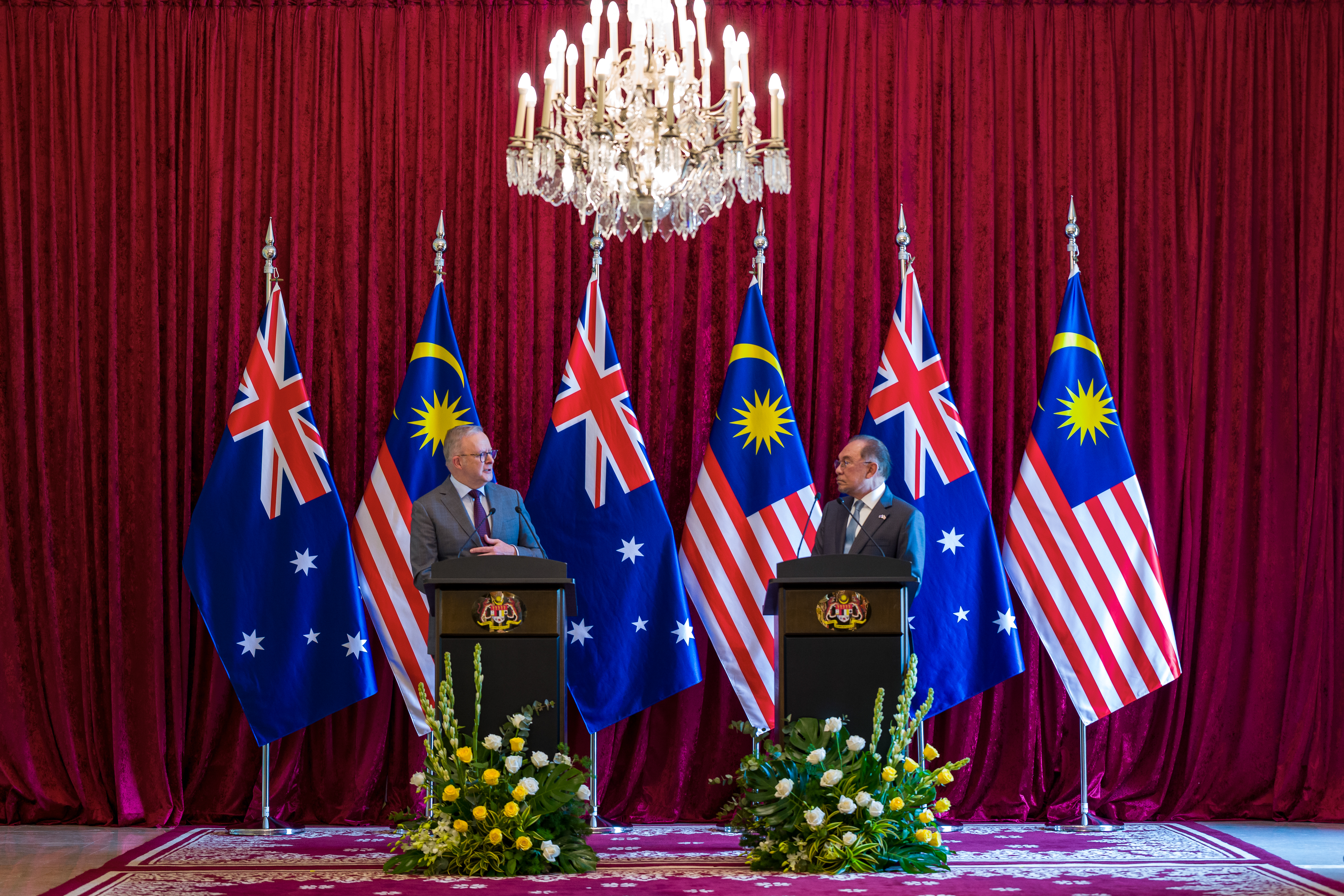
The Australian Prime Minister came to Malaysia not just in friendship but in strategic necessity and both nations are better positioned for it
PUTRAJAYA, 18 April – There is a telling detail in the language Anthony Albanese chose when he arrived in Kuala Lumpur this week. Before the ceremonies, before the signing of documents, before the joint press conference with its carefully crafted diplomatic register, the Australian Prime Minister had already signalled the purpose of his visit in plainly operational terms.
“We are taking every step to reinforce relationships and engage with key partners to keep our fuel supply flowing,” he said. “My government is continuing to take every practical action to shield Australians from the impact of the war in the Middle East.”
This was not the language of protocol. It was the language of a leader managing a crisis one that has made distant friendships suddenly consequential.
The three-day official visit to Malaysia from 15 to 17 April 2026 produced tangible outcomes: a Joint Statement on Energy Security, an MoU on the Strategic Halal Red Meat Partnership, a frank joint press conference, and what both leaders described as the deepening of a relationship already elevated to Comprehensive Strategic Partnership status in 2021. But to assess the visit’s real significance, one must understand both what brought Albanese to Kuala Lumpur and what the two countries have built together over decades because the foundation on which this week’s diplomacy rested was not improvised. It was long in the making.
A Relationship Older Than Independence
The Malaysia-Australia relationship is one of the oldest bilateral partnerships in the region. It predates the independence of Malaya in 1957. Australian troops fought alongside Malaysians during the Second World War, the Malayan Emergency, and the Konfrontasi with Indonesia. Australia established a commission in Kuala Lumpur as early as 1955, and the two countries signed their first bilateral trade agreement in 1958, the first such commitment Australia made anywhere in Southeast Asia formalising deeper commercial ties that would later be anchored by the Malaysia-Australia Free Trade Agreement in 2013, and reinforced through the ASEAN-Australia-New Zealand Free Trade Area, RCEP, and the CPTPP.
By 2015, the relationship had been elevated to a Strategic Partnership. Six years later, in January 2021, Prime Ministers Scott Morrison and Muhyiddin Mohd Yassin upgraded it further to a Comprehensive Strategic Partnership the highest bilateral designation Malaysia has accorded Australia structured around three pillars: economic prosperity, society and technology, and defence and regional security. People-to-people ties have grown in parallel, with hundreds of thousands of Malaysian students having studied in Australia over the decades.
That human dimension found its most visible expression this week in the presence of Foreign Minister Penny Wong, who accompanied Albanese throughout the visit and held bilateral talks with her Malaysian counterpart, Dato’ Seri Mohamad Hasan. Malaysian-born and raised in Kota Kinabalu before her family relocated to Australia, Wong is not merely a senior minister in this context — she is a living embodiment of the depth of connection between the two countries. Her presence in Putrajaya carried meaning that no communiqué could fully articulate.
It is against this long backdrop that Albanese’s April 2026 visit must be understood. This was not a relationship being invented under pressure. It was one being activated at its fullest, precisely because the groundwork was already there.
What Brought Him Here
The immediate catalyst is the ongoing conflict in West Asia Operation Epic Fury which has disrupted global energy markets since hostilities broke out in late February 2026. The Strait of Hormuz has effectively been closed for seven weeks. Anwar put it starkly at the joint press conference: “We are really encountering post-normal times. Developments are unanticipated and continue to haunt us. Supply chains are disrupted and the consequences are pummelling through the seven seas.”
Australia is acutely exposed. The country relies heavily on imported fuel, and its supply chains run through sea lanes now disrupted by war. That exposure was thrown into sharp relief during the press conference itself, when Albanese confirmed that an overnight fire had broken out at the Viva Energy refinery in Geelong one of Australia’s key fuel processing facilities. He reported that the fire had been extinguished with no workers harmed, but acknowledged there would be consequences for fuel supply requiring proper assessment.
Against that backdrop, he announced that his government had secured an additional 100 million litres of diesel one shipment from Brunei, secured the day prior, and one from South Korea under new strategic reserve powers backed by Export Finance Australia. “This is the first of many expected shipments,” he said, adding that the diesel would be directed where it is needed most, including to Australian farmers facing planting season.
The announcement, made from Putrajaya, was a vivid illustration of why this regional tour was never merely diplomatic in nature.
Malaysia, for its part, relies on Australia as a dominant external supplier of LNG, which supports the gas network in Peninsular Malaysia. At the same time, Malaysia is an important regional supplier of refined fuel and fertiliser products to Australia. The interdependence runs in both directions, and in more precise terms than is often appreciated.
At the press conference, Anwar explained the triangular structure clearly: Malaysia requires phosphate rock from Australia to sustain its own agricultural production, and in turn exports urea fertiliser to Australia, which uses it to grow the wheat and other crops it supplies back to Malaysia.
“There are certain items and minerals that we require,” Anwar said. “We import LNG from Australia and they have assured us of this supply. So we have to ensure that their requirements beyond what we can make available will be equally honoured. That’s what friendship is all about.”
Albanese made this structural reality the centrepiece of his public remarks.
“Nearly 60 per cent of Malaysia’s wheat and 75 per cent of its lamb and beef come from Australia,” he said. “And our neighbours know that providing fuel and fertiliser to Australia helps put food on the table in this region. As comprehensive strategic partners, we’re working together to prepare and shield our citizens from the worst of the impacts of this global conflict.”
He also situated the Kuala Lumpur visit within a broader regional sweep, having travelled to Singapore and Brunei in the days prior, securing energy and supply assurances from each. Malaysia, however, was the most strategically significant stop the largest economy on the itinerary and the country with the deepest structural energy ties to Australia.
“The Indo-Pacific is not a place that we visit,” Albanese said. “It’s our home.”
It was a line that deserved to be heard a deliberate rebuttal to any suggestion that Australia’s engagement with Southeast Asia is driven solely by crisis management rather than long-term strategic commitment.
What the Visit Delivered
The Joint Statement on Energy Security is the visit’s most consequential formal product. It commits both governments to maintaining open trade flows for fuel and LNG, and establishes a “no surprises” consultation framework on energy trade matters meaning neither side will make significant unilateral moves without prior notification to the other. Both nations also pledged to work together on supply chain resilience, support for the energy transition, and the promotion of renewable energy adoption. Both energy ministers were tasked with continuing coordination on the crisis response.
Prime Minister Anwar was characteristically direct in framing Malaysia’s position. Acknowledging the severe stress on global energy markets, he invoked the language of durable friendship “Malaysia will always be a reliable partner to Australia. We will be mates through thick and thin as we have always been” while simultaneously making clear that PETRONAS-led consultations would follow, calibrated against domestic supply requirements on both sides.
“What we need to do is to see first our domestic requirements and also Australia’s domestic energy requirements, and see where we can assist each other on a quid pro quo basis,” he said.
It was a measured signal: solidarity, yes but on terms of mutual benefit and national responsibility.
Anwar also reaffirmed that Malaysia maintains constructive engagement with all major powers the United States, Russia, and Iran alike positioning Kuala Lumpur as a facilitator rather than a partisan actor in the broader crisis.
“My priority, the mandate I have, is to protect the interests of the people of this country,” he said.
It was a reminder that Malaysia’s foreign policy posture is defined by principled non-alignment.
Gaza, Pope Leo, and the Moral Dimension
It would be a misreading to characterise this visit as purely transactional. Both leaders addressed the humanitarian and moral dimensions of the West Asia crisis with unusual candour and found common ground across their different national and religious positions.
Anwar’s remarks on Gaza were among the most forceful he has delivered in a bilateral context. There is a ceasefire, he acknowledged but he refused to allow that word to carry false comfort.
“Let us be honest about what that has meant so far,” he said. “The killings have not stopped, the hunger has not ceased in the West Bank. Settlements continue to expand and violence continues to escalate with utter impunity. The world must not avert its gaze and allow a ceasefire to become the silence of the grave.”
He reiterated Malaysia’s firm and unconditional commitment to a viable Palestinian state.
Albanese emphasised that his government would continue advocating de-escalation and dialogue rather than further military escalation.
“We will continue to argue for de-escalation and for a resolution through dialogue rather than through military action,” he said.
Both leaders also invoked the newly elected Pope Leo, whose appeals for global peace have drawn wide international attention.
What Both Countries Gain
For Australia, the visit secured reassurance. With the Strait of Hormuz crisis compressing global energy supply and domestic concerns rising over fuel availability, the Joint Statement on Energy Security signals that the government is actively managing its supply relationships.
For Malaysia, the visit reaffirms its standing as a geopolitically central actor in the region.
Total two-way trade in 2025 reached RM78.63 billion (US$18.38 billion), with Malaysia exporting RM48.64 billion worth of goods to Australia. Both nations ranked as each other’s 12th largest trading partner.
These are not the figures of a peripheral relationship. They are the figures of two economies that need each other.
Looking Ahead
Both leaders indicated that bilateral engagement will continue and deepen ahead of the Fourth Annual Leaders’ Meeting, to be held in Australia.
Albanese came to Kuala Lumpur because Malaysia matters to Australia’s energy security, its food supply chains, and its regional partnerships.
He left with a signed energy pact, a halal meat partnership, and the measured assurance of a Prime Minister who understands his own country’s strategic value.
That is what mature partnerships are for.
And this week, in Putrajaya, this one proved its worth. – TNS NEWS
ENDS
Tengku Noor Shamsiah Tengku Abdullah is Editor-in-Chief of TNS News and Founder of TNS Consulting, a strategic business and development consultancy. Both operate under TNS Media Consultant, a Kuala Lumpur-based firm. She has covered Malaysian and regional affairs for more than 30 years and was previously based in Singapore.