


By TENGKU NOOR SHAMSIAH TENGKU ABDULLAH
Column No. 3 — 27 March 2026 — TNS News
ASEAN’s Crowded In-Tray: Digital Ambition, Energy Reckoning, and a War That Will Not Wait
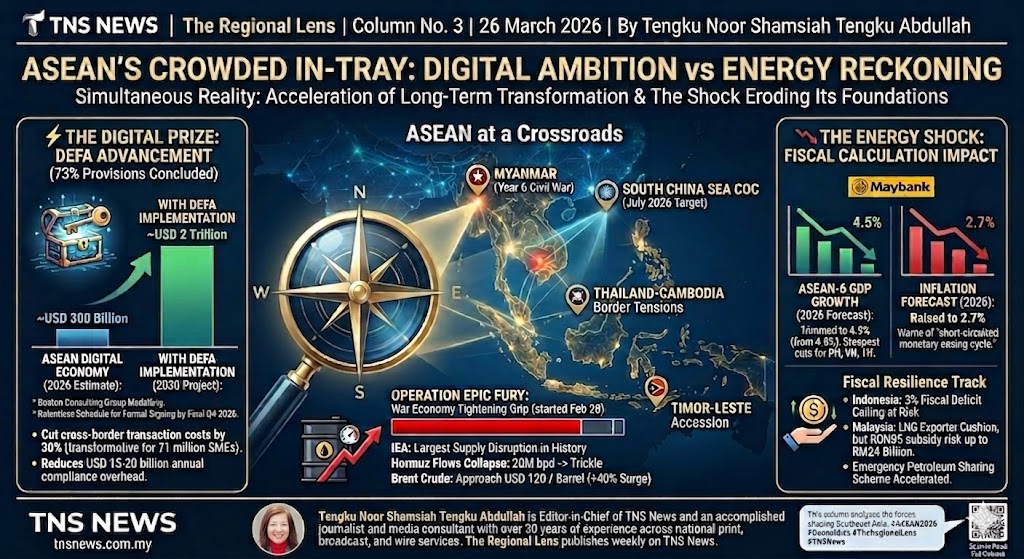
ASEAN entered 2026 with an ambitious agenda: a landmark digital economy agreement, new strategic partnerships, and a chairmanship designed to showcase Manila’s regional leadership. Then Operation Epic Fury began. Nearly four weeks in, Southeast Asia is managing two realities simultaneously — an acceleration of its long-term transformation, and an energy shock eroding the foundations that transformation depends on.
There is a particular quality to the pressure facing ASEAN right now. It is not the pressure of a single crisis but of many simultaneous demands: a digital framework on the cusp of signature, a South China Sea code of conduct with an end-of-July deadline, Myanmar entering its sixth year of civil war, a Thailand-Cambodia border requiring careful tending, a new member in Timor-Leste, and overlaid on all of it, a war in the Middle East whose economic shockwaves are reshaping every government’s fiscal calculations.
DEFA: The Digital Prize Inches Forward
ASEAN’s most consequential long-term initiative is advancing despite the turbulence. From 8 to 10 March, negotiators convened in Manila for the 18th round of ASEAN Digital Economy Framework Agreement (DEFA) talks, part of a relentless schedule targeting formal signing by the final quarter of 2026. Substantial conclusion of negotiations was announced at the 26th ASEAN Economic Community Council Meeting in Kuala Lumpur in October 2025, covering 73 percent of core provisions. Commercially sensitive areas — cross-border data flows, financial services, and digital payment interoperability remain under negotiation.
The economic stakes are real. ASEAN’s digital economy currently stands at approximately USD 300 billion. With DEFA’s full implementation, Boston Consulting Group modelling projects this could reach USD 2 trillion by 2030. Divergent digital regulations currently cost ASEAN businesses an estimated USD 15–20 billion annually in compliance overhead. The agreement would cut cross-border transaction costs by an estimated 30 percent a transformative gain for the region’s 71 million small and medium enterprises. The Philippines has designated DEFA a Priority Economic Deliverable. The clock is running.
The Iran War: An Energy Shock That Changes the Calculus
Operation Epic Fury, now entering its fourth week, has done more than spike oil prices. The International Energy Agency has assessed it as the largest supply disruption in the history of the global oil market, with flows through the Strait of Hormuz collapsing from 20 million barrels per day to a trickle. Brent crude has approached USD 120 a barrel a 40 percent surge since hostilities began, and a level not seen since 2008. Unlike the Russia-Ukraine energy shock of 2022, which could be partially rerouted and substituted, the physical closure of Hormuz obstructs the very ability of producers to export.
Maybank Investment Bank, in a note released on 24 March, trimmed its ASEAN-6 GDP growth forecast to 4.5 percent in 2026 from 4.8 percent, with the steepest cuts for the Philippines, Vietnam, and Thailand. It raised the inflation forecast to 2.7 percent and warned that “surging energy prices and disruptions to commodity supplies will be negative for most ASEAN countries” and that “the energy price shock has short-circuited the monetary easing cycle.”
Prof. Geoffrey Williams of Williams Business Consultancy, commenting in TNS News, has highlighted the compounding risk: the Iran shock arrived when ASEAN economies were already navigating post-pandemic debt overhangs, residual inflation, and US tariff disruptions. Each additional week of Hormuz disruption makes recovery harder and more expensive, particularly for economies with thin fiscal buffers. Shan Saeed, Global Chief Economist at Juwai IQI, has reinforced this view in TNS News analysis, arguing that energy security must now be treated as a core national security priority across Southeast Asia, not merely a policy aspiration.
“The most dangerous assumption is that this crisis will be short-lived. Even if hostilities pause, the damage to oil facilities, LNG terminals and shipping networks will not be repaired overnight.” Prof. Phar Kim Beng, IIUM
Prof. Phar Kim Beng of the Institute of International and ASEAN Studies at IIUM noted in Malay Mail on 25 March that Malaysia’s status as a net LNG exporter provides a relative cushion but should not be mistaken for immunity. PETRONAS has confirmed domestic fuel supplies secured through end-May 2026. However, the RON95 subsidy bill could reach RM24 billion by year-end if the conflict continues, while Indonesia’s 3 percent fiscal deficit ceiling is at risk if the oil shock is prolonged.
ASEAN Responds and Faces Harder Choices Ahead
The Philippine chairmanship has moved to accelerate the ASEAN Emergency Petroleum Sharing Scheme, push for energy diversification including renewables and biofuels, and convene an ASEAN+3 financial resilience track. The diplomatic calendar presses on: the 44th ASEAN Capital Markets Forum Chairs’ Meeting takes place today in Boracay.
The two ASEAN Leaders’ Summits, the 48th in Cebu in May and the 49th in Pasay City in November now face domestic pressure, with some legislators proposing postponement to free up an estimated PHP 17 billion in hosting costs. Former Finance Secretary Gary Teves floated the proposal; Senate President Pro Tempore Panfilo Lacson backed it for “serious study.”
Foreign Affairs Secretary Lazaro has said the final decision rests with Malacañang. President Marcos should hold firm: to retreat from the chairmanship’s most visible commitments at this moment would send entirely the wrong signal to partners and adversaries alike.
The South China Sea Code of Conduct, with its July 2026 target, looms. Geopolitical crises have a habit of crowding out the patient, incremental work that negotiated agreements require. Secretary Lazaro has sought to maintain momentum but bandwidth has limits.
What this moment demands of ASEAN is simultaneity: managing the acute crisis while advancing the long-term integration agenda that is the region’s most durable answer to external vulnerability. DEFA deepens the digital services economy. The ASEAN Power Grid reduces fossil fuel dependence. The COC reduces the risk premium that unresolved sovereign disputes add to investment. These are not abstractions they are the structural architecture of a more resilient ASEAN.
The Iran war did not create the vulnerabilities it has exposed. It merely made them impossible to ignore. Whether ASEAN converts this urgency into lasting structural change or allows the moment to pass as another emergency eventually absorbed and forgotten is the central question of this chairmanship year. The in-tray is full. The clock is running. And the region is watching.
- TNS NEWS