


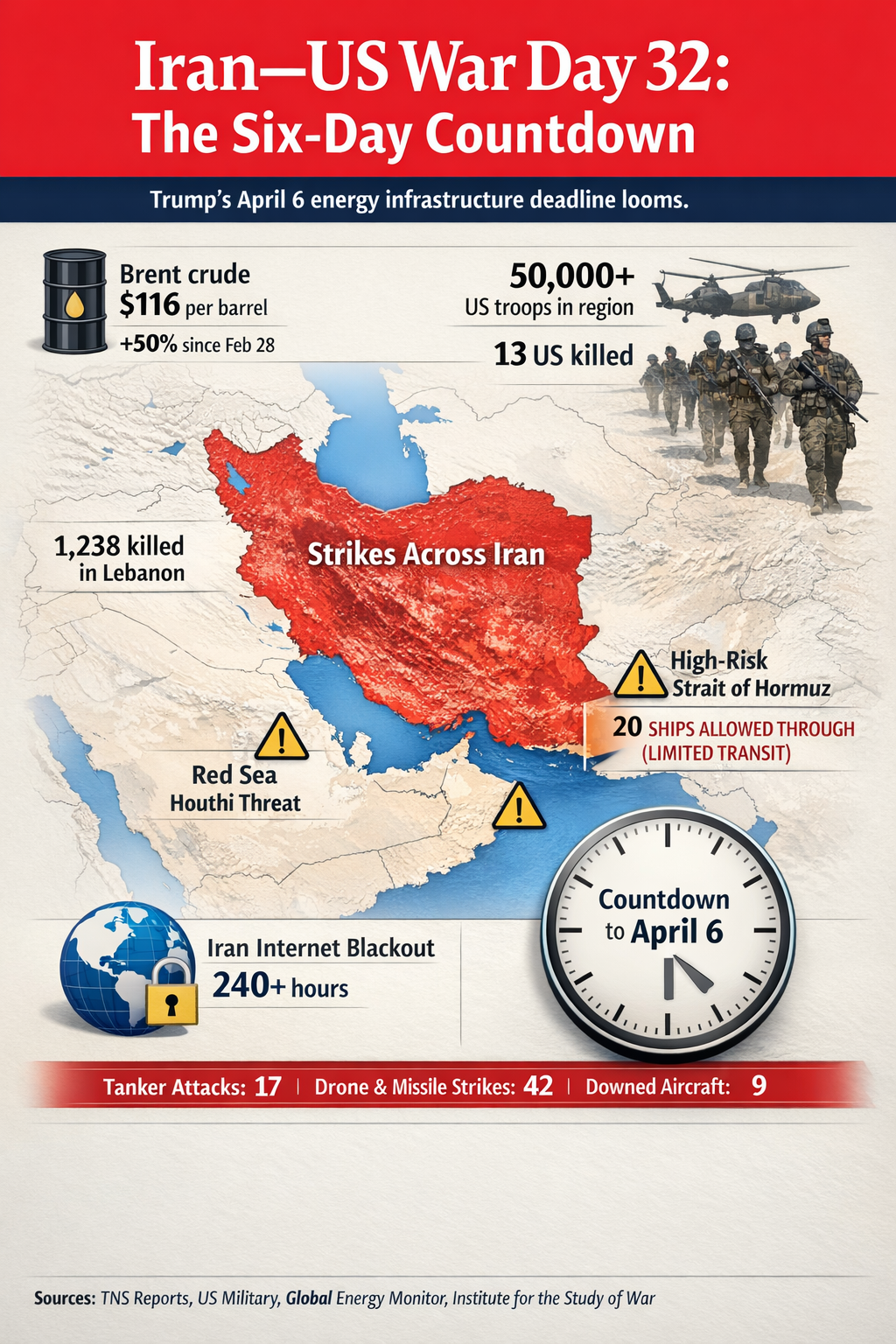
Iran–US War Day 32: Trump Sets April 6 Energy Deadline as Hormuz Crisis and Red Sea Threat Expand Conflict
MONDAY, 31 MARCH 2026 | DAY 32 OF OPERATION EPIC FURY
Editor’s Note
This is an updated edition of the 30 March briefing, refreshed on 31 March to incorporate President Donald Trump’s April 6 energy infrastructure deadline, updated US casualty and troop deployment figures, and the Iran internet blackout milestone. The opinion section has been revised to reflect the deadline as the central strategic variable shaping the conflict’s next phase.
Conflict Snapshot
Brent Crude: US$116+ per barrel
Change since 28 Feb: +50%
US Troops in Region: 50,000+
US Military Dead: 13
Key Diplomatic Date: April 6 energy strike deadline
Diplomacy & The Countdown
Trump Sets April 6 Deadline: Reopen Hormuz or Iran’s Energy Plants Face Destruction
President Donald Trump announced on 26 March that he was pausing strikes on Iranian energy infrastructure for ten days, until Monday 6 April 2026 at 8pm Eastern Time, saying the extension came at the Iranian government’s request and that talks were “going very well”.
The announcement followed a pattern of escalating ultimatums. On 22 March Trump threatened to destroy Iran’s power plants within 48 hours. On 23 March he delayed action for five days citing “productive conversations”. On 26 March the deadline was extended again to 6 April.
Iran has publicly denied requesting any pause and has denied that direct negotiations with the United States are taking place.
Trump’s envoy Steve Witkoff told a Cabinet meeting that the United States had transmitted a 15-point peace framework to Iran via Pakistan and believed there were “strong signs” of a possible agreement.
Iran’s parliament speaker Mohammad Bagher Ghalibaf responded that Washington was signalling negotiations publicly while preparing for a potential ground invasion.
The 6 April deadline now stands as the most consequential date in the war’s diplomatic calendar.
Pakistan Hosts Four-Nation Summit; Iran Allows Limited Ship Transit Through Hormuz
The foreign ministers of Pakistan, Saudi Arabia, Turkey and Egypt met in Islamabad on 29 March in the broadest diplomatic intervention since the war began.
Pakistani Foreign Minister Ishaq Dar said Islamabad would be honoured to facilitate talks between Washington and Tehran aimed at reaching a comprehensive settlement.
In a parallel signal, Iran allowed 20 ships — largely Pakistan-flagged oil tankers — to transit the Strait of Hormuz, roughly two per day.
Trump described the move as a “gift” and evidence that Iran was cooperating. Iranian officials described it as a sovereign decision rather than a concession.
The distinction is important: Tehran continues to treat the Strait as a political lever, not as a fully reopened commercial waterway.
Approximately 20,000 seafarers remain stranded, and the Strait remains effectively closed to normal commercial traffic.
Ground Invasion Options Under Preparation
Military planning inside the Pentagon increasingly includes limited ground operation scenarios, according to reporting from US media.
Planning reportedly includes:
• Possible seizure of Kharg Island, Iran’s primary oil export terminal
• Coastal operations to destroy mine-laying and drone capabilities
• A reported mission to secure enriched uranium stockpiles
The New York Times estimates the US military presence in the wider Middle East now exceeds 50,000 personnel.
Recent deployments include:
• USS Tripoli, carrying the 31st Marine Expeditionary Unit (3,500 troops)
• USS Boxer, transporting the 11th Marine Expeditionary Unit (2,200 Marines)
• 2,000 paratroopers from the 82nd Airborne Division
Pentagon planners are reportedly considering an additional 10,000 troops.
Military analysts note the force structure appears designed for short, targeted operations rather than a prolonged ground campaign.
Iran’s ground forces commander Brigadier General Ali Jahanshahi said Iranian territory remained fully defended and under continuous surveillance.
Military & Strikes
Tehran Power Grid Hit; Citywide Blackout Reported
Israeli strikes on Tehran’s power infrastructure caused a widespread blackout across the capital on the night of 30 March. Iranian authorities later reported partial restoration.
The Israeli military said it was “attacking infrastructure of the Iranian government throughout Tehran.”
Explosions were reported in multiple locations across Iran over the past two days including Karaj, Shiraz, Qom, Abadan, Tabriz and northern Tehran.
Israel also struck the Iran University of Science and Technology, which Israeli sources say has connections to IRGC research activities.
In response, Iranian officials declared American and Israeli universities in the Middle East “legitimate military targets.”
Steel plants in Isfahan and Ahvaz, partly linked to IRGC industrial holdings, were also targeted.
US Central Command says it has struck more than 11,000 targets inside Iran since the conflict began on 28 February.
Independent monitoring group ACLED has recorded more than 3,000 attack events across 29 of Iran’s 31 provinces.
Houthis Enter the War; Red Sea Shipping Risk Expands
Yemen’s Houthi movement entered the conflict on 28 March, launching ballistic missiles toward Israeli targets including the port city of Eilat. Both missiles were intercepted.
Houthi leadership declared attacks would continue until hostilities across “all resistance fronts” stop.
The move introduces the risk of a second maritime front.
Retired US Admiral James Stavridis warned that Houthi control of the Red Sea shipping corridor, combined with the Hormuz crisis, could create “an enormous gun pointed at the global economy.”
If Houthi forces begin actively targeting shipping traffic, the world’s two most critical oil and cargo routes could be simultaneously threatened.
The internationally recognised Yemeni government condemned the missile launches and accused Iran of drawing Yemen into the war.
Energy, Markets & Humanitarian
Oil Records Biggest Monthly Jump Since 1990
Brent crude finished March above US$116 per barrel, marking the largest monthly rise since the 1990 Gulf War.
Prices have climbed more than 50 percent since 28 February.
The International Energy Agency described the Hormuz disruption as the largest oil supply shock in modern history, with up to 20 million barrels per day temporarily removed from global circulation.
In an attempt to stabilise markets, the United States issued a 30-day waiver allowing Iranian oil already at sea to be sold, effective until 19 April.
The Trump administration has also eased some sanctions on Russian crude supplies.
Southeast Asian refiners have begun shifting supply sources. Vietnam’s Binh Son Refining and Petrochemical is among companies purchasing additional Russian crude.
Australia announced free public transport in two states through July to help households manage rising fuel costs.
An Indian worker was killed in Kuwait when an Iranian strike damaged infrastructure at a desalination facility.
The International Labour Organization estimates 24 million migrant workers across Gulf states remain highly exposed to conflict-related risks.
Humanitarian Situation Worsens
Lebanon’s Health Ministry says the conflict has killed 1,238 people and injured more than 3,500 since Israel expanded operations there on 2 March.
UNICEF estimates 1.2 million people — roughly one fifth of Lebanon’s population — have been displaced.
Inside Iran, the country’s near-total internet blackout has now exceeded 240 hours, making it the second-longest nationwide shutdown ever recorded.
Connectivity has dropped to as low as 4 percent of normal levels.
Authorities have reportedly issued restricted “white SIM cards” to approved users for limited access.
Between 3.2 million and 4 million Iranians are estimated to be internally displaced.
US casualties across the region stand at 13 killed and more than 300 injured, according to the Pentagon.
Three Lebanese journalists were killed in an Israeli strike in Jezzine, southern Lebanon.
UK defence intelligence reports Russia is providing technical support to Iran’s drone warfare operations.
Opinion
Six Days to April 6: The Deadline That Could Change Everything — or Nothing
There are six days remaining until 6 April 2026, the deadline Donald Trump has set for Iran to reopen the Strait of Hormuz or face the destruction of its energy infrastructure.
It is the third deadline issued in two weeks.
The pattern is revealing. Each ultimatum has been extended before it expires. Each extension has been justified by claims of diplomatic progress that Tehran publicly denies.
Deadlines that repeatedly move risk losing their credibility. Iran has learned that ignoring a US ultimatum can produce another ultimatum.
The problem is structural.
Washington’s reported peace framework demands the dismantling of Iran’s nuclear programme, sharp limits on its missile arsenal and the rollback of proxy networks.
Iran’s counter-demands include recognition of its strategic authority over the Strait of Hormuz and broad security guarantees.
These positions describe two incompatible visions of the regional order.
Pakistan can facilitate messages between capitals, but it cannot bridge that divide.
The entry of Yemen’s Houthis into the war adds a new variable. If Red Sea shipping also comes under sustained attack, the global economy will face disruption on two critical maritime routes simultaneously.
For Malaysia and ASEAN, the implications are immediate.
Energy imports, shipping insurance costs and export logistics all pass through corridors now under threat.
Thirty-two days into the war, the absence of a visible ASEAN diplomatic initiative is increasingly noticeable.
The 6 April deadline will determine whether diplomacy gains momentum — or whether the war enters a far more dangerous phase.