


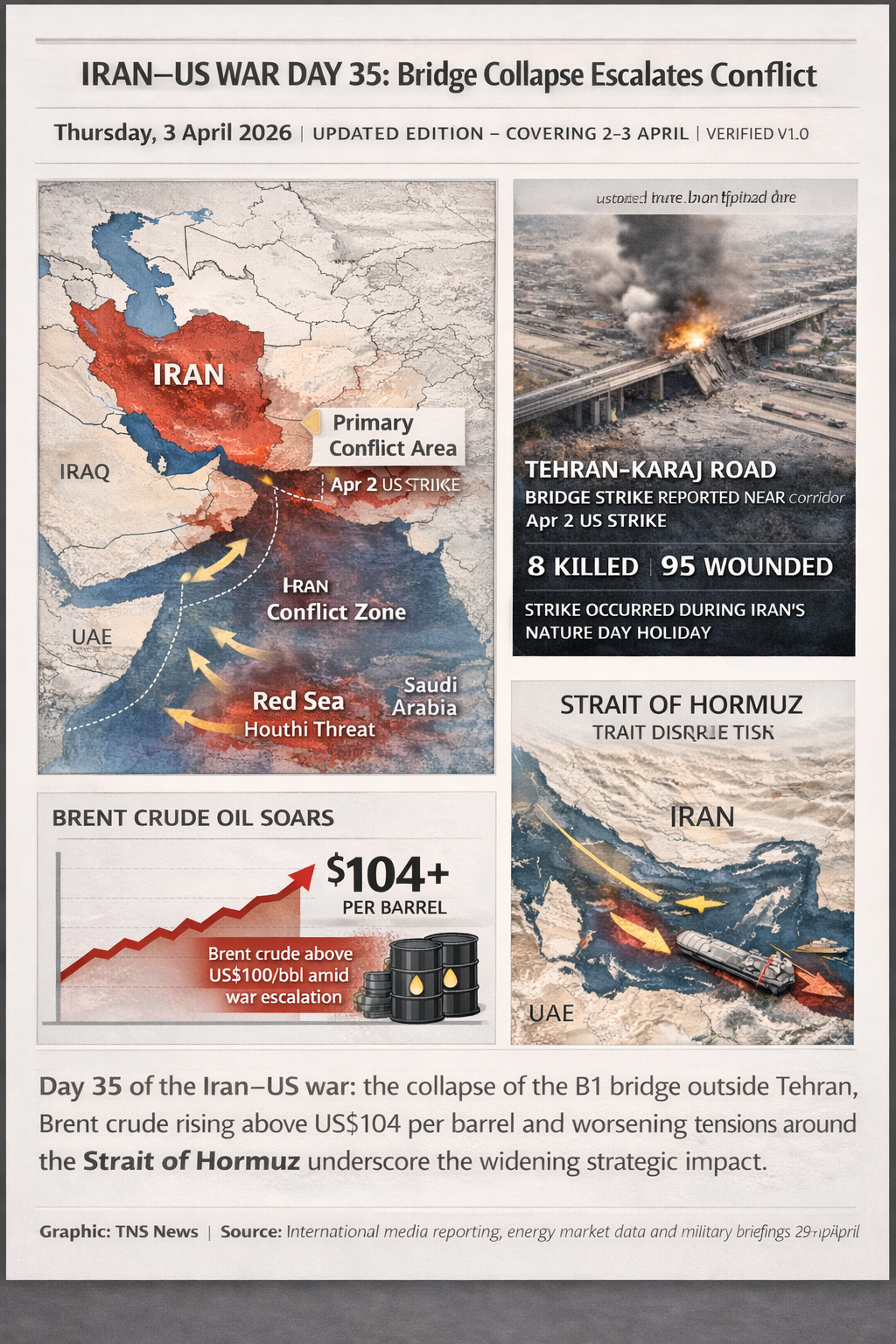
Iran–US War Day 35: Bridge Strike Escalates Conflict as Oil Prices Surge and April 6 Deadline Approaches
THURSDAY, 3 APRIL 2026 | DAY 35 OF OPERATION EPIC FURY | UPDATED EDITION
Editor’s Note
This edition was delayed from 2 April and updated on the morning of 3 April to include the most significant overnight developments. These include the collapse of the B1 bridge outside Tehran following a US strike, confirmation of the death of a senior Iranian missile commander by Israeli forces, and new disruptions to global aviation and energy markets.
Conflict Snapshot
Killed in Iran: 2,076+ (Health Ministry, 2 April)
Brent Crude: US$104+ per barrel
US Crude One-Day Rise: 11% (largest since 2020)
Key Strategic Date: April 6 energy infrastructure deadline
The Big Stories
B1 Bridge Destroyed in US Strike
US forces struck the B1 bridge linking Tehran to Karaj twice on 2 April, collapsing its central section. The structure, described in regional reporting as the tallest bridge in the Middle East, was reduced to rubble after the second strike.
Alborz provincial authorities reported eight people killed and 95 wounded.
A US defence official told American media the bridge had been used as a military logistics route supporting Iran’s ballistic missile and drone operations. The New York Times reported the same assessment.
President Donald Trump posted a short video of the destruction on Truth Social, writing that “the biggest bridge in Iran comes tumbling down, never to be used again.”
The strike occurred during Iranian Nature Day, when families were outdoors. Iranian officials said the second strike occurred after emergency responders had arrived, describing it as a deliberate double-tap attack.
Iran warned that bridges across the region — including structures in Israel, Kuwait, Saudi Arabia, the United Arab Emirates and Jordan — could now become legitimate military targets in retaliation.
Iran Ballistic Missile Commander Killed
The Israeli military said on 2 April that an airstrike in western Iran killed Makram Atimi, commander of Iran’s central ballistic missile unit.
According to Israeli officials, Atimi oversaw dozens of missile launches against Israeli territory during the conflict. Several battalion-level commanders were also reportedly killed.
Iran has not officially confirmed the deaths.
The strike follows a sustained Israeli campaign targeting Iran’s missile command structure since the war began.
Meanwhile, Iran’s nationwide internet blackout entered its 34th consecutive day, according to monitoring organisation NetBlocks, leaving tens of millions of citizens largely cut off from independent information.
Oil Markets Jolt Global Aviation
Energy markets reacted sharply to the latest escalation.
US crude oil prices recorded their largest single-day rise since 2020, jumping more than 11 percent.
Brent crude traded above US$104 per barrel, while cumulative gains since the start of the conflict have reached 94 percent for US crude.
Average US gasoline prices climbed to US$4.08 per gallon.
Jet fuel prices have more than doubled globally compared with February levels, according to the International Air Transport Association.
Airlines across Asia-Pacific have begun emergency adjustments. Korean Air announced it was entering crisis management mode, while Vietnam Airlines and Air New Zealand have cut flights. The Philippines government warned grounding aircraft may become necessary if fuel shortages worsen.
China has banned jet fuel exports to preserve domestic supplies, while Chinese carriers are increasingly routing European flights through Russian airspace rather than the Middle East.
Diplomacy and the Strait
UN Security Council Split Over Hormuz
Russia, China and France blocked a Bahrain-sponsored draft resolution at the UN Security Council that would have authorised states to use “all defensive means necessary” to reopen the Strait of Hormuz.
All three countries opposed language allowing the use of force.
The vote on the proposal is expected on 3 April.
At the same time Britain hosted a virtual meeting of more than 40 countries to discuss possible mechanisms for restoring maritime access to the waterway.
Iran’s armed forces spokesperson Abolfazl Shekarchi said the Strait would remain closed long-term to the United States and Israel.
Iranian Foreign Minister Abbas Araghchi told Russian counterpart Sergei Lavrov that any UN resolution on Hormuz would be unacceptable to Tehran.
Two Diplomatic Channels Operating
Diplomatic contacts are continuing through intermediaries.
Israeli media reported that US Vice President JD Vance is communicating with Pakistan’s army chief, who relays messages to Tehran. At the same time US envoy Steve Witkoff is maintaining a separate diplomatic track.
Iran has acknowledged receiving messages through intermediaries but insists no formal negotiations are under way.
Foreign Minister Araghchi told Al Jazeera that Iran was prepared for at least six months of war and rejected the US proposal for zero uranium enrichment as legally unjustified.
Iranian President Masoud Pezeshkian also issued an open letter addressed to the American public questioning whether the conflict truly serves American national interests.
Strikes, Casualties and Regional Impact
Medical Institute Hit as Death Toll Rises
Iran’s Ministry of Health said more than 2,076 people have been killed in the country since the war began on 28 February, including 216 children.
The Pasteur Institute of Iran, one of the country’s oldest biomedical research centres, was heavily damaged in an overnight strike in Tehran.
President Pezeshkian called the attack a crime against humanity and appealed for assistance from the World Health Organization, the Red Cross, and Médecins Sans Frontières.
Iran’s Revolutionary Guards claimed to have struck an Oracle data centre in Dubai, though authorities in the UAE said there was no significant damage.
An Iranian drone attack also hit fuel depots at Kuwait International Airport, triggering a major fire but causing no injuries.
The Iranian Red Crescent says 316 healthcare and emergency facilities have been damaged since the war began.
NATO Fractures Widen
Political divisions among NATO members deepened this week.
Spain, France and Italy have all restricted US military use of their bases and airspace for operations linked to the Iran war.
Spanish Prime Minister Pedro Sánchez said the strikes risk violating international law.
President Trump criticised NATO in an interview with the Daily Telegraph, calling the alliance “a paper tiger” and suggesting the United States could reconsider its membership.
Meanwhile the aircraft carrier USS Gerald R. Ford has returned to the conflict zone after a port visit in Croatia.
In Lebanon, more than 1,000 people have been killed and 1.2 million displaced since Israel expanded operations there on 2 March. Foreign ministers from 18 European countries issued a joint statement calling for an immediate end to Israeli strikes.
Opinion
The Bridge, the Missile Chief and the Question That Cannot Wait
The collapse of the B1 bridge represents a significant shift in the character of the war.
When the campaign began on 28 February, the targets were clearly military: missile bases, nuclear facilities and command structures. Striking a major civilian infrastructure link during a public holiday introduces a different set of legal and moral questions.
Military planners describe such structures as logistical arteries that sustain armed forces. Under the laws of armed conflict they can therefore become legitimate targets.
Yet the timing, the civilian casualties and the public celebration of the strike create an image that will resonate far beyond the battlefield.
The killing of Iran’s ballistic missile commander is far less ambiguous. He commanded the unit responsible for missile attacks against Israel and was therefore a legitimate military objective.
But the systematic elimination of senior officials on both sides carries another risk: it removes many of the individuals capable of negotiating an end to the conflict.
Every senior commander killed may represent a tactical victory — but it can also narrow the path toward diplomacy.
The April 6 Energy Deadline
Only three days remain before President Trump’s deadline to destroy Iranian energy infrastructure if the Strait of Hormuz is not reopened.
Russia, China and France have blocked the UN Security Council route to legitimising the use of force.
Iran says it is prepared for months of fighting.
Energy markets are already under strain. Oil prices have surged, jet fuel costs have doubled, and aviation networks are adjusting routes and schedules across multiple continents.
If the United States follows through with strikes on Iranian oil and power facilities, the humanitarian and economic consequences could be far greater than anything seen in the conflict so far.
For countries such as Malaysia — heavily dependent on maritime trade and global energy flows — the impact would be immediate.
The next three days may determine whether the war enters a new diplomatic phase or a far more dangerous one. – TNS NEWS
Sources
CNN, Al Jazeera, NBC News, The Hill, The War Zone, Iran International, TRT World, bne IntelliNews, New York Times, Wall Street Journal, IATA, NetBlocks and other international reporting compiled between 1–3 April 2026