


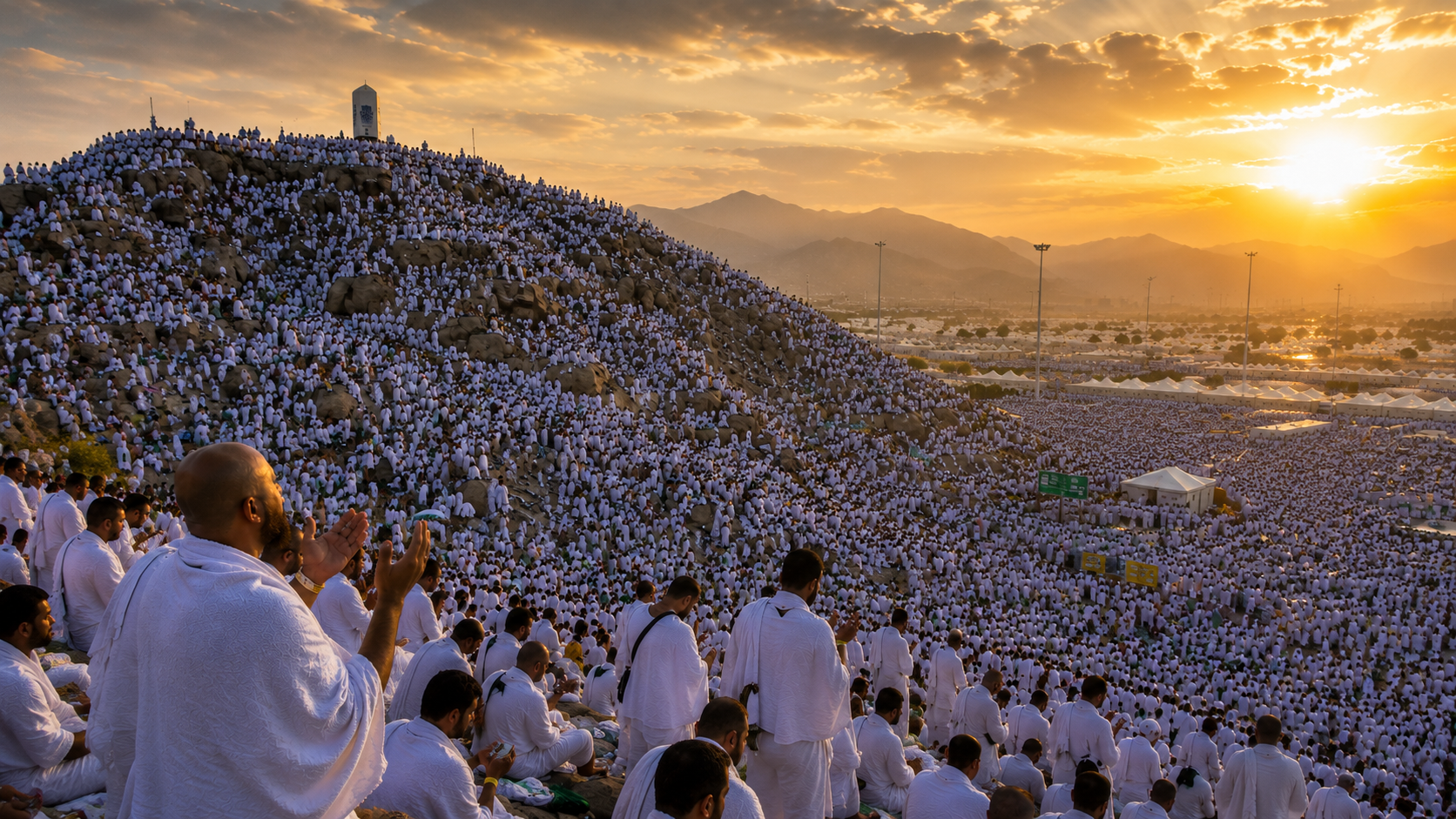
After years of saving, waiting and praying, 31,600 Malaysians finally reached Islam’s holiest gathering today. The world’s largest annual pilgrimage is now at its spiritual peak.
BY TNS NEWS DESK
Tuesday, 26 May 2026
The plains of Arafah fell silent with supplication today as the Haj pilgrimage reached its most sacred moment — and among the nearly two million faithful gathered under the intense Arabian sun were 31,600 Malaysians, many of whom had waited a decade or more for this single afternoon.
Today is Wukuf Day, 9 Zulhijjah 1447H. It is the day that, in Islamic tradition, completes the Haj.
Everything before it — the months of preparation, the long flights, the heat, the crowds — leads to this. To stand here, in prayer, is the point.
Tomorrow is Eid al-Adha. The rituals of Jamarat, sacrifice and Tawaf al-Ifadah follow. But today belongs entirely to Arafah.
THIRTY-ONE THOUSAND SIX HUNDRED MALAYSIANS
The movement began at dawn. Minister in the Prime Minister’s Department (Religious Affairs) Dr Zulkifli Hasan was at the departure point to witness it.
“Alhamdulillah, the time has come for a historic moment as Malaysian Haj pilgrims, the dhuyufurrahman, begin their journey for the masyair. We started at 7.30am, and Insya Allah, everything will be completed today.”
— Dr Zulkifli Hasan, Minister of Religious Affairs
Twenty-five buses per maktab transported pilgrims from seven hotels across three departure phases, covering the roughly 20 kilometres between Makkah and the plains of Arafah. By midday, all 31,600 were expected to be in position.
The 1447H/2026M season marks Lembaga Tabung Haji’s most ambitious operational year to date. The first Malaysian flight departed KLIA on 18 April; the last landed in Saudi Arabia on 20 May.
Five hundred and sixty-four TH personnel are deployed across the Holy Land to support pilgrims through every stage of the pilgrimage.
UPGRADED FOR COMFORT — AND THE HEAT
With temperatures in Mina and Arafah regularly exceeding 40°C, heat is not merely an inconvenience — it is a medical risk. Tabung Haji group managing director and CEO Mustakim Mohamad oversaw a significant overhaul of on-ground facilities for this season.
New tents in Arafah are fitted with heat-insulation panels and split-unit air conditioning. Each sofa bed carries a name tag and photograph of its assigned pilgrim — a small touch, but one that matters when you are elderly, exhausted and trying to find your place among thousands.
In Mina, the number of toilet facilities has been increased sixfold — from roughly 100 units to around 600 — and phone charging sockets have been installed throughout pilgrim accommodation areas. Individual sofa beds replace older sleeping arrangements.
“The improvements at Arafah and Mina are among our major initiatives to date to optimise pilgrims’ comfort throughout the Masyair period.”
— Mustakim Mohamad, Group Managing Director and CEO, Tabung Haji
MEDICAL TEAMS ON THE GROUND — NO ONE LEFT BEHIND
Two hundred and twenty-four medical personnel — specialists, doctors and nurses — have been deployed across Masyair operational sites.
Deputy head of the Malaysian Haj delegation (medical) Dr Mohamad Zamri Harun warned that extreme heat significantly elevates the risks of dehydration, heat stroke and respiratory complications. Pilgrims have been advised to drink at least 10 glasses of water daily and to avoid outdoor activity during peak afternoon hours.
As of the latest update, 16 Malaysian pilgrims have been referred to Saudi government hospitals, predominantly for heart, respiratory, neurological and fatigue-related conditions. Their status is reported as stable.
None will miss Wukuf if Tabung Haji can help it.
Head of the Malaysian Haj Delegation Mohd Hisham Harun confirmed that arrangements are being made to transport hospitalised pilgrims to Arafah, even if only for the minimum period required.
“We will do our best to bring them to Arafah, at least for a short period. We understand they have waited a long time to perform the Haj, so we will assist as much as possible.”
— Mohd Hisham Harun, Head of Malaysian Haj Delegation
THE COST HELD — DESPITE THE PRESSURES
In a year of regional conflict and rising fuel costs, Tabung Haji held the line on pricing.
The 1447H/2026M Haj cost under the Muassasah scheme remains at RM33,300 per pilgrim — unchanged from the previous season.
Subsidised rates for B40 pilgrims stand at RM15,000, with an RM18,300 subsidy including a RM1,000 government contribution per pilgrim. The M40 rate remains at RM23,500. A total of RM210 million has been allocated for Haj Financial Assistance.
The stability was made possible by early bookings, long-term accommodation contracts, and a three-year flight agreement with Malaysia Airlines and Saudia Airlines.
TH chairman Tan Sri Abdul Rashid Hussain noted that the agreement includes an oil-price adjustment clause, triggered if crude exceeds approximately US$90 per barrel. For now, the buffer holds.
Mustakim indicated that costs for future seasons may need to be reviewed if the conflict in West Asia persists and drives a more sustained increase in global oil prices.
A PILGRIMAGE THAT DEFIED THE WORLD’S TROUBLES
The sheer fact that nearly two million Muslims are standing on the plains of Arafah today is, in itself, a statement.
The world around them is fractured: Gaza remains at war, the US-Iran confrontation that erupted in February 2026 is technically under ceasefire but has resumed at lower intensity since May, and several major governments — including the United States, Germany and the United Kingdom — have issued updated travel advisories for Saudi Arabia and the wider Middle East.
And yet, the pilgrims came.
The Haj is the fifth pillar of Islam. It is obligatory once in a lifetime for every Muslim who is physically and financially able to make the journey.
For most, it is not a choice weighed against risk assessments or geopolitical conditions. It is a duty, and a calling.
This year’s attendance — with more than 1.6 million international pilgrims from over 120 countries, alongside several hundred thousand Saudi nationals and residents — reflects that reality.
Iran is the conspicuous absence.
Visa processing for Iranian nationals has been suspended, consular infrastructure disrupted, and direct flights cancelled as a consequence of the wider US-Iran fallout. For Iranian Muslims, the pilgrimage is currently unreachable — a profound deprivation for a community with a deep and historic attachment to Mecca.
Egypt, meanwhile, is restructuring its Haj logistics permanently. Overland pilgrim buses from Egypt will no longer be permitted entry into Saudi Arabia from 2026, as the Kingdom moves to rely exclusively on its own internal transportation network during the pilgrimage season.
Egyptian authorities are working with Saudi regulations to redesign their programmes accordingly.
Saudi Arabia, for its part, has invested heavily in making this gathering work.
The airport in Jeddah is fully operational. An integrated crowd management system — AI-powered density sensors, CCTV networks feeding a central control room, time-slotted movement windows enforced by Nusuk Card, and the multi-level Jamarat Bridge for the stoning ritual — is coordinating the movement of millions across Mina, Arafah and the Grand Mosque.
A “Hajj Without Luggage” scheme has cut airport processing times from over two hours per arrival cohort to under 15 minutes by routing baggage directly from origin airports to pilgrim accommodation.
Temperatures of 43°C across the Mina valley and Arafah plains remain the most persistent operational challenge. Saudi authorities have deployed 5G communications, AI crowd modelling and specialised healthcare units to manage what remains, by every measure, one of the most logistically complex gatherings on earth.
A REMINDER FROM TABUNG HAJI: PUT DOWN THE PHONE
In an advisory that speaks to the times, Tabung Haji’s Haj Guidance Operations director Shahrin Awaluddin urged pilgrims — particularly younger ones — to resist the pull of social media while in the Holy Land.
The concern is straightforward: the instinct to document and share can erode the very presence that makes the pilgrimage meaningful.
“The trend could affect the devotion and completeness of their Haj rituals.”
— Shahrin Awaluddin, Haj Guidance Operations Director, Tabung Haji
TH has also asked families at home not to worry, assuring them that every pilgrim is being monitored for welfare, health and worship.
HAJ 2026: BY THE NUMBERS
• Nearly 2 million pilgrims gathered at Arafah from more than 120 countries
• 31,600 Malaysian pilgrims in the 1447H/2026M season
• 564 Tabung Haji personnel deployed across the Holy Land
• 224 medical staff assigned to Masyair operations
• Temperatures exceeding 43°C across Mina and Arafah
• RM33,300 standard Haj cost per Malaysian pilgrim
• RM210 million allocated for Haj Financial Assistance
• 16 Malaysian pilgrims hospitalised; all reported stable
• 600 toilet units in Mina this season, up from around 100 previously
• 30 May 2026 marks the final day of Haj 1447H
FIVE DAYS. A LIFETIME OF WAITING.
The Haj continues through Saturday, 30 May.
The Days of Tashreeq — the ritual stoning of the three Jamarat pillars in Mina on the 11th, 12th and 13th of Zulhijjah — follow Eid al-Adha tomorrow before the pilgrimage formally concludes.
For the 31,600 Malaysians now on the plains of Arafah, the schedule is secondary.
Many are elderly. Many saved for this journey over decades. Some were hospitalised just days ago and may yet be brought here on a stretcher.
For all of them, the afternoon call to prayer that echoes today across this valley is not background sound.
It is the reason they came.