


As global politics accelerates into the algorithmic age, IDFR’s Distinguished Lecture Series pushes Malaysia to rethink how diplomacy, technology and national leadership must converge.
By TENGKU NOOR SHAMSIAH TENGKU ABDULLAH
KUALA LUMPUR, Nov 25 – Artificial intelligence is reshaping the foundations of global politics faster than many governments can adapt. Nations that once competed through military power or economic weight are now navigating a new currency of influence: data, algorithms and digital credibility. In this shifting landscape, diplomacy—traditionally anchored in negotiation, relationship-building and statecraft—is undergoing a profound structural transformation.
Malaysia is not immune to these pressures. The question is no longer whether AI will influence foreign policy, but whether the country is ready to navigate this transformation in a way that is strategic, ethical and future-proof.
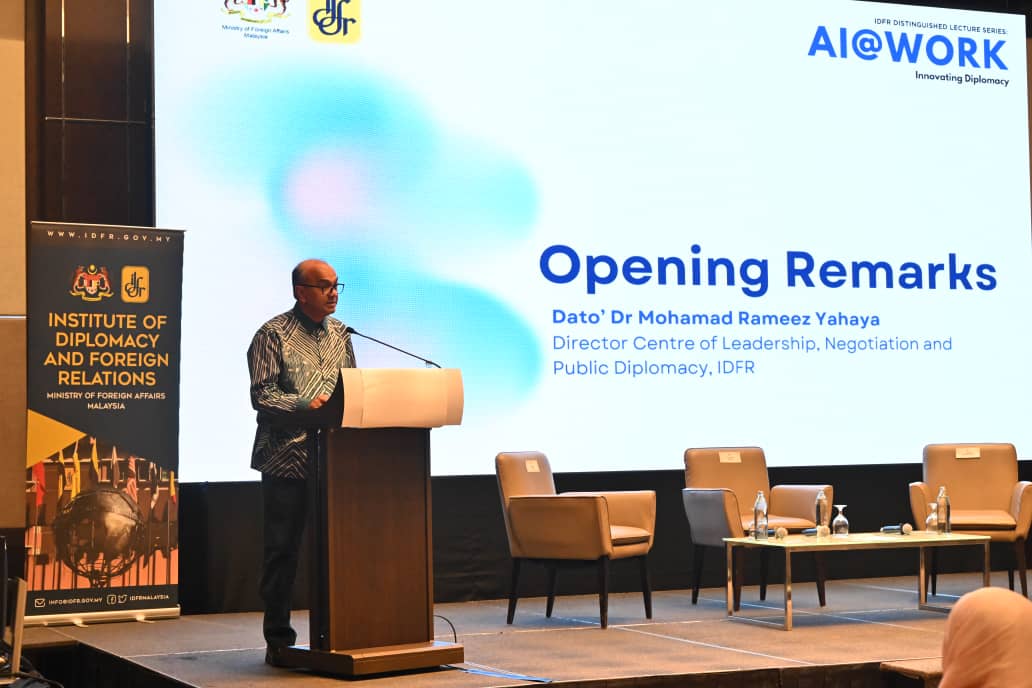
This is why the Institute of Diplomacy and Foreign Relations’ (IDFR) latest Distinguished Lecture Series, “AI@Work: Innovating Diplomacy,” arrives at precisely the right moment. Delivering the opening address, Dato’ Dr. Mohamad Rameez Yahaya framed AI as “a powerful tool transforming how nations interact, how governments serve their people, and how diplomacy itself is practiced.”
He made it clear that Malaysia cannot afford a wait-and-see approach, stressing that this moment “demands more than passive observation” and instead calls for “active understanding, adaptation, and leadership.”
The presence of the National Cyber Security Agency (NACSA) in the lecture series further reinforced the central message: diplomacy and cybersecurity are now inseparable, and governing AI ethically and securely is a collective national responsibility.
AI Redraws the Diplomatic Map
Artificial intelligence has become intertwined with modern diplomacy. It drives data-driven negotiation support, real-time translation, crisis mapping and the detection of misinformation. These tools shape how governments think, determine priorities and respond to fast-moving global developments.
Dato’ Dr. Rameez highlighted how AI enhances diplomatic capability through advanced analysis, multilingual communication, automation that relieves administrative burden, and simulations that allow policymakers to test scenarios before they unfold.
But AI also introduces profound vulnerabilities. Deepfake manipulation, algorithmic bias, cyber intrusions and information warfare now pose risks capable of undermining diplomatic trust and national credibility. His remarks underscored the need for accountability, transparency and strong ethical safeguards so that AI does not reinforce inequity or distort international outcomes.
The conclusion is unmistakable: diplomats must operate in an environment where truth can be engineered, narratives can be weaponised and influence can be coded. Traditional diplomatic tools alone are no longer sufficient.
The Diplomat of 2030: A New Skillset
Tomorrow’s diplomats will need a new blend of skills that go far beyond classical diplomacy. They must understand how algorithms guide public sentiment, how AI-enhanced systems influence conflict prevention, how digital platforms can be exploited, how narratives can be manipulated at scale, and how AI ethics shape global governance norms.
Dato’ Dr. Rameez emphasised that AI is not merely a tool but a force accelerating global complexity. Diplomats must rethink decision-making, communication and negotiation to match a world becoming “faster, more complex, and more interconnected by the day.”
With IDFR embedding AI literacy into its lecture series and training modules, Malaysia signals a decisive institutional shift toward technologically fluent diplomacy.

Security, Trust and Credibility: The New Battleground
Another significant theme emerging from the lecture is that AI security and diplomatic credibility are now deeply interlinked. If narratives can be manipulated, if private exchanges can be compromised and if misinformation can erode interstate trust, diplomatic processes cannot function effectively.
Dato’ Dr. Rameez underscored the importance of protecting information integrity and strengthening governance to prevent the deepfake-driven disruptions and AI-enabled intrusions that threaten global trust.
IDFR’s emphasis on ethical governance, secure development and strong regional cooperation—particularly within ASEAN—reflects a core reality: diplomacy in the AI era must be built on resilience, transparency and secure systems.
Malaysia’s Strategic Advantage: Ethics and Multilateralism
Malaysia’s strength lies not in technological dominance but in its principled foreign-policy identity—commitment to ethics, moderation, multilateralism and credibility as a middle power. These characteristics have become more valuable than ever as nations debate AI ethics and global standards.
Dato’ Dr. Rameez stressed the need for Malaysia to shape, not simply adopt, AI by building an ecosystem rooted in ethics, sustainability, integrity and inclusivity.
This approach allows Malaysia to influence norms and governance frameworks even without being a technological superpower.
IDFR’s lecture series highlights this strategic advantage: Malaysia can help define the rules of AI diplomacy, contributing to global architecture while safeguarding national interests.

A Call to Action: Diplomacy Must Evolve
Malaysia’s diplomatic readiness for the AI era must be deliberate and strategic. This requires modernising diplomatic training, expanding AI literacy across public institutions, strengthening cybersecurity governance, deepening global partnerships and investing in research and foresight.
IDFR has already taken a leadership role by integrating AI into the core of diplomatic education. This positions Malaysia as an informed and principled participant in global debates on AI governance, not a passive observer.
The Future: Diplomacy, Reinvented
AI may enhance efficiency and analysis, but it cannot replace judgment, empathy, ethical reasoning or the human qualities that define diplomacy. Nations that succeed in the AI era will be those that harness technology while preserving the values that underpin credible, peaceful and responsible engagement.
Dato’ Dr. Rameez reminded participants that diplomacy must remain anchored in empathy, trust, cultural awareness and human leadership—qualities AI can support but can never replicate.
With “AI@Work: Innovating Diplomacy,” IDFR has taken a bold and necessary step to prepare Malaysia for this new chapter of global affairs—one in which diplomacy is reinvented, but never dehumanised.
- TNS NEWS