


By Tengku Noor Shamsiah Tengku Abdullah
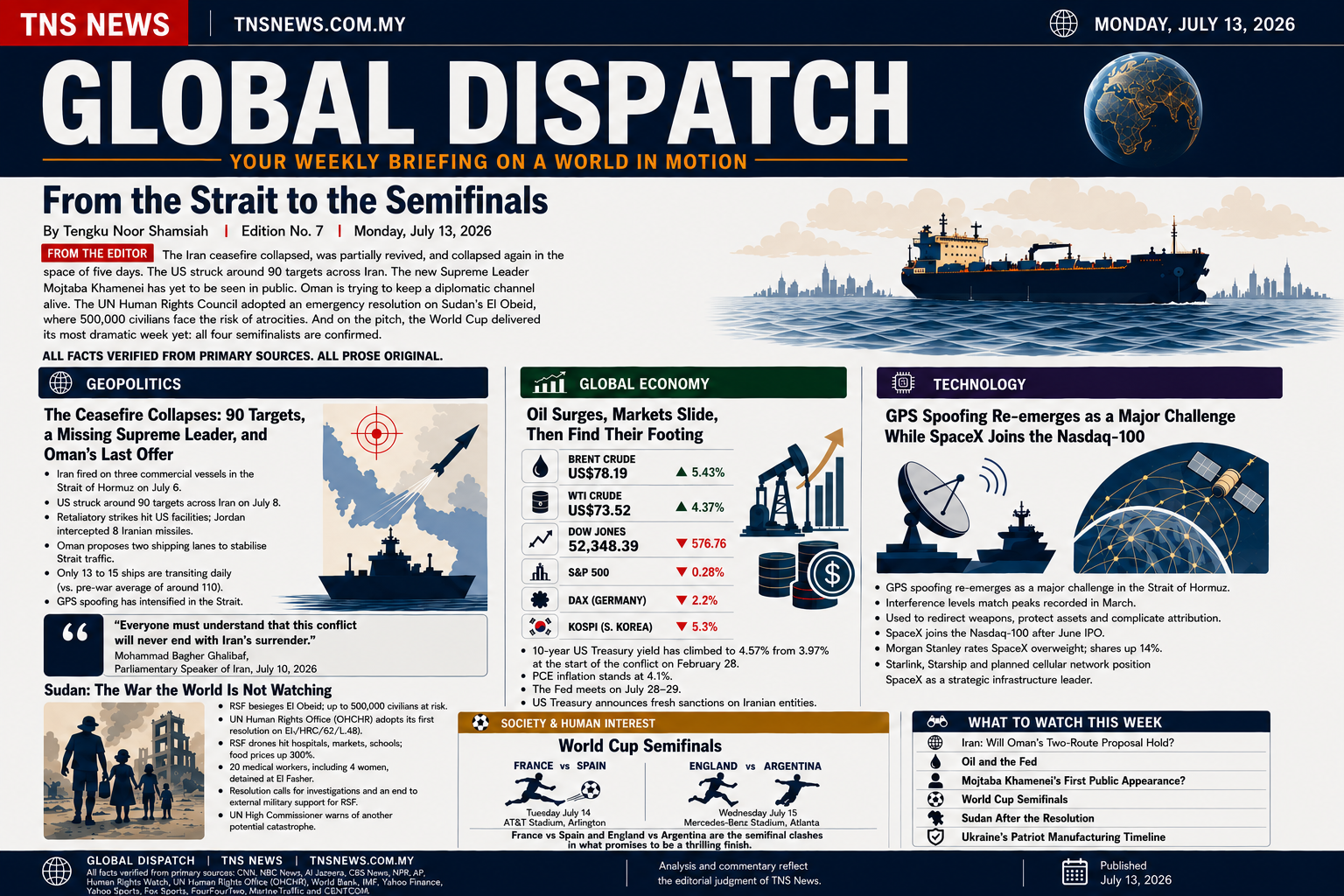
The Iran ceasefire collapsed, briefly flickered back to life, and then unravelled again within five days. The United States struck around 90 targets across Iran. The new Supreme Leader, Mojtaba Khamenei, has yet to appear in public. Oman is working to keep a diplomatic channel alive. Meanwhile, the UN Human Rights Council adopted an emergency resolution on Sudan’s El Obeid, where half a million civilians face the risk of atrocities. On the football pitch, the World Cup delivered its most dramatic week yet, with all four semifinalists now confirmed.
Geopolitics
The Ceasefire Collapses: 90 Targets, a Missing Supreme Leader, and Oman’s Last Offer
The Islamabad Memorandum of Understanding, signed less than four weeks ago, effectively collapsed this week in a cycle of ship attacks and retaliatory strikes that has placed the Iran war’s diplomatic framework under its most severe stress yet.
On the night of Monday, July 6, Iran fired missiles at three commercial vessels transiting the Strait of Hormuz. US Central Command responded by striking around 90 targets across Iran on Wednesday, July 8, hitting sites in Iranshahr, Bandar Abbas, Konarak, Chabahar, Bushehr and Aq Qala in northeastern Iran.
One firefighter was killed in an attack on Iranshahr Airport, according to Iranian state news agency IRNA.
Iran retaliated by targeting US military facilities and allies across the Gulf. Alerts were triggered in Qatar, Bahrain and Kuwait. Jordan intercepted eight Iranian ballistic missiles that the Islamic Revolutionary Guard Corps (IRGC) said were aimed at a US command-and-control centre and air base.
Trump, speaking at the NATO summit in Ankara on Wednesday, declared the ceasefire over. He described Iranian leaders as “scum” and “sick people”, saying talks could continue but negotiators were wasting their time.
Later on Friday, July 10, he softened his position slightly, posting on Truth Social that Iran had requested further talks and the United States had agreed, while simultaneously reaffirming in capital letters that the ceasefire was OVER.
Iran’s chief negotiator and parliamentary Speaker Mohammad Bagher Ghalibaf said Tehran remained deeply distrustful of Washington but stopped short of formally withdrawing from the negotiating framework. US Deputy Representative to the United Nations Tammy Bruce told the Security Council that Washington continued to prefer diplomacy while remaining prepared to hold Iran accountable.
Two developments added further uncertainty.
Israel shared intelligence with the United States suggesting Iran had devised a new plan to assassinate President Trump, CNN reported on Thursday, citing multiple sources.
Meanwhile, Mojtaba Khamenei, who succeeded his father as Supreme Leader, has yet to appear publicly during days-long funeral ceremonies held in Iran and Iraq, fuelling speculation about his security. Iran specialists told CNN that any public appearance could expose him to assassination risks following the intelligence failures that enabled the opening strikes of the war.
Foreign Minister Abbas Araghchi was also physically attacked by hard-line regime supporters during the funeral, illustrating deep internal divisions over the ceasefire negotiations.
One diplomatic thread nevertheless remains alive.
On Saturday, July 11, Araghchi met his Omani counterpart in Muscat. According to CNN, Oman has drafted a tentative proposal to manage traffic through the Strait of Hormuz using two separately administered shipping lanes, one overseen by Iran and the other by international maritime authorities.
If accepted, the proposal could resolve the ambiguity surrounding the memorandum’s maritime access provisions while helping stabilise commercial navigation through the Strait.
Only 13 to 15 vessels are currently transiting the Strait each day, compared with a pre-war average of around 110.
GPS spoofing has also intensified in recent days, complicating navigation while increasing operational risks for commercial shipping.
“Everyone must understand that this conflict will never end with Iran’s surrender.”
— Mohammad Bagher Ghalibaf, Parliamentary Speaker of Iran
July 10, 2026
Sudan: The War the World Is Not Watching
While the Iran conflict has dominated headlines since February, a separate humanitarian catastrophe has continued to unfold in Sudan with remarkably little international attention.
The Rapid Support Forces (RSF), which have been fighting Sudan’s regular military since April 2023, are now besieging El Obeid, the capital of North Kordofan State.
On Friday, July 10, the United Nations Human Rights Council adopted Resolution A/HRC/62/L.48 without a vote, its first resolution focused specifically on El Obeid, following an emergency session requested by the United Kingdom, Germany, Ireland, the Netherlands and Norway.
Britain’s Human Rights Ambassador Eleanor Sanders warned the Council that as many as 500,000 civilians could face large-scale atrocities if the siege continues.
The UN Fact-Finding Mission reported repeated RSF drone attacks on hospitals, markets, schools and residential areas. Food prices inside the city have risen by as much as 300 per cent.
The Sudan Doctors Network also reported that RSF forces detained 20 medical workers, including four women, after overrunning El Fasher.
Earlier this year, the UN Fact-Finding Mission concluded that killings in El Fasher bore the hallmarks of genocide.
The Council’s latest resolution calls for an urgent investigation into violations in and around El Obeid and urges all external actors to cease military support for the RSF.
UN High Commissioner for Human Rights Volker Türk warned that another humanitarian catastrophe could unfold unless preventive action is taken before further atrocities occur.
Global Economy
Oil Surges, Markets Slide, Then Find Their Footing
Financial markets experienced one of their most volatile trading sessions of 2026 after Trump declared the Iran ceasefire over.
On Wednesday, July 8, Brent crude briefly climbed to US$79.64 per barrel before closing at US$78.19, up 5.43 per cent.
WTI settled at US$73.52, a gain of 4.37 per cent.
The Dow Jones Industrial Average fell 576.76 points to 52,348.39.
The S&P 500 lost 0.28 per cent.
Germany’s DAX declined 2.2 per cent, while South Korea’s Kospi dropped 5.3 per cent amid concerns that the AI-driven rally was losing momentum alongside rising geopolitical risks.
Markets partially recovered by Friday after Trump’s Truth Social post confirmed negotiations would continue and diplomatic engagement through Oman remained active.
The US Treasury simultaneously announced a fresh package of sanctions targeting Iranian entities accused of circumventing existing restrictions.
The benchmark 10-year US Treasury yield has now climbed to 4.58 per cent from 3.97 per cent at the start of the conflict on February 28.
With the Federal Reserve’s July 28–29 meeting approaching and PCE inflation standing at 4.1 per cent, policymakers once again face the prospect of higher energy prices complicating the inflation outlook.
Technology
GPS Spoofing Re-emerges as a Major Challenge While SpaceX Joins the Nasdaq-100
The Strait of Hormuz has become not only an energy chokepoint but also a technology battleground.
GPS spoofing has re-emerged as a major operational challenge across the Strait this week.
Vessel-tracking and aviation data indicate interference levels comparable to those recorded during the heaviest fighting in March.
The technology is used to redirect GPS-guided weapons, protect military assets and complicate attribution of attacks.
Maritime operators say the interference has significantly increased navigational risks despite apparently safe satellite positioning.
Away from the conflict, SpaceX formally joined the Nasdaq-100 following its June IPO.
Morgan Stanley initiated coverage with an overweight recommendation, describing the company as uniquely positioned to transform space infrastructure into a strategic intelligence platform.
Shares gained 14 per cent in early Tuesday trading.
With Starlink, Starship and its planned terrestrial cellular network, SpaceX has become one of the world’s most closely watched newly listed companies.
Society & Human Interest
World Cup Quarterfinals Deliver Classic Encounters
World Cup Quarterfinals: England and Argentina Are Going to Atlanta
The 2026 FIFA World Cup quarterfinals produced one of the tournament’s most dramatic weekends, setting up semifinal clashes that could produce one of the competition’s most memorable finals.
On Thursday July 9, France beat Morocco 2-0 at Gillette Stadium in Foxborough, Massachusetts, in a rematch of their 2022 World Cup semifinal. Morocco goalkeeper Yassine Bounou saved a Kylian Mbappe penalty in the 28th minute, holding France scoreless at half-time. Mbappe responded with a curling strike into the far corner on the hour. Ousmane Dembele, the current Ballon d’Or holder, added the second minutes later to seal a result that was more comfortable than the scoreline suggested.
On Friday July 10, Spain eliminated Belgium 2-1 at SoFi Stadium in Los Angeles, with substitute Mikel Merino the hero for the second consecutive knockout match. With the scores level and the game heading toward extra time, Belgium substitute goalkeeper Senne Lammens, who had come on to replace the injured Thibaut Courtois, spilled a Pau Cubarsi long-range effort and Merino pounced to score. Lamine Yamal won Man of the Match. Spain had entered the tournament without conceding a goal in six consecutive World Cup matches; Belgium ended that run but could not prevent Spain’s place in the last four.
Saturday July 11 delivered two unforgettable matches. In Miami, England beat Norway 2-1 after extra time at Hard Rock Stadium. Andreas Schjelderup put Norway ahead with a brilliant first-half strike. Jude Bellingham equalized before the interval and then sealed England’s place in the semifinals with a second goal in extra time. It is England’s first World Cup semifinal since 2018. In Kansas City, Argentina beat Switzerland 3-1 after extra time at Arrowhead Stadium. Switzerland, reduced to 10 men, took the game to extra time, but Lautaro Martinez buried a stoppage-time rebound to confirm Argentina’s passage. Lionel Messi now stands at eight tournament goals, level with France’s Mbappe, who holds the Golden Boot tiebreaker with three assists. Argentina meet England in Atlanta on Wednesday July 15, a semifinal loaded with history. France play Spain in Arlington, Texas, on Tuesday July 14.
What to watch this week
Iran: Will Oman’s Two-Route Proposal Hold? Araghchi and his Omani counterpart met Saturday in Muscat. Oman’s two-lane Hormuz proposal is the most concrete diplomatic idea on the table. Watch whether Iran formally accepts it this week, or whether fresh military incidents overtake the diplomacy before the deal can be structured.
Oil and the Fed: With Brent at US$78 and the FOMC meeting on July 28-29, watch for Fed speakers this week and whether the latest round of Iran sanctions and oil price volatility changes the rate-hike calculus ahead of the meeting.
Mojtaba Khamenei: Will Iran’s New Supreme Leader Appear?: The new Supreme Leader’s continued absence from public view is the most significant unknown in Iranian politics. His first public statement or appearance will define the internal political direction of the ceasefire negotiations.
World Cup Semifinals: France vs Spain, AT&T Stadium in Arlington, Texas, Tuesday July 14 at 3pm ET. England vs Argentina, Mercedes-Benz Stadium in Atlanta, Wednesday July 15 at 3pm ET. The final is Sunday July 19 at MetLife Stadium in East Rutherford, New Jersey.
Sudan: El Obeid After the Resolution: The HRC adopted its resolution on Friday July 10. Watch whether the RSF pauses its drone campaign in response to international pressure, or presses ahead toward El Obeid as it did in El Fasher. Any further escalation this week will test whether the resolution carries any practical weight.
Ukraine: Patriot Manufacturing Timeline: Trump pledged at NATO to allow Ukraine to manufacture Patriot systems domestically. Watch for the first technical agreements between US defence contractors and Ukrainian counterparts, and whether Russia responds by accelerating its air campaign against Ukrainian defence industry sites.
- GLOBAL DISPATCH | TNS NEWS | TNSNEWS.COM.MY
All facts verified from primary sources: CNN, NBC News, Al Jazeera, CBS News, NPR, AP, Human Rights Watch, UN News, AllAfrica, Yahoo Sports, Fox Sports, FourFourTwo, MarineTraffic and CENTCOM. Analysis and commentary reflect the editorial judgment of TNS News.