


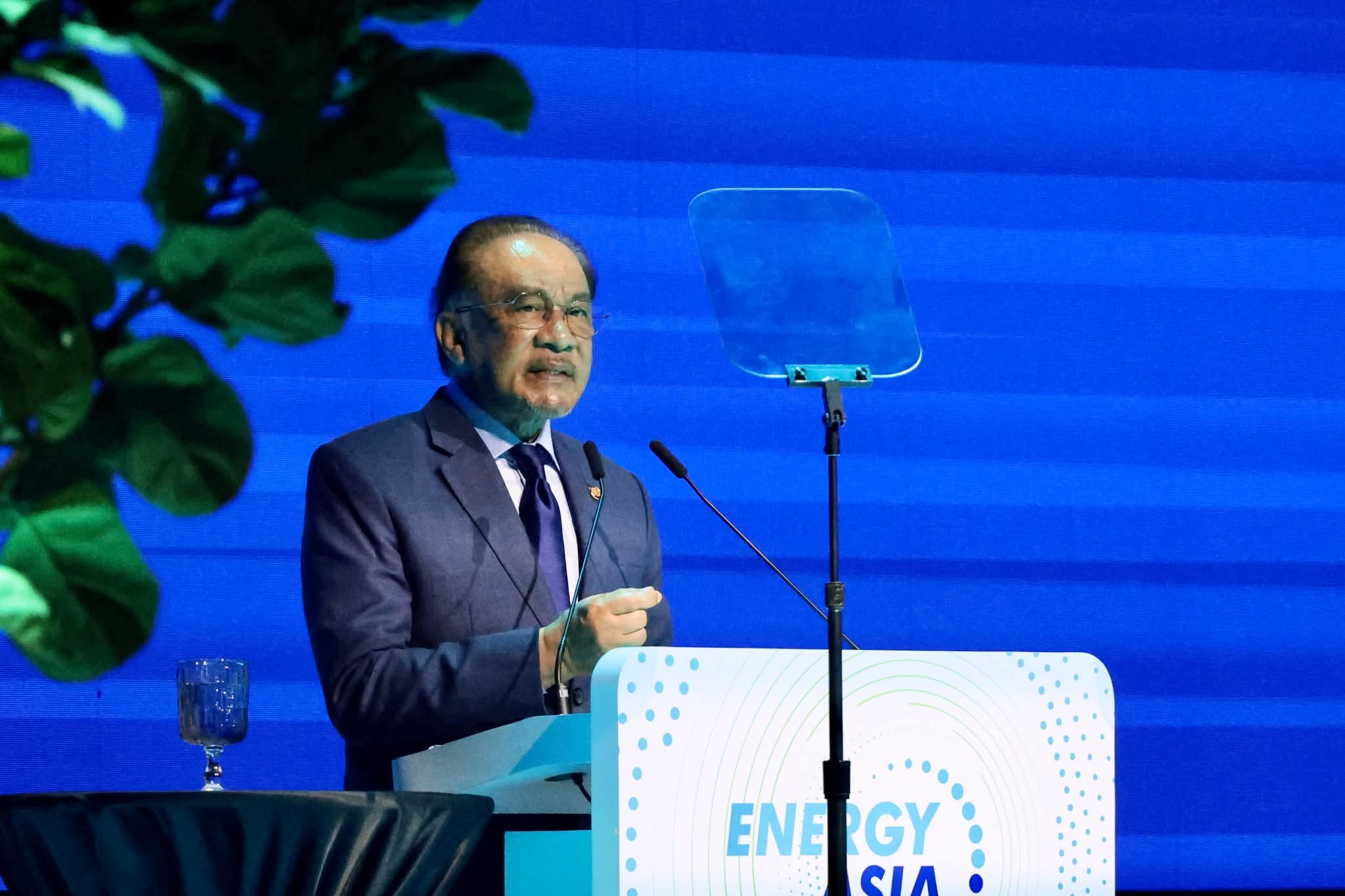

By Phubieyas Ahmad
KUALA LUMPUR, June 16 — Prime Minister Dato’ Seri Anwar Ibrahim has laid out a bold new energy doctrine for Asia — one that blends climate ambition with economic justice, and positions Malaysia as a regional anchor for the clean energy revolution.
Delivering the keynote address at the opening of Energy Asia 2025, Anwar called for urgent, coordinated action to power a just, inclusive energy transition. His vision was clear: climate targets must not come at the expense of equity or access.
“Energy security must go beyond supply stability,” Anwar said. “It must guarantee universal access. Affordable, reliable energy is not just a policy goal — it’s a foundation for justice and long-term prosperity.”
Energy Asia 2025: Malaysia at the Helm of Energy Transition Running from June 16 to 18 at the Kuala Lumpur Convention Centre, Energy Asia 2025 has emerged as the region’s most influential energy platform — attracting over 4,000 delegates, 50 countries, and major players from across the global energy landscape.
Hosted by PETRONAS in collaboration with CERA Week by S&P Global, the summit is chaired by Tan Sri Tengku Muhammad Taufik, PETRONAS President and Group CEO. Energy leaders from Shell, Total Energies, ENEOS, Mitsubishi, JX Nippon, and others joined the dialogue — reflecting a united push across oil, gas, and renewables toward a low-carbon future.
From Regional Headwinds to Regional Resolve Anwar opened with a clear-eyed view of today’s fractured global order — marked by protectionism, disrupted supply chains, and rising geopolitical tensions.“This very interconnectedness is now under strain,” he warned. “We must resist polarising policy shifts that pit competition against collaboration.”
Despite these headwinds, he underscored ASEAN’s commitment to unity, citing the Kuala Lumpur Declaration on ASEAN 2045 and the historic ASEAN–GCC–China Summit as markers of renewed multilateral momentum.Asia: Epicentre of Emissions, Engine of Solutions With Asia accounting for 50% of global energy demand and 60% of emissions, Anwar positioned the region not as a problem, but as a solution-driver.
He praised ASEAN’s pledge at COP28 to triple renewable energy capacity by 2030 and reaffirmed Malaysia’s domestic strategy through the National Energy Transition Roadmap (NETR) — aligning climate goals with economic resilience and public-private synergy.
Unleashing Investment: A New Financial ArchitectureAnwar didn’t stop at vision — he backed it with action. Highlighting Southeast Asia’s meagre 2% share of global clean energy funding, he called for a rethink of how capital is deployed. Malaysia is leading by example:Through CRESS, companies can access clean energy via the national grid.
The Green Technology Financing Scheme supports private-sector climate investments.“We must create a financial architecture that builds trust and unlocks scale,” he stressed.
Supercharging Grids, Connecting Nations Grid infrastructure was another focal point. Anwar described it as “the lifeblood of modern economies” — and essential to regional resilience.Malaysia is doubling down.
Tenaga Nasional Berhad is investing RM43 billion to modernise its grid with AI systems and energy storage, while at the regional level, the ASEAN Power Grid is being accelerated with a new cross-border financing network.
“Energy interconnectivity is about building shared prosperity,” he said. “Not just moving electrons, but building resilience.” A Just Transition — Not Just a Fast One Anwar sent a powerful message: decarbonisation cannot deepen inequality.
He called for a balanced, equity-driven approach that recognises emissions-abated oil and gas as transitional tools for economies not yet ready to go fully green.“The path to net zero must be fair — or it will not be sustainable.”
Carbon Capture: Malaysia’s Next Frontier Anwar announced the recent passing of the Carbon Capture, Utilisation and Storage (CCUS) Bill 2025, setting a regulatory foundation for a new growth sector.
Malaysia, through PETRONAS, is developing three offshore CCS hubs, working with global leaders like Shell, Total, ENEOS, Mitsubishi, and JX Nippon. Plans are underway to store CO₂ captured from partner countries, particularly Japan.“CCS is more than a decarbonisation tool,” Anwar said. “It’s a new economic stream for Malaysia and the region.”
Malaysia’s Message: Act Now, Lead Together Closing his address, Anwar called on delegates to convert ideas into tangible action.“There is much yet that we must do. But with the expertise in this room, I am confident we will chart a future that is resilient, equitable, and sustainable.”As Energy Asia 2025 continues, one thing is clear: Malaysia is not waiting to be led — it is leading.
- TNS News