


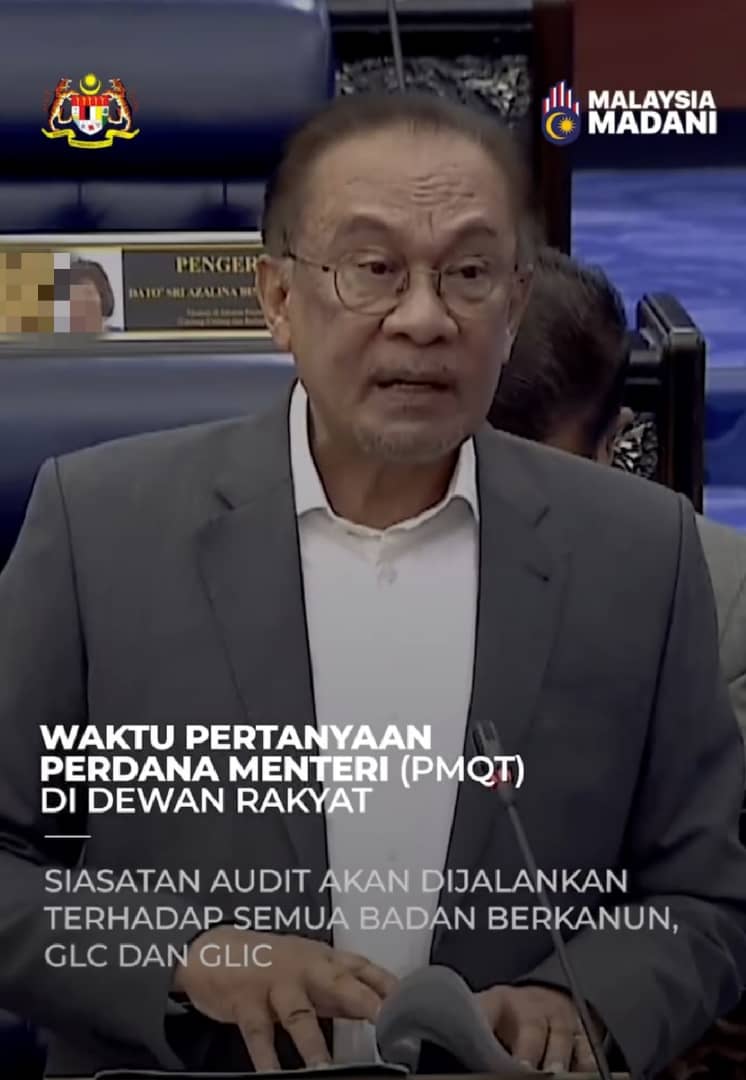

Pantau MADANI Takes Center Stage: PM Datuk Seri Anwar Ibrahim Anwar Outlines New Measures for GLC Reforms
By TNS Team
KUALA LUMPUR, Oct 21 – In today’s Parliament session, Prime Minister Datuk Seri Anwar Ibrahim responded to questions raised by Paya Besar MP, Datuk Mohd Shahar Abdullah, on the government’s reform agenda for government-linked investment companies (GLICs), government-linked companies (GLCs), and other related agencies.
The debate focused on ensuring that these entities achieve a balance between corporate objectives and socio-economic responsibilities while boosting the nation’s economic competitiveness.
GLCs and GLICs Rationalization Plan
Addressing Mohd Shahar’s inquiry on reform strategies, the Prime Minister recognized that many statutory bodies and agencies initially served specific purposes, such as empowering Bumiputera participation in the economy.
However, he acknowledged that some agencies had drifted towards commercial interests, sidelining their original mandates.
To correct this, the government established a special committee chaired by former Treasury Secretary-General Datuk Seri Asri Hamidon to rationalize the operations of federal statutory bodies and companies limited by guarantee (CLBG).
To further monitor the implementation of reforms, the government introduced the “Pantau MADANI” initiative, led by Mohd Khalid Mohamed Latiff. This monitoring system aims to ensure that the agencies’ activities remain aligned with their intended objectives, particularly in areas such as supporting local small and medium enterprises (SMEs) and the Bumiputera community, while driving economic growth.
Streamlining for Greater Efficiency
The Prime Minister emphasized efforts to merge agencies with overlapping functions to improve cost-efficiency and operational effectiveness. He cited examples such as the merger of the Malaysian Aviation Commission (MAVCOM) with the Civil Aviation Authority of Malaysia (CAAM), and the potential consolidation of the Halal Industry Development Corporation (HDC) with the Malaysia External Trade Development Corporation (MATRADE). These efforts are part of a broader initiative to streamline the operations of GLCs and GLICs to avoid redundancy and optimize resources.
Leadership Selection and Performance Evaluation
During the supplementary question, Mohd Shahar expressed concerns about leadership within GLCs, suggesting the establishment of a “search committee” to recruit top-notch CEOs capable of steering these entities effectively. He advocated for a “carrot and stick” approach in evaluating performance, where rewards and bonuses would be based on meeting Key Performance Indicators (KPIs), while poor performers would face consequences.

Paya Besar MP, Datuk Mohd Shahar Abdullah questioned the government on its reform agenda for GLCs.
Prime Minister Anwar agreed with the need for stringent governance and highlighted that the previous practice of awarding six to eight months of bonuses as standard, regardless of performance, had been discontinued. He reiterated the importance of ensuring that compensation is linked to the companies’ actual achievements.
Ensuring Accountability Through Audits
The Prime Minister supported Mohd Shahar’s suggestion for the National Audit Department to conduct thorough audits of around 2,000 GLCs to improve accountability. He noted that while GLCs have socio-economic roles distinct from private companies, they must still demonstrate financial discipline and responsible management. He emphasized that non-performing agencies could no longer assume that bonuses would be guaranteed.
Prime Minister Anwar cited successful examples, such as Ramly Burger and Aerodyne, to showcase the potential of GLCs in driving economic growth. He highlighted that Aerodyne, a leading drone company supported by Khazanah Nasional and the Retirement Fund Incorporated (KWAP), has become a key supplier to global giants like Google.
Moving Forward with Balanced Reforms
The government’s ongoing reforms aim to strike a balance between maintaining commercial viability and fulfilling socio-economic responsibilities. By streamlining agency functions, implementing comprehensive audits, and tying compensation to performance, the government seeks to ensure that GLCs and GLICs remain effective in contributing to the nation’s growth while upholding their original mandates.
Today’s debate underscores the government’s commitment to improving governance, reducing inefficiencies, and enhancing the overall performance of GLCs and GLICs, with a clear focus on accountability and national development priorities.
- TNS News